Why does our universe exist when it would be so much easier to have nothing in its place? For what reason did any of this happen? These are the types of questions I seek to answer when looking into the big philosophical question of “why is there something, rather than nothing”. To help me theorize I will be researching the three abstractions of space and time, cosmology and cosmogony, and existence and consciousness.
Space and Time
How does our reality exist within space and time? How does the past, present and future blend together to create our world? A theory posed by Leibniz suggests that God is the only reason for our existence. This theory revolves around the idea that God wanted to create a universe, so he did, and without God there would be nothing at all. Although this may seem probable to people of religious faith, is this the reality for those who do not believe in God? I wanted to include this theory in my reasoning, to shine a light on some possibilities even if I myself do not believe in this sense of reasoning.
By clicking this logo you should be able to access the article that I used when researching Leibniz'z theory on why there is something rather than nothing. If not, the link is below: https://theconversation.com/answering-the-biggest-question-of-all-why-is-there-something-rather-than-nothing-65865
Cosmology and Cosmogony
Cosmology and cosmogony is a crucial abstraction when theorizing why something exists rather than nothing because it is the study of the universe and why it exists. Spinoza argues that there must be something, for it is impossible for there to be nothing. He theorizes that the universe and its contents, laws and events must exist in the particular way that it does, for that is the way that it is. This theory does make sense to me, as it is hard to imagine there being nothing, but why is it impossible for there to be nothing when it seems so much easier for there to be nothing rather than something. This theory will help me create my own answer to this question, because it highlights the importance of something being there and suggests that everything that is in our universe is there for a specific reason.
By clicking this logo you should be able to access the article that I used when researching Spinoza's theory on why there is something rather than nothing. If not, the link is below: https://theconversation.com/answering-the-biggest-question-of-all-why-is-there-something-rather-than-nothing-65865#:~:text=One%20kind%20of%20answer%20is,in%20the%20way%20it%20does.
Existence and Consciousness
We are all conscious that there is something, for if there were nothing then we would not be here. However, a thought we battle in our consciousness is why there is something rather than nothing. Krauss theorizes that there is something instead of nothing because nothing itself is unstable and will always produce something. This theory is interesting because it focuses on the fact that there cannot be nothing, rather than why there is something. This viewpoint helps me clarify that for there to be nothing it would be impossible and brings forward a new way of thinking that has not been presented in other theories which is shifting the question away from wondering about this nothingness and accepting it as an impossible reality.
By clicking this logo you should be able to access the article that I used when researching Krauss's theory on why there is something rather than nothing. If not, the link is below: https://www.npr.org/2012/01/13/145175263/lawrence-krauss-on-a-universe-from-nothing#:~:text=And%20in%20fact%20the%20question,here%20if%20that%20was%20true.
In Conclusion
There is something rather than nothing simply because there is. I theorize that there is a specific reason as to why the world and universe formed as it did, and because it did form that is why there is something. I believe that we are here for a reason, and that the universe does not create accidents, and even if we were here by accident, we are still here.
What is the meaning of our lives? There have been billions here before us as there will be billions that follow, what is it all for? Does life have a meaning? These are the types of questions that I seek to answer. The three abstractions that I have chosen for this philosophical question are existence and consciousness, necessity and possibility, and mind and matter. By looking deeper into this question through these abstractions, I hope to gain further knowledge and develop a theory of my own.
Existence and Consciousness
Does the conscious mind recognize our lives as meaningful or meaningless? I see this as a subjective question, as some people may feel important and useful to the world, where others may question their place in society and wonder if they are doing enough. Thomas Nagel argues that life is absurd and meaningless, his reasoning being that we view our lives both objectively and subjectively. With the sense of the objective there is no way to justify why life matters, whereas the subjective makes life seem important and valuable. In Nagel's theory, because the two ways that we view our lives contradict one another, life must be meaningless. When I think about the meaning of life, I feel that you must observe your life through all lenses and I find Nagel’s theory very interesting in determining my own theory for this philosophical question.
By clicking this logo you should be able to access the article that I used when researching Thomas Nagel's theory on the meaning of life. If not, the link is below: https://u.osu.edu/group2/2014/10/13/thoughts-on-nagels-the-meaning-of-life/#:~:text=His%20main%20claim%20was%20that,we%20feel%20that%20nothing%20matters.
Necessity and Possibility
Is it possible that our lives have no meaning? Why is this possibility deemed scary when facing the fact that you could be on this earth living life for no reason? Aristotle argues that this is not a possibility, and that all lives have one ultimate meaning, that meaning being happiness. In this quotation, his theory is more prominently explained, “Happiness is the meaning and purpose of life, the whole aim and end of human existence” (Aristotle). I agree with Aristotle’s theory, as I do believe that on this earth, we are all living for and trying to obtain happiness, but I cannot help but wonder if there is more to it than that? It seems like such a simple answer for a very deep and subjective question. As I work towards creating my own theory, I will use what I learned from Aristotle, and perhaps add on to his theory.
By clicking this logo you should have access to the article that I used when researching Aristotle's theory on the meaning of life. If not, the link is: https://www.heartoftheart.org/?p=1219
Mind and Matter
Does one's thought process affect one's definition of the meaning of life? Or is the meaning of life one single universal answer that fits everyone? Kant theorizes that the meaning of life is the pursuit of the highest good, whatever that may be. I like this theory because it can be altered to fit every single person on the planet, as the meaning of the “highest good” can vary depending on one's situation. Kant’s theory is very compelling because of this aspect, and has given me the knowledge I need to create my very own theory on the meaning of life.
By clicking this logo you should have access to the article that I used when researching Kant's theory on the meaning of life. If not, the link is below: https://www.taylorfrancis.com/chapters/edit/10.4324/9781315385945-19/kant-meaning-life-terry-godlove
In Conclusion
I theorize that the meaning of life is to find your happiness, and passion that makes you want to be alive. I believe that one of the main meanings of life is to make your life meaningful, to others and to yourself. The meaning of life looks different for everyone, as everyone has different passions and finds happiness in different things. However, I believe that everyone has the common goal of being content and happy with their lives, therefore giving them meaning.
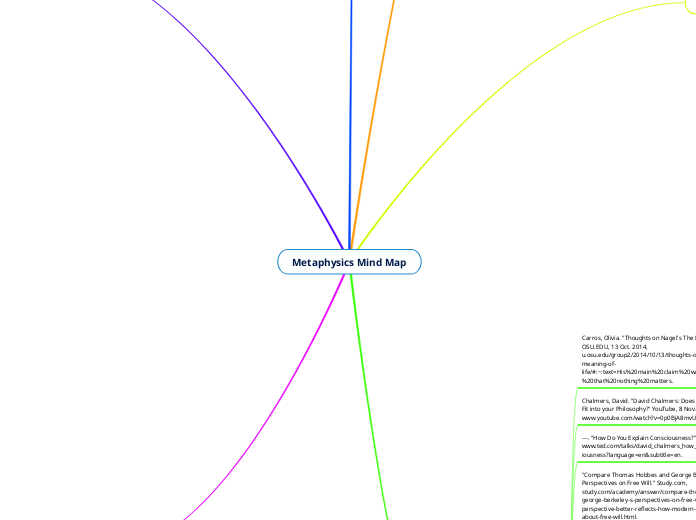
Carros, Olivia. "Thoughts on Nagel's The Meaning of Life." OSU.EDU, 13 Oct. 2014, u.osu.edu/group2/2014/10/13/thoughts-on-nagels-the-meaning-of-life/#:~:text=His%20main%20claim%20was%20that,we%20feel%20that%20nothing%20matters.
Chalmers, David. "David Chalmers: Does the Concept of God Fit into your Philosophy?" YouTube, 8 Nov. 2011, www.youtube.com/watch?v=0p0BjA8mvU4.
---. "How Do You Explain Consciousness?" TED, Mar. 2014, www.ted.com/talks/david_chalmers_how_do_you_explain_consciousness?language=en&subtitle=en.
"Compare Thomas Hobbes and George Berkeley's Perspectives on Free Will." Study.com, study.com/academy/answer/compare-thomas-hobbes-and-george-berkeley-s-perspectives-on-free-will-whose-perspective-better-reflects-how-modern-psychologists-think-about-free-will.html.
Fraser, Giles. "Nietzsche's Passionate Atheism Was the Making of Me." The Guardian, 5 Feb. 2012, www.theguardian.com/commentisfree/2012/feb/05/passionate-atheism-me-christianity-nietzsche.
Gennaro, Rocco J. "Leibniz on Consciousness and Self-Consciousness." Oxford Scholarship Online, 2003, oxford.universitypressscholarship.com/view/10.1093/0195165411.001.0001/acprof-9780195165418-chapter-17#:~:text=%E2%80%9CLeibniz%20on%20Consciousness%20and%20Self,one%20is%20in%20that%20state.
Godlove, Terry F. "Kant and the Meaning of Life." Taylor & Francis Group, www.taylorfrancis.com/chapters/edit/10.4324/9781315385945-19/kant-meaning-life-terry-godlove.
Jorgensen, Larry M., "Seventeenth-Century Theories of Consciousness", The Stanford Encyclopedia of Philosophy (Spring 2020 Edition), Edward N. Zalta (ed.), URL = .
"Lawrence Krauss on 'A Universe from Nothing.'" npr, 13 Jan. 2012, www.npr.org/2012/01/13/145175263/lawrence-krauss-on-a-universe-from-nothing#:~:text=And%20in%20fact%20the%20question,here%20if%20that%20was%20true.
Loftus, Emma. "Aristotle - The Purpose of Life." Heart of the Art, 7 Dec. 2015, www.heartoftheart.org/?p=1219.
Nimbalkar, Namita. "John Locke on Personal Identity." National Library of Medicine, 9 Dec. 2011, www.ncbi.nlm.nih.gov/pmc/articles/PMC3115296/#:~:text=John%20Locke%20holds%20that%20personal,the%20soul%20or%20the%20body.
Strickland, Lloyd. "Answering the Biggest Question of All: Why Is There Something Rather than Nothing?" The Conversation, 11 Nov. 2016, theconversation.com/answering-the-biggest-question-of-all-why-is-there-something-rather-than-nothing-65865.
"Thomas Aquina's Five Ways to Prove the Existence of God." csulb.edu, home.csulb.edu/~cwallis/100/aquinas.html.
Timpe, Kevin. "Free Will." Internet Encyclopedia of Philosophy, iep.utm.edu/freewill/#:~:text=Thomas%20Hobbes%20suggested%20that%20freedom,Understanding%252C%20David%20Hume%20thought%20that.
Woods, Sarah. "A Morally Consistent Character or Absolute Free Will: Which Should We Choose?" Pepperdine University, Apr. 2015, digitalcommons.pepperdine.edu/cgi/viewcontent.cgi?article=1095&context=sturesearch#:~:text=1)%20According%20to%20the%20Aristotle,also%20affirm%20absolute%20free%20will.
How does one prove the existence of someone the world has ever seen? I was raised in an agnostic/atheist household and came up with the conclusion that proving that God exists is no different than proving the existence of Santa Claus. However, I do recognize that philosophically it does not matter what I was raised to believe if I have no evidence to prove its truth. Exploring this question through the abstractions of religion and spirituality, necessity and possibility and, existence and consciousness has allowed me to gain a deeper understanding of the question at hand.
Religion and Spirituality
The abstraction of religion and spirituality is very useful in exploring the possibility of God/Gods and what their role is in our world. Nietzsche is recognized as a “key philosopher” in this abstraction strand of philosophy. Nietzsche uses Atheism to pose his beliefs that Gods existence ultimately does not matter, and that Christianity suppresses society rather than uplift the spirits of those who follow it. After reviewing the question at hand through the abstraction of religion and spirituality I found it compelling that so many philosophers (unlike Nietzsche) believed in God yet could not prove its existence. I believe that when trying to answer this question, Nietzsche’s questioning of not only Gods existence, but why it would even matter, is important to take into consideration as it gives different insight into the question and allows one to think deeper into the meaning of God, if any.
By clicking this logo you should be able to access the article I used when researching Nietzsche's theory on God and Atheism. If not, the link is below: https://www.theguardian.com/commentisfree/2012/feb/05/passionate-atheism-me-christianity-nietzsche
Necessity and Possibility
When exploring this question through necessity and possibility I pose it such as this: how is God necessary for the world to exist and what is the possibility of God existing? Thomas Aquina has five key arguments for Gods existence, one of these are possibility and necessity. Aquina argues that at one point in time nothing existed, and if it hadn't been for God there would still be nothing. This proves that God is a necessary being, as without him all things necessary would be nothing. I find this argument interesting as it gives reason to our existence in the world, however I counter the argument by insisting that there is no definitive way to prove that God is the reason for all things necessary. Aquina’s argument helped me further understand the role that necessity and possibility have in determining Gods existence and left me with the conclusion that as a philosopher I must explore all possibilities including that of God and except the fact that there might be something/someone out there bigger than this world.
By clicking this logo you should be able to access the article I used when researching Thomas Aquina's theory on Gods existence. If not, the link is below: https://home.csulb.edu/~cwallis/100/aquinas.html
Existence and Consciousness
Does the consciousness of the religious mind differ from the consciousness of the atheist? Do conscious minds effect Gods existence? How do we know that something exists? These are all questions that the abstraction of existence and consciousness can help give a more definitive answer to. David Chalmers is a philosopher that believes there are many different possibilities in which our world was created, and not all these possibilities end with the answer of God or no God. Chalmers gives interesting insight on how people of religious backgrounds explore God through their consciousness, and I thought this was interesting when posing the question of Gods existence. I began to wonder what would happen if those religious minds did not maintain a position with God through their consciousness, would God still exist? Is God just a mindset of those with a religious conscious? By exploring the question of Gods existence through this abstraction and looking deeper into Chalmers theory I can now understand the conscious reasoning in determining Gods existence.
By clicking this logo you should be able to access a short YouTube highlighting David Chalmers' belief on what consciousness has to do with Gods existence. If not, the link is: https://www.youtube.com/watch?v=0p0BjA8mvU4
In Conclusion
My conclusion to the question of Gods existence is not a simple one. After researching through the abstractions of religion and spirituality, necessity and possibility and, existence and consciousness I have theorised that God, as a man in human form, does not exist and has never existed. I rather cling to the idea that there are certain unexplained energies that guide us in our universe.
We as humans are all conscious beings with our own thoughts and own opinions. It is well known that without a conscious we would not be aware of ourselves, or the life we are living. But what is consciousness exactly? Everyone has a conscious, yet no one seems to be able to give an answer to this burning question. One famous philosopher puts this big philosophical question into words during a TedTalk, “if we were not conscious, nothing in our lives would have meaning or value, but at the same time it is the most mysterious phenomenon in the universe” (David Chalmers).
By clicking this logo you should be able to access the TedTalk I reference by David Chalmers where he tries to give a better understanding on his theory of consciousness. If not, the link is: https://www.ted.com/talks/david_chalmers_how_do_you_explain_consciousness?language=en&subtitle=en
Mind and Matter
Mind and matter is a very useful abstraction to use when determining what consciousness is because it is a study of the mind and body. When judging the meaning of consciousness, I believe that Descartes holds interesting observations on the topic. Descartes theorizes that consciousness is an essential collection of all thoughts, in which the person having those thoughts becomes aware of the thoughts they are having. When I reflect on what I believe consciousness means, I use Descartes theory as a guideline, is consciousness simply someone's own self-awareness of their thoughts and place in life?
By clicking this logo you should be able to access the article I used when researching Descartes theory on consciousness. If not, the link is: https://plato.stanford.edu/entries/consciousness-17th/#:~:text=Consciousness%2C%20for%20Descartes%2C%20is%20an,from%20the%20initial%20thought%20itself.
Existence and Consciousness
We know that consciousness exists within our mind because if we did not have consciousness, we would not have our own thoughts and ideas inside our mind. However, that is about all that we know about consciousness at this point in time. Viewing the idea of consciousness through the existence and consciousness abstraction allows us to narrow down what the meaning of consciousness really is. For instance, Philosopher John Locke has the theory that a person's consciousness defines their personal identity, opposed to their soul or their body. This is very interesting because it gives consciousness the title of being the foundation of a person, meaning that without your own personal consciousness you may very well be the same as everyone else in the world. The ideas brought forward through this abstraction help me when creating my own theory of consciousness because it furthers my understanding of the importance that consciousness has on our personal identities.
By clicking this logo you should be able to access the article I used when researching Locke's theory on consciousness. If not, the link is below: https://www.ncbi.nlm.nih.gov/pmc/articles/PMC3115296/#:~:text=John%20Locke%20holds%20that%20personal,the%20soul%20or%20the%20body.
Identity and Change
Identity and change is a useful abstraction to use when defining consciousness because, as Locke’s theory suggests, your consciousness is your identity. Leibniz is a key philosopher of this abstraction, and he theorizes that a person's mental state is only conscious if they are having thoughts or are aware that they are in a conscious state. This is a very interesting theory, because it suggests that if a person is not actively having thoughts, they are not conscious. By examining this theory, I am posed with more ideas for how the conscious mind really works. This is very useful when creating my own theory on consciousness as I can build off Leibniz’s ideas and create what I believe consciousness to be.
By clicking this logo you should be able to access the article that I used when researching Leibniz's theory on consciousness. If not, the link is below: https://oxford.universitypressscholarship.com/view/10.1093/0195165411.001.0001/acprof-9780195165418-chapter-17#:~:text=%E2%80%9CLeibniz%20on%20Consciousness%20and%20Self,one%20is%20in%20that%20state.
In Conclusion
My theory is that consciousness is our uninterrupted steam of thoughts that happen in an unintentional manner. Consciousness is what holds all of our memories, shapes our personalities, and defines who we are as a human being. Without a unique stream of consciousness, everyone would be the same and have the same thoughts. Consciousness is what sets us apart from one another and is what makes each person their own.
Free will is a concept that is widely regarded as something obtainable, depending on the country you live in. In Canada we are given freedom of speech and freedom of choice, but does that equivocate to free will? Is free will a circumstantial concept that only few can obtain, depending on their wealth and status in the world? By exploring what free will means, and examining other philosopher’s theories through the abstractions of determination and free will, mind and matter, and identity and change I will have the knowledge to answer this big philosophical question to the best of my ability.
Determination and Free Will
Free will is the power of choice, whereas determinism is the idea that every event, decision, and action has been predetermined by past events. How does one differentiate how our destinies are created? Thomas Hobbes theorizes that one is free to do what they please so long as no obstacles prevent them from completing their task. Since there are so many obstacles in life, are we really free to do whatever we please? I agree with Hobbes’ theory in the sense that yes, technically we all hold the power to whatever we would like but there are major obstacles that are oppressing people in the world from doing so. Poverty is something that can affect a family for generations and suppress them from having the free will to, for instance, get an education opposed to going straight into the work force. By implementing Hobbes’ theory, I can see that it’s possible to have free will, however not everyone has the power to obtain it therefore making universal free will impossible.
By clicking this logo you should be able to access the article that I used when researching Thomas Hobbes theory on free will. If not, the link is below: https://iep.utm.edu/freewill/#:~:text=Thomas%20Hobbes%20suggested%20that%20freedom,Understanding%2C%20David%20Hume%20thought%20that
Mind and Matter
Is free will something that you can achieve in your mind? If one were to believe that free will exists, does that make it true for them? Philosopher George Berkeley believes that free will does in fact exist. His reasoning for this is that one person’s will is not determined by anything other than themselves and the choices they make and completely their own, therefore free will. I do understand Berkeley's thought process behind this, as ultimately everyone makes their own decisions for themselves which could be interpreted as free will, however I do wonder that if people are unable to carry out these decisions, is that free will? Berkeley’s theory is crucial when building my own theory on free will, because it gives me insight to how our thoughts being determined by ourselves, and ourselves only, could be classified as free will.
By clicking this logo you should be able to access the article that I used when researching George Berkeley's theory on free will. If not the link is: https://study.com/academy/answer/compare-thomas-hobbes-and-george-berkeley-s-perspectives-on-free-will-whose-perspective-better-reflects-how-modern-psychologists-think-about-free-will.html
Identity and Change
Does free will have an identity, i.e.; does free will exist in our world? Aristotle's argues that one's free will is determined by their own character. The idea behind this theory being that it depends on one's intent with the decisions they make and suggests that a person's character can stop them from obtaining free will. This theory (like Hobbes) argues that free will is possible depending on an outside factor, therefore these two theories prove that free will does not exist because the idea of free will is that it is not determined by anything. Aristotle’s theory helps me understand that free will may be possible for some people, however, the article I used to research Aristotle’s theory made it clear that free will was either obtainable or not, not a halfway situation.
By clicking this logo you should be able to access the article that I used when researching Aristotle's theory on free will. If not, the link is: https://digitalcommons.pepperdine.edu/cgi/viewcontent.cgi?article=1095&context=sturesearch#:~:text=1)%20According%20to%20the%20Aristotle,also%20affirm%20absolute%20free%20will.
In Conclusion
I believe that as a society, no, we do not have free will. I base this theory on my personal definition of free will, being that free will means to be able to do what one pleases whenever one chooses. By this definition, there is no free will as there are always outside factors that are stopping you from doing whatever you please. If I wanted to drop out of high school and move to North Korea there are multiple factors making it impossible for me to do so, therefore demolishing free will. Although it may be easier for some to do as they please, such as the fortunate and wealthy people of society, I believe that they also face their own set of factors/pressures that stop them from doing all that they wish as well. In conclusion, no one living in our society truly has free will.