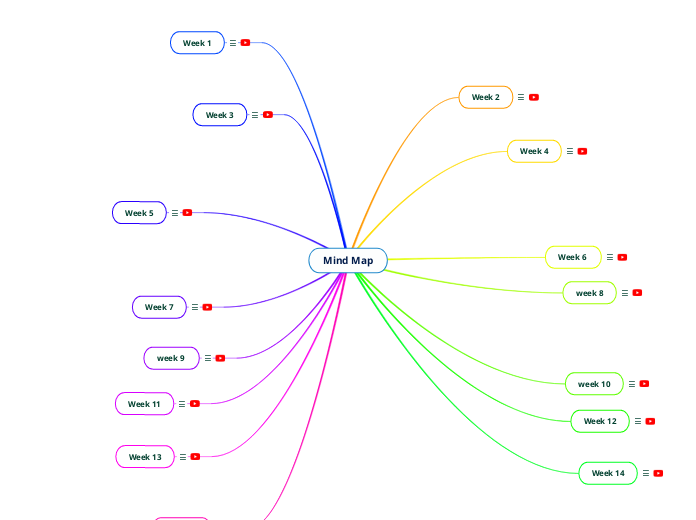
Mind Map
Week 2
Numeration Systems: There are lots of different bases that we learned about. We started with the most basic which is base-10. Base-10 has ones, tens, hundreds, thousands, etc. We learned how to write numbers in base-10 in expanded notation, and how to write any regular number into base-10. We also learned about base-5, it is the same idea as base-10. Base-5 has ones, fives, 25's, 125's etc. We also learned about base-3 which also follows the same rules as base-10 and base-5. Examples: 111 base-5 = (1x5^2)+(1x5^1)+(1x5^0)111 base-5 = (25)+(5)+(1)111 base-5 = 31Write 43 in base-543 base-5 = 133 base-5https://www.youtube.com/watch?v=fSAEi3Uoc4M
Week 4
Division8/4=2We learned all about the different ways to solve division problems Standard Algorithm; this is just regular long divisionPlace Value; this is similar to long division, but instead of just leaving blank spaces, you put numbers as place holders.Alternative Algorithm; This method is similar to the place value method. You find find the numbers then add them to get your answerMultiplicationStandard Algorithm; this is the most basic way of doing multiplicationPlace Value; This method involves multiplying the different numbers in the problem. If the problem was 23x14 you would do 20x3 and 3x4 and vice versa Expanded Notation; In this method you write the numbers out in expanded notation then solve it. Lattice Multiplication; This method is you make a box then put the numbers outside and multiply. You make rows and add up all the numbers in each row. https://www.youtube.com/watch?v=5ZJlwvJ-7zI
Week 6
Number Theory:a is divisible by b if there is a number c that meets this requirementB x C = A10/5=2 so 10 is a multiple of 5 and 2Ending by 2: 0,2,4,6,8by 5: 0,5by 10: 0 Sum of the digits: by 3 if the sum of the digits is divisible by 3by 9 if the sum of the digits is divisible by 9If it is divisble by 2 and the sum of digits is divisble by 3by 4 if the last 2 digits are divisible by 4by 8 if the last 2 digits are divisible by 8by 7 you chop off the last number, multiply it by 2 then subtract it from the rest of the number then see if that number is divisble by 7 by 11 you chop off the last 2 digits, then add with the remaining number. From there you chopp off the last 2 digits of your new sum and add them with the remaining number you have left Example: 29,194 is it divisible by 11?291+94= 3853 + 85 = 8888/11=8Factors: 28: 1,2,4,7,14,28Prime numbers: 2,3,5,7,11,13,,17,19,23,29,31,37,41,43,4791: 1,7,13,91https://www.youtube.com/watch?v=sYopk5NQZw0
week 8
Fractions:Meanings:Part-wholeQuotient: 3/5RatioModels:Surface AreaLengthGroups of things28 ab^2/42a^2b^2 =7x2x2xaxbxb/7x2x3xaxaxbxb = 2/3a20 students 12 girls 8 boysgirls/whole= 12/20 = fractionboys/whole= 8/20 = fractiongirls/boys= 8/12 = NOT fraction ratioboys/girls= 12/8 = NOT fraction ratio https://www.youtube.com/watch?v=UK-_qEDtvYo
week 10
We went over the study guide:Possibility rulesPrime number, prime factorizationTrue-false statementsFind GCF LCMFractions- problem solving- homeworkWe also went over examples of practice word problems:Jim took 1/4 bars Kim and Lenny took 1/3 Megan took 4, how many bars total are there? and how many did each person take? To solve this you find the LCM which is 12. With this information you draw a rectangle and split it into 12 squares. We shade in 3 squares for Jim since 1/4 of 12 is 3. Then for Kim and Lenny you shade in 4 squares for each since 1/3 of 12 is 4. That leaves one square left which is Megan's. We know that she has 4 bars so each box is worth 4 bars. From there you multiply 3x4 for Jim which is 12, and 4x4 for Kim and Lenny each, so they have 16 bars each. And for the total you multiply 4x12 since there are 12 boxes and each one is worth 4. This means there are 48 bars total. https://www.youtube.com/watch?v=kMPhdAXlM8k
Week 12
xDecimalsWe reviewed how decimals are part of a whole. We used money as an example, it helps students. 50 cents is 1/2 of a dollarWe went over place value:millions, hundred thousands, ten thousands, thousands, hundreds, tenths, onesPie is not a decimal, it is an irrational numberWe went over the how to solve all the operations with decimalsAddition :100/1000+20/1000+8/1000 = 128/1000175.32+3.1= 178.4232.79+3.35 = 36.14Subtraction: 5.00-1.35= 3.6575.39-1.27 = 74.12Multiplication:3.3 x 2.1 = 6.932.31 x 2.3 = 5.313Division: 5/6 = 5 divided by 6 You can solve this by setting up long division to set up this problem and solve it. We also went over percents: Per cent = per 100 30% of 300 is 301/100= 10% .75=75%https://www.youtube.com/watch?v=mayYt5-fsFo
Week 14
We learned the chip method of solving equations with positive and negative numbers: Addition:5+1 = 6You would draw a circle and put in 5 positive chips and then you would add one more. In class we used chips, with one color representing positive and the other negative. -5+(-1)= -6 For this one you would draw a circle with 5 negative circles and then you would add another negative circle 5+ (-1) = 4For this one you would have your 5 positive circles then you would add a negative circle. This creates a zero pair so that gets you the answer 4 Subtraction:+5 - (+2) = +3For this you would draw 5 positive circles, since you are subtracting, you would then draw arrows on 2 of the positive circles since they are being taken away.+5 - (-1) = +6 For this you would draw your 5 positive circles then you would add in a negative circle and a positive circle to make zero pair. This would give you your answer. Multiplication: 3x2 = 6 For multiplication you draw 3 groups of circles with 2 positive circles in each one or vice versa Division: You create fact families or "bonds" +3 x -2 = -6-6/3= -2 -6/-2= 3 https://www.youtube.com/watch?v=T02BtPogAIg
Week 1
Problem Solving Steps:Understand the problem. This means understanding what you are trying to solve and thinking about how to do it. Devise a plan: This means creating a hypothesis and figuring out how to solve the problem. Carry out the plan: This is actually solving the problem by following the plan you created for yourself. Look back: You reflect on your work. Example Problem: There are seven people in a room, if each person shakes every other person's hand, how many handshakes will take place? Person 1: 2,3,4,5,6,7Person 2: 3,4,5,6,7Person 3: 4,5,6,7Person 4: 5,6,7Person 5: 6,7Person 6: 7Added up that equals 21 total handshakes https://www.youtube.com/watch?v=tk0Q37GDmJ8
Week 3
Operations: Addition (Put together/join) 3+4=7Identity Property: a+0=a 4+0=4Commutative Property (Order) a+b=b+a3+4=4+3Associative Property (Grouping) (a+b)+c = a+(b+c)(2+3)+5 = 2+(3+5)Subtraction: 7-3=4 4 is the differenceMeanings: take away: 5 take away 2 is 3Comparison: If one tower is taller it's obvious which is has more blocksMissing Added: 3+x=7 Multiplication: 3 x 4 = 12. 12 is the product3x2= 3 groups of 2 ax0= 0 anything multiplied by 0 is 0 (axb) x C= a x(bxc) arrayax(b+c)= (axb) +(axc) Distributive Property https://www.youtube.com/watch?v=HAhg0uXn9GA
Week 5
Addition AlgorithmsWe talked about a bunch of different ways of solving addition problemsAmerican Standard; This is the most basic way of adding. Partial Sums; This is similar to American Standard, but instead of carrying numbers you write out the entire number. You make rows and add all the numbers in each row to get your answer Partial Sums with Place Value; This is basically the same as partial sums except in this one you add zeros for place holders in the rows. Left to Right; This way is you start on the left and add the hundreds then the tens then the ones. You just start with the biggest number then you add up all the sums to get your final answer. Expanded Notation; You write the number in expanded notation, then add the numbers based on their value. 576+279= 500 + 70 + 6 200 + 70 + 9 800 + 50 + 5 = 855. Lattice; This is you add the numbers and put the sum of each in a box. You have rows and can easily add the numbers up to get your answer. https://www.youtube.com/watch?v=mAvuom42NyY
Week 7
Prime Factorization:The "fingerprint" or "DNA" of every composite nu,ber, always the same24: 2 122 , 62 , 324= 2 x 2 x 2 x 3Greatest Common Factor: GCFLeast Common Multiple: LCM25: 1,5,25100: 1,2,4,5,20,25,50,1001/4+1/6= 3/12+2/12 = 5/12GCF: 24, 36List method:24: 1,2,3,4,6,8,12,2436: 1,2,3,4,6,9,12,18,36Prime Factorization Method24: 2x2x2x336: 2x2x3x3GCF: 2 x 2 x 3 = 12LCM 24, 36List Method:24: 24,48,7236:36,72https://www.youtube.com/watch?v=XBnUWjo3TgM
week 9
Addition and Subtraction (common denominator)3/8+2/8 = 5/81/4+2/4 = 3/45/8-1/8= 4/8 = 1/2We also learned how to draw pictures to better help understand how to solve the problemsImproper number: 7/6 = 1 1/61/2 + 1/6 = 4/6Find LCM then add like you regularly wouldMultiplication: 1/2 x 1/2 is the same as saying 1/2 of 1/2 1/2 x 1/2 = 1/41/2 x 1/4 = 1/81/3 x 1/8 = 1/162/3 x 3/5 = 6/15Division: To divide fractions you multiply the first fraction by the reciprocal of the second fraction.2/3 divided by 4/5 = 2/3 x 5/4 = 10/12We did a lot of practice with word problems involving fractions. We learned how to draw pictures/diagrams relating to the problem that make solving it much simpler. One example problem we solved was: There are 3/4 pie in the fridge, John ate 2/3 how much of the entire pie did he eat. We draw a circle and divide it into 4 parts, we get rid of one the parts since there are only 3/4 left. Form there we shade in 2/3 which gives us our answer of John eating 1/2 of the pie.https://www.youtube.com/watch?v=qmfXyR7Z6Lk
Week 11
Took test Test review https://www.youtube.com/watch?v=_xUn8kAZGOw
Week 13
We did a lot of practice problems this week:= means is x = of N = what?11% of 45 is what number.11x45= 4.95.09 of N is 17 0.09/0.09 x N = 17/0.099/1700 = 188.88 or 189You use long division to get your answer17/25= N25/1700 you solve this using long division= .68 = 68%Student gets 37 out of 45 questions correct on a test. What percent did student answer correctly? 45xN/45 = 37x100/45= .82You solve the 3700/45 using long division 13 of 20 cans are recycled, what percent is recycled? 13/20 You would set up long division with 20 going into 13. This would get you .65 which is 65%30% of 32,000 32,000 x .3 = 9,600https://www.youtube.com/watch?v=JeVSmq1Nrpw
Week 15
Work on mindmapStudy for finalTake final on Thursdayhttps://www.youtube.com/watch?v=KPJfWZwDCO4