Learning Skills are required in order for the educator to learn and teach effectively. Students are connected to learning skills because they must navigate and experiment with different learning strategies to learn class content and the curriculum is connected because learning skills are required from both the teacher and students to get through course material.
Educator
Know personal executive functions and help teach others how to identify theirs in order to grow.
Every educator has their own set of learning skills that work best for them. However, it is their responsibility to be aware of various different learning skills within the classroom in order to cater to their students’ needs.
Learner
Explore and practice various learning skills to best fit their learning needs. (Guided with help from the teacher).
Curriculum
Set expectations and goals throughout the year.
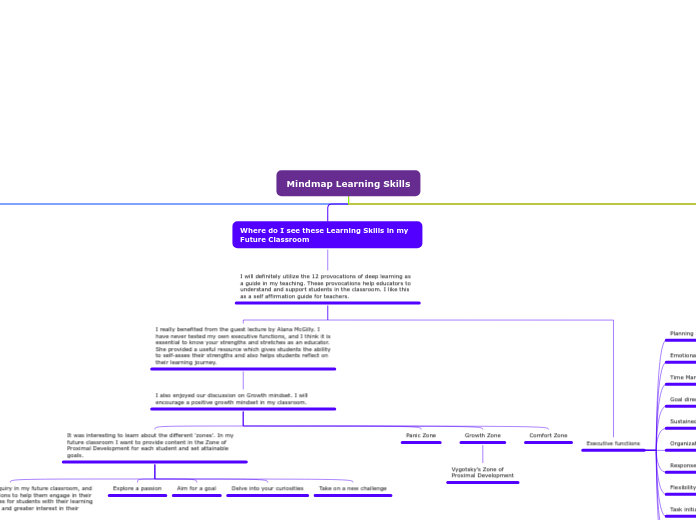
I will definitely utilize the 12 provocations of deep learning as a guide in my teaching. These provocations help educators to understand and support students in the classroom. I like this as a self affirmation guide for teachers.
I really benefited from the guest lecture by Alana McGilly. I have never tested my own executive functions, and I think it is essential to know your strengths and stretches as an educator. She provided a useful resource which gives students the ability to self-asses their strengths and also helps students reflect on their learning journey.
I also enjoyed our discussion on Growth mindset. I will encourage a positive growth mindset in my classroom.
It was interesting to learn about the different 'zones'. In my future classroom I want to provide content in the Zone of Proximal Development for each student and set attainable goals.
I also want to encourage inquiry in my future classroom, and invite students to ask questions to help them engage in their learning. Encouraging choices for students with their learning allows them to have a voice and greater interest in their learning.
Explore a passion
Aim for a goal
Delve into your curiosities
Take on a new challenge
Panic Zone
Growth Zone
Vygotsky’s Zone of
Proximal Development
Comfort Zone
Executive functions
Planning and prioritizing
Emotional control
Time Management
Goal directed persistance
Sustained attention
Organization
Response inhibition
Flexibility
Task initiation
Working Memory
Metacognition
I understand that adapting to new technology is essential in the classroom. How do I learn about new programs to teach students?
I also wonder how to teach students with a different skill set that use learning skills that I'm not familiar with?
SAMR
Difference between Enhancement vs. Transformation in relation to utility in the classroom?
A question I liked in my Thoughtbook that made me wonder was "recall a time as a student when you were most engaged in your work". After reflecting on this question I realized it was the teacher who showed the most interest in her students lives and motivated us. She instilled confidence in me which encouraged my engagement in her class. I was always motivated to do my best and she made a significant impact on my life. What I took from this question was that knowing about your students and their interests really makes a difference. Students know when their teacher cares and caters to their interests.
I think that learning skills are part of a learning story. Every student and educator has their own set of learning skills that they utilize to be the best learner they can be. We are constantly learning new skills to explore and make changes to our learning journey. There are many different steps and different approaches for various learners. My learning story may be very different than a lot of my future learners. As a future educator it will be my responsibility to guide my students' diverse learning stories.