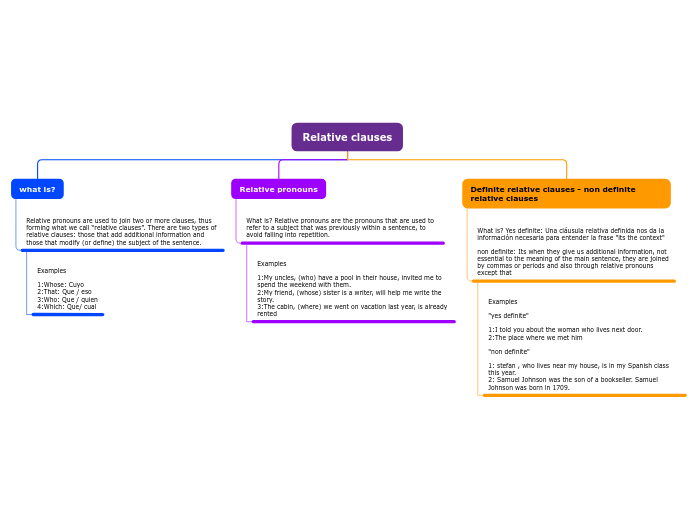
Relative pronouns are used to join two or more clauses, thus forming what we call “relative clauses”. There are two types of relative clauses: those that add additional information and those that modify (or define) the subject of the sentence.
Examples
1:Whose: Cuyo
2:That: Que / eso
3:Who: Que / quien
4:Which: Que/ cual
What is? Relative pronouns are the pronouns that are used to refer to a subject that was previously within a sentence, to avoid falling into repetition.
Examples
1:My uncles, (who) have a pool in their house, invited me to spend the weekend with them.
2:My friend, (whose) sister is a writer, will help me write the story.
3:The cabin, (where) we went on vacation last year, is already rented
What is? Yes definite: Una cláusula relativa definida nos da la información necesaria para entender la frase "its the context"
non definite: Its when they give us additional information, not essential to the meaning of the main sentence, they are joined by commas or periods and also through relative pronouns except that
Examples
"yes definite"
1:I told you about the woman who lives next door.
2:The place where we met him
"non definite"
1: stefan , who lives near my house, is in my Spanish class this year.
2: Samuel Johnson was the son of a bookseller. Samuel Johnson was born in 1709.