Japanese Candians
Population
Canada had 21,000 Japanese Canadians in British Columbia which accounted for 75% of all Japanese Canadians in Canada.
Mistreatment of Japanese Canadians
Suspicions
Japanese submarines were known to be operating off the coast of British Columbia. The RCMP and Canadian military did not suggest there was any threat by the even after investigation. But theres no guarantee that these Japanese Canadians were loyal.
Actions
Most of these Japanese Canadians were fishermen so the government had decided to seize 1,200 fisher boats due to fear of spying by the Canadian military.
Notices Sent Out
Ahead of the camps Japanese Canadians were given a notice before being sent to camp. The notice told them that they would be sent there and warned them if they were found anywhere else without permit may face liabilities.
Sent to Camp
Over 23,000 Japanese Canadians were moved to the camps. They had any cars, cameras and radios confiscated by Canada due to "protective measures". These items were given to the Custodian of Enemy Aline Property these assets were then sold and use to pay for the interment.
In The Camps
Living
The Japanese people were living in huts with 2 bedrooms and a kitchen where two families would share. They had no electricity or running water. Some women and children were squeezed into livestock buildings and beds were covered with hay for comfort.
Aid
Japan had sent these Japanese people in the camps food packages through the Canadian Red Cross.
Financial
The Japanese Canadians were paid very little at around $1.00 a day and they were expected to pay for their own stay.
After The War
Sent Away
After the war Japanese Canadians were forced to either return to Japan or go to Eastern Canada. After the war had ended it was illegal for Japanese Canadians to return to Vancouver. Deportations were eventually stopped after protests but 4000 people had ben deported already.
Loss of Citizenship
Japanese Canadians had lost Canadian citizenship and weren't able to obtain it again.
Apology
Canada 43 years after had apologized for the miss-treatment of these Japanese Canadians and they provided compensation for their troubles in the following ways.$21,000 for every individual directly wrongedFunding for social services to combat racism and support Japanese people living in Canada
Hitler was a dictator of Germany who was known for his horrible acts and strict rules he set for Germany.
Uprising
Timeline
Overthrowing of German Government
Hitler had tried to overthrow the government using violent attacks by civilians. Due to the Great Depression people were already in anger and were hosting protests, so in response to this, Hitler had decided to create targets for these people to attack. These targets included his political opposition. Thos however did not work as he was sent to prison where he wrote his book "Mein Kampf" meaning my struggle.
Becoming Chancellor
The depression had caused many more people to vote for Nazis as they wanted change and Hitler gave them that. In 1933 Von Papen convinced Hindenburg to allow Hitler to become Chancellor.
The Enabling Act
The enabling act was passed after communists were banned from the Reichstag. The act read "HITLER CAN RULE ALONE FOR FOUR YEARS. THERE IS NO NEED TO CONSULT THE REICHSTAG.". The Reichstag was the parliament of Germany. This act allowed Hitler to make his own laws whenever he felt and did not have to consult anybody.
Banning of Opposing Parties
Hitler with the power of the Enabling Act had banned all other political parties to allow him to be the only party and now had greater power.
The Reichstag Fire
In February of 1933 the Reichstag building which was like Parliament of Germany was burnt down. A communist who was found inside the building admitted responsibility for the fire. Hitler as Chancellor convinced the people that the communists were trying to take power using terrorism. Communists were then banned from the Reichstag.
The Night of the Long Knives
Hitler's S.S. was given the task of killing Ernst Rohm which was Hitler's political opponent. This night on June 30th 1934 Hitler's S.S. killed over 1000 S.A. members which was an opposing political party. The army was pleased with this and Hitler had now gained the support of the army.
Death of President Hindenburg
In August 1934 the death of President Hindenburg had allowed Hitler to obtain the role of both Chancellor and President. He called himself "Der Fuhrer".
Oath of Loyalty
Hitler had made every soldier sweat an oath of loyalty to him.
Use of power
Nazi Military State
Hitler made his own Nazi military.
High Nationalism and Parades
Hitler held many parades where people would hold out their right hands straight and flat and praise Hitler.
Rallies
Book Burnings
Propaganda
Hitler Youth
Hitler Understood that the youth were the future so he put a lot of effort into controlling them and getting his words into their minds as they would then go on the be leaders and political members. He formed the Hitler Youth where the youth were taught his ways and it was similar to a military so they trained as well.
Acts in War
Holocaust
Jews blamed for all Germany's problems. They were sent to camps where they were worked and killed. In these camps there were 2 groups, those who were killed right away and those who were put to work first before death. 11 million people were killed and of those 6 million were Jews. This tragic event wiped almost 60% of the Jewish population at the time. even still, Hitler had felt as if he was a failure as he planned on wiping the entire population of Jews.
Appeasement
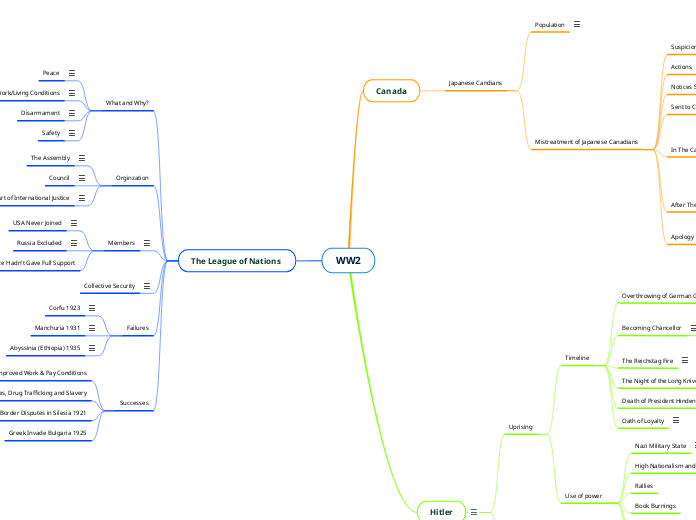
What and Why?
Peace
the League of Nations was set up to bring nations together to not allow for conflict and act as a parliament to settle disputes in a peaceful manner.
Improve Work/Living Conditions
The League allowed people to live and have better work as it improved international trade. They believed the war was due to injustice and poverty.
Disarmament
Persuaded all nations to disarm including winning nations this was to prevent future war.
Safety
Protected countries and agreed that other countries would help out when one was in conflict.
Orginzation
The Assembly
They met once. year and every nation only had one vote meaning a Nation's decision had to be unanimous.
Council
The council had met regularly to deal with incidents.
Court of International Justice
The Court of International Justice settled international disputes between nations.
Members
42 countries joined in the begging and that hit 60 in the 1930's. However defeated countries in WW1 couldn't join. The League was a "Winners Only Club".
USA Never Joined
The USA never joined the league as the American Congress refused to sign the peace treaties.
Russia Excluded
Russia was excluded from the league due to them facing a communist revolution in 1917.
Britain & France Hadn't Gave Full Support
Collective Security
A promise made by members to take action and defend one another in the event of attack or invasion.
Failures
Corfu 1923
Italians invade Greek island due to an Italian diplomat being murdered there. Italians demanded money and an apology. However the League insisted the money would go to them but Mussolini had overturned the decision, this event made the league come out and seem weak.
Manchuria 1931
Japan invaded Manchuria, China. The league provided no support as no country send in their Navy and all the League did was condemn it. All the countries were busy and worried about the Great Depression and the League had realized they couldn't stop Japan.
Abyssinia (Ethiopia) 1935
Mussolini decided to invade Abyssinia for the purpose of their great oil reserves. League condemns the attack and creates trade sanctions against Italy except oil which was pretty pointless. Italy had a clear advantage with a modern military against their forces which mainly consisted of spears. Mussolini had a great victory over the League here.
Successes
Improved Work & Pay Conditions
Refugees, Drug Trafficking and Slavery
Border Disputes in Silesia 1921
Greek Invade Bulgaria 1925