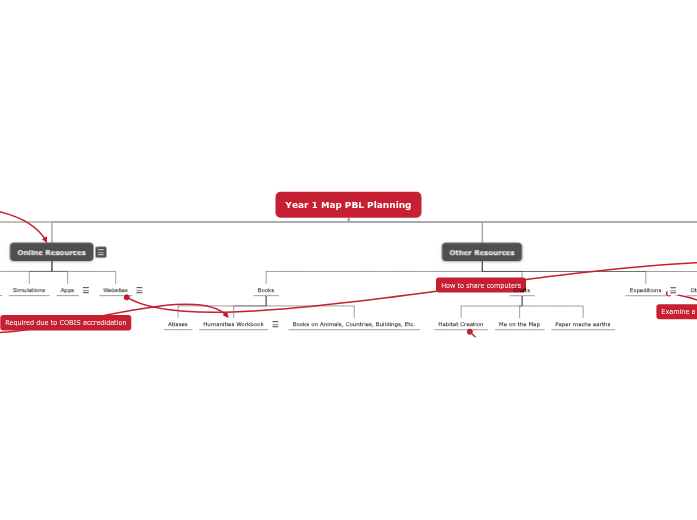
Year 1 Map PBL Planning
Standards
English
Reading
1Ro1 Hear, read and write initial letter sounds.1Ro2 Know the name of the most common sound associated with every letter in the English Alphabet.1Ro3 Identify seperate sounds (phonemes) within words, which may be represented by more than one letter, e.g. 'th', 'sh', 'ch'.1Ro4 Use knowledge of sounds to read and write single syllable words with short vowels.1Ro5 Blend to read, and segment to spell, words with final and initial adjacent consonants, e.g. bl, nd.1Ro6 Use phonic knowledge to read decodable words and to attempt to sound out some elements of unfamiliar words.1Ro7 Demonstrate and understanding that one spoken word corresponds to one written word.1Ro8 Join in with reading familiar, simple stories and poems.1Ro9 Know that in English, print is read from left to right and top to bottom.1Ro10 Read a range of common words on sight.1Ro11 Enjoy reading and listening to a range of books, drawing on background information and vocabulary provided.1Ro12 Make links to own experience.1Ro16 Read aloud independently from simple books.1Ro17 Pause at full stops when reading.1Ro18 Identify sentences in a text.1Rx1 Read labels, lists, and captions to find information1Rv1 Show awareness that texts for different purposes look different, e.g., use of photographs, diagrams1Rv2 Know the parts of a book, e.g. title page, contents.
Writing
1Wo1 Develop a comfortable and efficient pencil grip.1Wo2 Form letters correctly.1Wo3 Know that a capital letter is used for I, for proper nouns and for the start of a sentence. 1Wo4 Use knowledge of sounds to write simple regular words, and to attempt other words including when writing simple sentences dictated by the teacher from memory.1Wo5 Read own writing aloud and talk about it.1Wo6 Develop strategies to build vocabulary1Wa2 Use relevant vocabulary.1Wa3 Record answers to questions, e.g. as lists, charts1Wa5 Write for a purpose using some basic features of text type.1Wa6 Write simple information texts with labels, captions, lists, questions and instructions for a purpose.1Wt1 Mark some sentence endings with a full stop.1Wp2 Compose and write a simple sentence with a capital letter and a full stop.1Wp3 Write sentence-like structures which may be joined by and.1Ws1 Begin to learn common spellings of long vowel phonemes, e.g. 'ee', 'ai', 'oo'.1Ws2 Spell familiar common words accurately, drawing on sight vocabulary.1Ws4 Recognise common word endings, e.g. -s, -ed, -ing.
Speaking and Listening
1SL1 Speak clearly and choose words carefully to express feelings and ideas when speaking of matters of immediate interest.1SL2 Converse audibly with friends, teachers and other adults.1SL3 Show some awareness of the listener through non-verbal communication.1SL4 Answer questions and explain further when asked.1SL5 Speak confidently to a group to share an experience. 1SL6 Take turns in speaking.1SL7 Listen to others and respond appropriately. 1SL8 Listen carefully to questions and instructions.1SL10 Understand that people speak in different ways for different purposes and meanings.
Art
Use a range of materials creatively to design and make products.Use drawing, painting and sculpture to develop and share their ideas, experiences and imagination.Develop a wide range of art and design techniques in using colour, pattern, texture, line, shape, form and space.
Maths
Number
1Nn2 Read and write numerals from 0 to 20.1Nn3 Count objects up to 20, recognising conservation of number. 1Nn7 Within the range 0 to 30, say the number that is 1 to 10 more or less than any given number.1Nn8 Use more or less to compare two numbers, and give a number which lies between them.1Nn11 Give a sensible estimate of some objects that can be checked by counting, e.g. to 30.1Nc8 Understand addition as counting on and combining two sets; record related addition sentences.1Nc11 Add/subtract a single-digit number by counting on/back.1Nc18 Begin to add single- and two-digit numbers.
Geometry
1Gp1 Use everyday language of direction and distance.
Measure
1Ml3 Use comparative language, e.g. longer, shorter, heavier, lighter.
Data
1Dh1 Answer a question by sorting and organising data or objects in a variety of ways, e.g.using block graphs and pictograms with practical resources; discussing the results.in lists and tables with practical resources; discussing the results.in Venn or Carroll diagrams giving different criteria for grouping the same objects.
Problem Solving
1Pt2 Explore number problems and puzzles1Pt3 Find many combinations, e.g. combinations of three items.1Pt4 Decide to add or subtract to solve a simple word problem (oral), and represent it with objects.1Pt5 Check the answer to an addition by adding the numbers in a different order.1Pt8 Identify simple relationships between numbers and shapes, e.g. this number is ten bigger than that number.1Pt9 Make a sensible estimate of a calculation, and consider whether an answer is reasonable.
ICT
Starting with Text (4269)Enter simple words, using keyboard or other input deviceSelect and edit text.Select basic icons (e.g. print, save, or spellcheck) using the mouse or other pointing device.Name, save and retrieve documents.Use appropriate methods to check text is error free.Starting Images (4270)Use simple shapes and lines to create pictures or patterns.Edit pictures, using visual effects.Add details to an existing picture, using straight lines or geometric shapes.Copy or delete character or object.Use 'save as' to store edited picture.Starting Graphs (4271)Store and classify information.Present information in charts or graphs.Use charts or graphs to answer simple questions.Draw simple conclusions from charts or graphs.Starting Searches (4273)Use buttons, menus and indexes to search for and navigate to information.Use keywords to search for information.Provide evidence of research undertaken.Select appropriate keywords.Select appropriate results.
Science
Scientific Inquiry
Stage 11Ep1 Try to answer questions by collecting evidence through observation.1Ep2 Ask questions and contribute to discussions about how to seek answers.1Ep3 Make predictions.1EP4 Decide what to do to try to answer a scientific question.1Eo1 Explore and observe in order to collect evidence (measurements and observations) to answer questions.1Eo2 Suggest ideas and follow instructions.1Eo3 Record stages in work.1Eo4 Make comparisons.1Eo5 Compare what happened with predictions.1Eo6 Model and communicate ideas in order to share, explain and develop them.Stage 22Ep1 Collect evidence by making observations when trying to answer a science question.2Ep2 Use first hand experience.2Ep3 Use simple information sources.2Ep4 Ask questions and suggest ways to answer them.2Ep6 Recognise that a test or comparison may be unfair.2Eo1 Make suggestions for collecting evidence.2Eo2 Talk about risks and how to avoid danger2Eo3 Make and record observations2Eo5 Use a variety of ways to tell others what happened.2Eo6 Make comparisons.2Eo7 Identify simple patterns and associations.2Eo8 Talk about predictions (orally and in text), the outcomes and why this happened. 2Eo9 Review and explain what happened.
Biology
Stage 11Bp3 Explore ways that different plants and animals inhabit local environments.Stage 22Be1 Identify similarities and differences between local environments and know about some of the ways in which these affect the animals and plants that are found there.
Humanities
Name and locate the world's seven continents and five oceans.Name, locate and identify characteristics of the four countries and capital cities of the United Kingdom and its surrounding seas.Use basic geographical vocabulary to refer to:key physical features, including; beach, cliff, coast, forest, hill, mountain, sea, ocean, river, soil, valley, vegetation, season and weather.key human features, including; city, town, village, factory, farm, house, office, port, harbour, and shop.Use world maps, atlases, and globes to identify the United Kingdom and its countries, as well as the countries, continents, and oceans studied at this key stage.Use simple compass directions (North, South, East and West) and locational directional language, e.g. near and far; left and right, to describe location of features and routes on a map.Use aerial photographs and plan perspectives to recognise landmarks and basic human and physical feature; devise a simple map; and use and construct basic symbols in a key.Use simple fieldwork and observational skills to study the geography of the school and its grounds and the key human and physical features of its surrounding environment.
Online Resources
I do plan to incorporate more into this section but need to spend time exploring options for Games and Simulations. The school ICT teacher will be meeting with me in two weeks due to the current IGCSE testing going on to discuss resources and times the primary lab is open.
Games
Simulations
Apps
I have 4 Ipads that I often let the students use. Apps currently on them related to the project are: Look and Learn AnimalsNational Geographic ExploreMoukJigsawGeoG'night SafariPlanet GeoVirtual CityKids PlanetLittle ExplorersToca BuildersToca TownToca NatureToca FarmToca CityI will do another app search prior to the project start
Websites
Google EarthWebquestGroup 4 will be paired up with group 1 for this due to age and inability to read.
Other Resources
Books
Atlases
Humanities Workbook
Regular lessons must continue due to accreditation process and inspections this year. But lessons can be moved so we learn more about the world, international transport, weather and habitats and complete corresponding pages in workbooks.
Books on Animals, Countries, Buildings, Etc.
Crafts
Habitat Creation
Me on the Map
Paper mache earths
Expeditions
Ala Archa (mountain habitat)Ata Turk (Forest Habitat)Lake across from the school.Options are listed above but only one field trip will be allowed due to school policy. A Safety risk assessment must be conducted by the Safety team before field trip can be selected.
Other
SongsPoemsFolder GamesRelated Learning center activities.Pocket Chart activities
Mini Lessons
Habitats
What is a habitat?Habitat Journals
Measuring
Reminder about how to use rulers and the difference between standard and non standard measurement.
Group Work
How do we work as a group?Assign roles and go over job descriptions.What do we do if we have a problem?Group 1 (ages 7-8 years)Nina: strong creative skillsOzan: strong readerQi Yi: strong technology and maths skillsAna Sofia: organized and good leaderGroups 2 and 3 (ages 5-7 years, mixed ability and can be adjusted with interests of students)MarselinaAysimaBatuYusufAsadbekTamerlanJalilaSalimAimanGroup 4 (4 years old) will have constant TA supervisionRalphaelInsanAlanAliyarSanjar (turned 4 years 2 weeks ago)
Field Trip Review
Good choices/bad choices reviewReminder of policiesUniform must be wornPermission form filled outSnack and water bottle must be brought.No cell phones or smart watches allowed.Stay with teacher or assigned group leader.
Map Overview
Introduce different types of maps to give students an introduction to all the optionsCity mapCountry MapWorld MapPolitical MapsPhysical MapsPopulation MapsElevation MapsClimate Maps
Vocabulary
MapPoliticalPhysicalPopulationHabitatPondMountainCityForestRainforestArcticDesertBeachOceanGrasslandsPlainsCountryContinentEnvironmentWeatherElevationClimate