Culture
Canada
Combined
Power Distance:
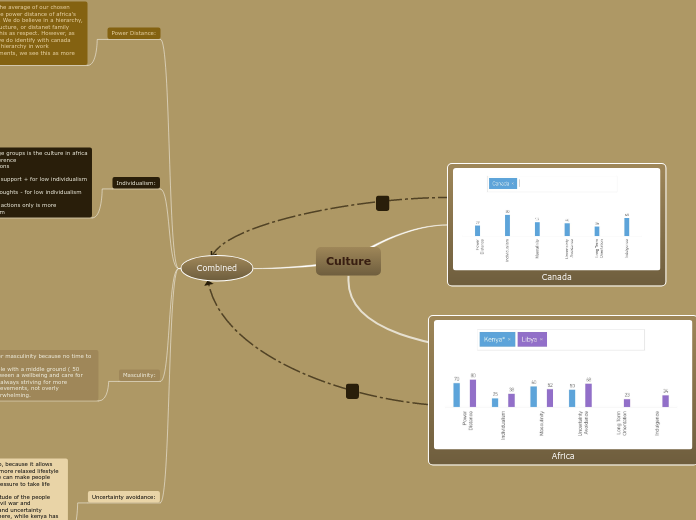
Canada's score is about half of the average of our chosen African countries. We relate to the power distance of africa's ratio in terms of family structure. We do believe in a hierarchy, and usually elders in a family structure, or distanet family have more "power" and we see this as respect. However, as functioning people of a society, we do identify with canada more ( we would rather less of a hierarchy in work environments and social environments, we see this as more equality)
Individualism:
Commitment and loyalty to large groups is the culture in africa compared to canada, a big difference
Both have their own pros and cons
Having a community around to support + for low individualism
Harder to have controversial thoughts - for low individualism
Being responsible for your own actions only is more manageable + high individualism
Masculinity:
It is pressuring to have higher masculinity because no time to relax and only win
We both feel more comfortable with a middle ground ( 50 mark) because a balance between a wellbeing and care for what goes around instead of always striving for more
Value time to appreciate achievements, not overly competitive, we see it as overwhelming.
Uncertainty avoidance:
- Relate more to the middle ground ratio, because it allows willingness for change for better, and a more relaxed lifestyle
- Higher levels of uncertainty avoidance can make people “uptight” and have much anxiety and pressure to take life seriously.
- A certain level of “stability” in the attitude of the people allows for a lower ratio. In Libya, with civil war and dictatorship, people do not like change and uncertainty because it has a negative connotation there, while kenya has remained stable for a while, and Canada has been growing because of change.