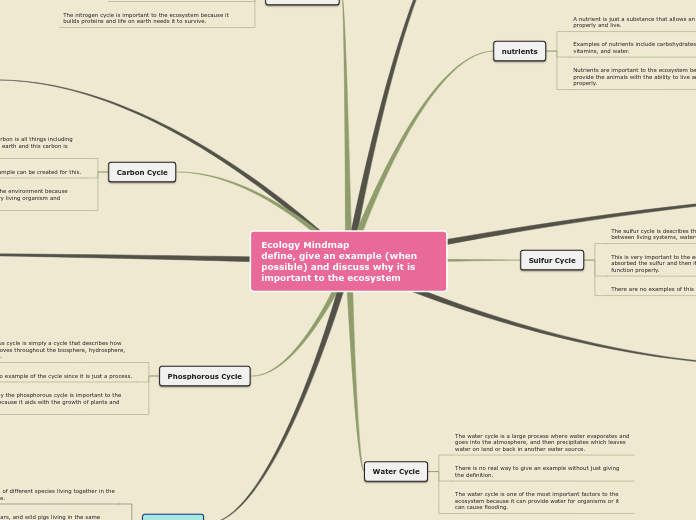
An ecosystem is the relationship between the animals living somewhere and the environment in which they live on.
The ecosystem is important to the ecosystem because it is in fact, an ecosystem.
A coral reef or a savanna are examples of ecosystems that occur in nature.
A nutrient is just a substance that allows an organism to grow properly and live.
Examples of nutrients include carbohydrates, protein, fats, vitamins, and water.
Nutrients are important to the ecosystem because they provide the animals with the ability to live and to function properly.
Biotic can simply be defined as any living thing in an ecosystem that affects the other living things in the ecosystem.
There are millions of examples of biotic factors and these include animals, bacteria, and fungi.
Biotic factors are very important to the ecosystem since they shape the lives of other organisms. These organisms could have postive or negative affects on the other organisms.
The sulfur cycle is describes the movement of sulfur as it goes between living systems, waterways, and rocks.
This is very important to the ecosystem because plants absorbed the sulfur and then it makes sure the proteins function properly.
There are no examples of this process.
An abiotic thing is a nonliving effect that an environment has on the organisms living there.
Abiotic factors are important to the ecosystem because they can severely affect which animals will live and which will die.
A couple of examples of an abiotic factor are rain, snow, wind, and temperature.
The water cycle is a large process where water evaporates and goes into the atmosphere, and then precipitates which leaves water on land or back in another water source.
There is no real way to give an example without just giving the definition.
The water cycle is one of the most important factors to the ecosystem because it can provide water for organisms or it can cause flooding.
The nitrogen cycle is a cycle that details how nitrogen travels between the atmosphere, land, and water.
There is no such example of a nitrogen cycle.
The nitrogen cycle is important to the ecosystem because it builds proteins and life on earth needs it to survive.
A species is a bunch of animals that are practically the same and are able to pass their genes off to their children.
Bears, pigs, cows, dogs, and cats are all examples of a species.
Without species there would be no ecosystem. That being said, species are very important to the ecosystem since they make it up.
The carbon cycle indicates that carbon is all things including animals, the atmosphere, and the earth and this carbon is always moving around.
No example can be created for this.
The carbon cycle is important to the environment because carbon is an essential part of every living organism and without it, nothing would live.
A population is the amount of organisms that inhabit a certain area.
An example of a population would be that the human population in the U.S. is over 300 million.
Populations are important for the environment because they show how well an organism is doing in an environment and if it is going extinct.
The phosphorous cycle is simply a cycle that describes how phosphorous moves throughout the biosphere, hydrosphere, and lithosphere.
There is no example of the cycle since it is just a process.
The reasons why the phosphorous cycle is important to the ecosystem is because it aids with the growth of plants and animals.
A community consists of different species living together in the around the same place.
If there were deer, bears, and wild pigs living in the same place, this would be an example of a community.
Communities are important to the ecosystem since the animals within the community can try to kill each other or even rely on each other.