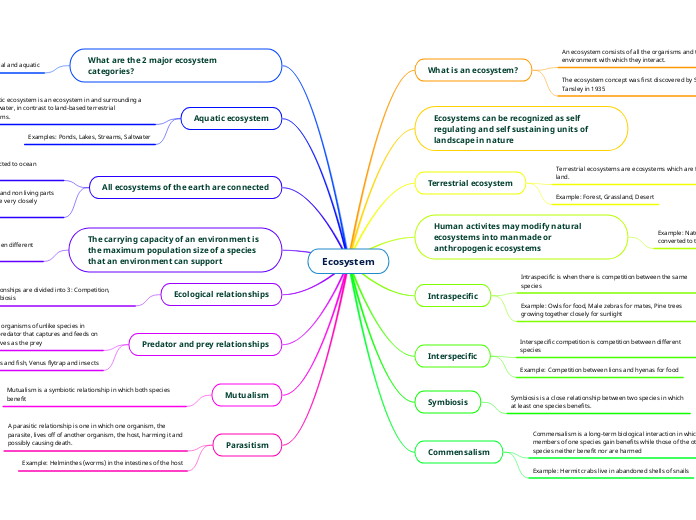
An ecosystem consists of all the organisms and the physical environment with which they interact.
The ecosystem concept was first discovered by Sir Arthur Tansley in 1935
Terrestrial ecosystems are ecosystems which are found on land.
Example: Forest, Grassland, Desert
Example: Natural forests have been cut and the land converted to tree plantations
Intraspecific is when there is competition between the same species
Example: Owls for food, Male zebras for mates, Pine trees growing together closely for sunlight
Interspecific competition is competition between different species
Example: Competition between lions and hyenas for food
Symbiosis is a close relationship between two species in which at least one species benefits.
Commensalism is a long-term biological interaction in which members of one species gain benefits while those of the other species neither benefit nor are harmed
Example: Hermit crabs live in abandoned shells of snails
The 2 major ecosystem categories are terrestrial and aquatic
An aquatic ecosystem is an ecosystem in and surrounding a body of water, in contrast to land-based terrestrial ecosystems.
Examples: Ponds, Lakes, Streams, Saltwater
For example, river ecosystems are connected to ocean ecosystems
The living organisms (biotic components) and non living parts (abiotic components) of the ecosystem are very closely connected
The limited resources leads to competition between different species and also organisms of the same kind
Ecological relationships are divided into 3: Competition, Predator and sybiosis
An interaction between two organisms of unlike species in which one of them acts as predator that captures and feeds on the other organism that serves as the prey
Example: Bears and fish, Venus flytrap and insects
Mutualism is a symbiotic relationship in which both species benefit
A parasitic relationship is one in which one organism, the parasite, lives off of another organism, the host, harming it and possibly causing death.
Example: Helminthes (worms) in the intestines of the host