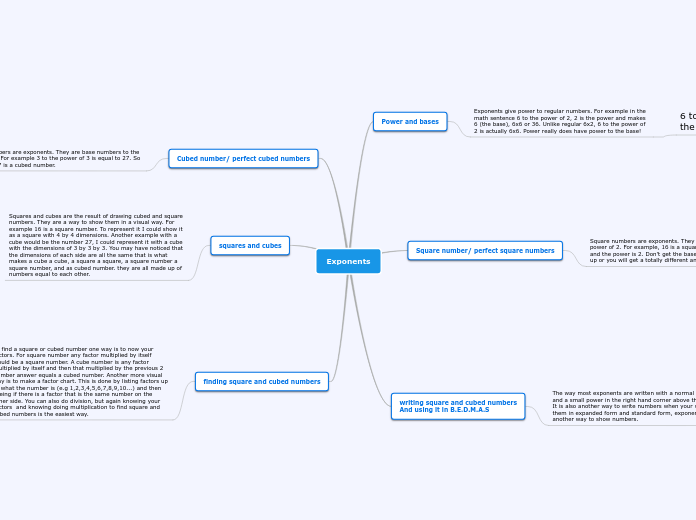
Exponents give power to regular numbers. For example in the math sentence 6 to the power of 2, 2 is the power and makes 6 (the base), 6x6 or 36. Unlike regular 6x2, 6 to the power of 2 is actually 6x6. Power really does have power to the base!
6 to the power of 2 equals 36! 2's got the power!
Square numbers are exponents. They are base numbers to the power of 2. For example, 16 is a square number. The base is 4 and the power is 2. Don't get the base and the power mixed up or you will get a totally different answer!
The difference between squared and perfect square numbers are that
- squared numbers can be any number with any number base and any number power (e.g it can be a decimal number wit ha decimal base and a regular number power)
- Perfect square numbers have to be whole numbers with whole number bases and powers
Fun Fact:
Most calculators have a button that you can press to find the square root of numbers with. It looks like a v with a line at the top attached to it. Kind of like this: v--
The way most exponents are written with a normal sized base and a small power in the right hand corner above the number. It is also another way to write numbers when your writing them in expanded form and standard form, exponent form is another way to show numbers.
When you are doing B.E.D.M.A.S, do you remember what the E stands for? Well it stands for exponents. So next time you get a B.E.D.M.A.S question remember that you solve brackets first then exponents. Then multiplication and division next (in left to right order because multiplication and division are in the same "category".) Then you solve addition and subtraction (in left to right order because multiplication and division are in the same "category".)
Cubed numbers are exponents. They are base numbers to the power of 3. For example 3 to the power of 3 is equal to 27. So therefore 27 is a cubed number.
The difference between cubed numbers and perfect cube number are that... -perfect square numbers are always whole numbers and have base whole numbers to the power of 3 -Square numbers can be any number such as as a decimal with a decimal base to the power of 3
Squares and cubes are the result of drawing cubed and square numbers. They are a way to show them in a visual way. For example 16 is a square number. To represent it I could show it as a square with 4 by 4 dimensions. Another example with a cube would be the number 27, I could represent it with a cube with the dimensions of 3 by 3 by 3. You may have noticed that the dimensions of each side are all the same that is what makes a cube a cube, a square a square, a square number a square number, and as cubed number. they are all made up of numbers equal to each other.
To find a square or cubed number one way is to now your factors. For square number any factor multiplied by itself would be a square number. A cube number is any factor multiplied by itself and then that multiplied by the previous 2 number answer equals a cubed number. Another more visual way is to make a factor chart. This is done by listing factors up to what the number is (e.g 1,2,3,4,5,6,7,8,9,10...) and then seeing if there is a factor that is the same number on the other side. You can also do division, but again knowing your factors and knowing doing multiplication to find square and cubed numbers is the easiest way.
An example of using multiplication is:
Multipling 3x3x3 to find the answer to 3 to the power of 3.