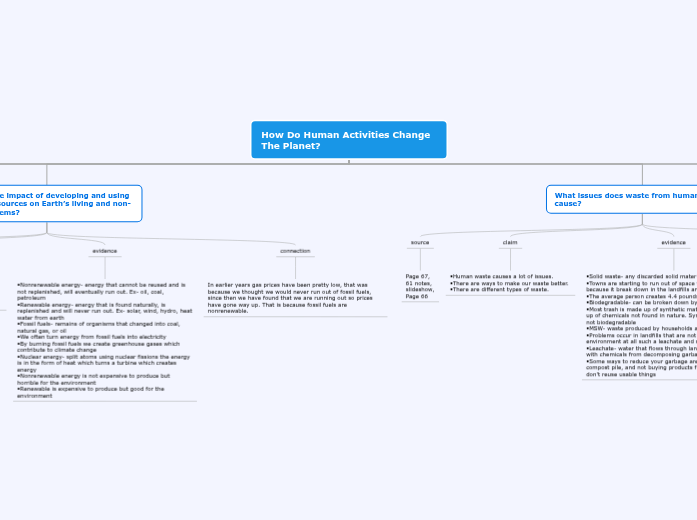
How Do Human Activities Change The Planet?
Initial answer
Every action has a reaction. Every single thing we do has an impact on the earth whether good or bad
Final answer
Humans take a lot from the earth. We take minerals to build things, fossil fuels to create energy, and use its resources to survive. Humans take a lot from the earth but we do nothing to actually help the Earth. We create tons upon tons of waste that we expect the earth to degrade and we change the climate by putting greenhouse gases into the air. We are now paying for that through natural disasters and climate change
How has human society been influenced by the availability of rock, mineral, and energy resources?
source
61 notes, slideshow
claim
•We use minerals for energy
•Use minerals in day to day life
•We mine to get the minerals
•Use oil to power many things
•We make alloys out of minerals
•Most of the things we do have a lot of environmental impacts
evidence
•Subsurface mining- Room and pillar mining, long wall mining, solution mining
•Surface mining- open pit mining, mountaintop removal, quarrying, solar salt evaporation, placer deposits, smelting, dredging
•Environmental impacts- noise and air pollution, water contamination, erosion, subsidence, reclamation, smog, underground mine fires
•We are creating new technology that can find the best place to mine so we can save money
connection
In Tipton, Iowa we have a quarry. At the quarry you can buy a ton of different types of minerals and rocks. There is also a giant hole in the earth where they are mining
What is the impact of developing and using energy resources on Earth’s living and non-living systems?
source
61 notes,
slideshow
claim
•For our human system there are several different ways of getting energy.
•Some are more clean than others.
•And there are 2 different types of energy.
evidence
•Nonrenewable energy- energy that cannot be reused and is not replenished, will eventually run out. Ex- oil, coal, petroleum
•Renewable energy- energy that is found naturally, is replenished and will never run out. Ex- solar, wind, hydro, heat water from earth
•Fossil fuels- remains of organisms that changed into coal, natural gas, or oil
•We often turn energy from fossil fuels into electricity
•By burning fossil fuels we create greenhouse gases which contribute to climate change
•Nuclear energy- split atoms using nuclear fissions the energy is in the form of heat which turns a turbine which creates energy
•Nonrenewable energy is not expensive to produce but horrible for the environment
•Renewable is expensive to produce but good for the environment
connection
In earlier years gas prices have been pretty low, that was because we thought we would never run out of fossil fuels, since then we have found that we are running out so prices have gone way up. That is because fossil fuels are nonrenewable.
What issues does waste from humans cause?
source
Page 67,
61 notes,
slideshow,
Page 66
claim
•Human waste causes a lot of issues.
•There are ways to make our waste better.
•There are different types of waste.
evidence
•Solid waste- any discarded solid material
•Towns are starting to run out of space to put their trash because it break down in the landfills and its piling up
•The average person creates 4.4 pounds of waste per day
•Biodegradable- can be broken down by natural processes
•Most trash is made up of synthetic materials which are made up of chemicals not found in nature. Synthetic materials are not biodegradable
•MSW- waste produced by households and businesses
•Problems occur in landfills that are not good for the environment at all such a leachate and methane
•Leachate- water that flows through landfills and combines with chemicals from decomposing garbage
•Some ways to reduce your garbage are recycling, making a compost pile, and not buying products from companies that don't reuse usable things
connection
In 1987 New York ran out of space to put their garbage so they put it on a boat and shipped it to another state. The other state did not want is and New York couldn't take it back so they ended up having to burn all the garbage. It started the biggest boom in recycling in history
How do human societies use Earth’s resources?
source
61 notes,
Page 68,
slideshow
claim
•Humans tend to live in places with rich environmental resources.
•As human populations increase resources are going down.
evidence
•Requirements to survive- food, clean air, water, shelter
•Natural resources- provisions that come from the environment and can be used by humans
•Types of resources- rock and mineral, energy, water, air and climate, land
•Ways we use earth's resources- agriculture, trade, and industry
connection
Indians would follow the buffalo because they were their main food resource. Humans also don't live in the desert because there isn't enough resources. Other people live in oil rich places because they can find a job working for the oil company.
What impact do natural hazards have on individuals and societies?
source
61 notes,
Page 68
claim
•We cannot prepare for natural hazards as much as we normally can for other disasters.
•Natural disasters can wipe out whole towns and little societies.
• We can sometimes predict natural disasters
•Societies also affect natural disasters
evidence
•Ways we can prepare- building houses with flexible base, avalanche control, underwater tunnels to redirect flood waters, cross beam braced walls
•How society is affected- cause damage to buildings, water facilities, and gas pipelines which can be more dangerous than the actual event
•Scientists use data patterns to predict natural disasters so they can warn the public
•We burn fossil fuels- leads to greenhouse gases- causes climate change- weather instability
•Natural Hazards - Effects of specific Earth processes that can cause harm to people and property.
•Types of natural hazards- geophysical, hydrological, climatological
connection
In OK from 1978- 2008 there were 21 3+ earthquakes. From 2014- 2016 there has been over 600