First Distinction
General Linguistics
Desriptive Linguistics
Second Distinction
Diachronic "Historical" Linguistics
Synchronic Linguistics
Third Distinction
Theoretical Distinction
Applied Linguistics
Fourth Distinction
Micro linguistics
Phonetics
Phonology
Morphology
Syntax
Semantics
Pragmatics
Macro linguistics
Psycholinguistics
Sociolinguistics
Neurolinguistics
Discourse Analysis
Computational Linguistics
Applied Linguistics
Science
(a form of inquiry and form of knowledge)
A Subjective Process
A Objective Process
A Creative Process
Grammar
Universal Grammar
Language
A "tool" or knowledge that constructs
an infinite number of sentences
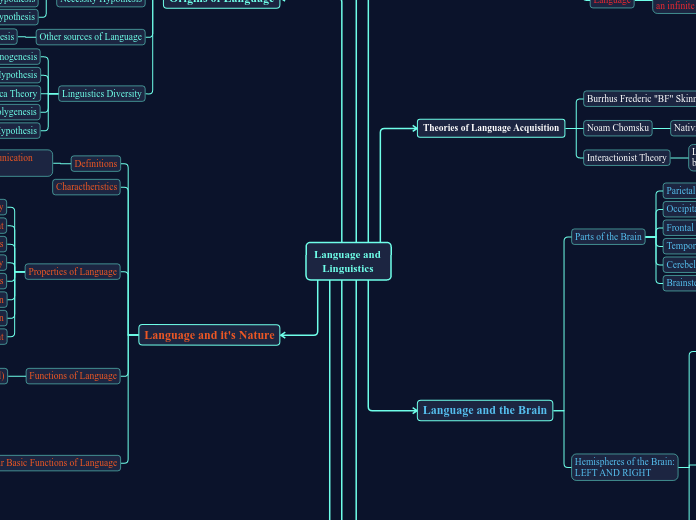
Burrhus Frederic "BF" Skinner
Listen, imitate, receive a
reward, repeat for recall
Noam Chomsku
Nativist Theory
There are "core" and "language specific"
rules in all languages
Interactionist Theory
Language development is
both biological and social
Parts of the Brain
Parietal Lobe
Sense of touch
Occipital Lobe
Sense of sight
Frontal Lobe
Problem solving
Temporal Lobe
Sense of hearing
Cerebellum
Balance
Brainstem
Pathway to the Body
Hemispheres of the Brain:
LEFT AND RIGHT
Left Brain is responsible for:
Logic
Sequential
Rational
Analytical
Objective
Looks at parts
Right Brain is responsible for:
Random
Intuitive
Holistic
Synthesizing
Subjective
Look at whole
Information about the two sides of
brain in which the brain recognized
Left Brain
Letters
Numbers
Words
Right Brain
Places
Objects
Faces
English
[ENL] English as a Native Language
[ESL] English as a Second Language
[EFL] English as a Foreign Language
Kachru's Concentric Circle
Inner Circle
[ENL]
"Mother Tongue" Variations of Language
Outer Circle
[ESL]
English as an "Additional Language"
Expanding Circle
[EFL]
Language is uses as a "Foreign Language"
Two Faces of English
Englishisation
Nativisation
Bilingual Creativity
Creative linguistic processes, the result
in two or more language
Paradigm Shifts
Shifts from frameworks and theories, significantly appropriate only to monolingual countries
Theories
Divine Creation
Natural Evolution
Invention/Necessity Hypothesis
"ding-dong" hypothesis
"pooh-pooh" hypothesis
"bow-bow" hypothesis
"ta-ta" hypothesis
Necessity Hypothesis
Warning Hypothesis
"yo-he-yo" Hypothesis
The Lying Hypothesis
Other sources of Language
Innateness Hypothesis
Linguistics Diversity
Monogenesis
The Mother Tongue Hypothesis
Out of Africa Theory
Polygenesis
The Candelabra Hypothesis
Definitions
Define as the tool used in communication process
Charactheristics
Properties of Language
Specificity
Displacement
Arbitrariness
Productivity
Discreteness
Duality or double Articulation
Cultural Transimission
Rule Government
Functions of Language
Metalingual Function (Halliday's Model)
Ideational
Interpersonal
Contextual
Four Basic Functions of Language
Informative Function
Interrogative Function
Interpersonal Function
Performative
Directive
Emotive
Expressive
According to medium
According to field discourse
According to User
Regional
Social
The Language User
Englishes
(Classifications of Models)
Kachru's Circle Theory
The Three Concentric Circle
Birth of Corpus Linguistics
[ICE] International Corpus of English
Aim to collect material for comparative studies of English across the globe
Features of Philippine English
Grammatical Features of Philippine English