Three Witches:
First Witch:
All hail, Macbeth! hail to thee, thane of Glamis!
Second Witch:
All hail, Macbeth, hail to thee, thane of Cawdor!
Third Witch:
All hail, Macbeth, thou shalt be king hereafter!
(Act 1, Scene 3)
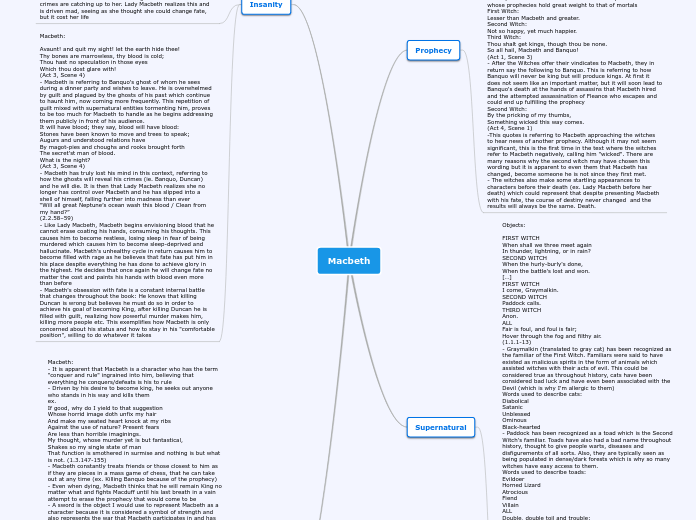
- The prophecies made by the witches in this scene are pivotal in the book because they are what cause Macbeth to start his obsession with the throne and how he would come to obtain it. However, what is even more confusing is the motives behind the witches telling Macbeth these prophecies when they already know what is going to happen! Perhaps to defy fate? Play with mortal emotions? The direct answer to this is not known, but it is known that the witches are a powerful force whose prophecies hold great weight to that of mortals
First Witch:
Lesser than Macbeth and greater.
Second Witch:
Not so happy, yet much happier.
Third Witch:
Thou shalt get kings, though thou be none.
So all hail, Macbeth and Banquo!
(Act 1, Scene 3)
- After the Witches offer their vindicates to Macbeth, they in return say the following to Banquo. This is referring to how Banquo will never be king but will produce kings. At first it does not seem like an important matter, but it will soon lead to Banquo's death at the hands of assassins that Macbeth hired and the attempted assassination of Fleance who escapes and could end up fulfilling the prophecy
Second Witch:
By the pricking of my thumbs,
Something wicked this way comes.
(Act 4, Scene 1)
-This quotes is referring to Macbeth approaching the witches to hear news of another prophecy. Although it may not seem significant, this is the first time in the text where the witches refer to Macbeth negatively, calling him "wicked". There are many reasons why the second witch may have chosen this wording but it is apparent to even them that Macbeth has changed, become someone he is not since they first met.
- The witches also make some startling appearances to characters before their death (ex. Lady Macbeth before her death) which could represent that despite presenting Macbeth with his fate, the course of destiny never changed and the results will always be the same. Death.
Objects:
FIRST WITCH
When shall we three meet again
In thunder, lightning, or in rain?
SECOND WITCH
When the hurly-burly's done,
When the battle's lost and won.
[…]
FIRST WITCH
I come, Graymalkin.
SECOND WITCH
Paddock calls.
THIRD WITCH
Anon.
ALL
Fair is foul, and foul is fair;
Hover through the fog and filthy air.
(1.1.1-13)
- Graymalkin (translated to gray cat) has been recognized as the familiar of the First Witch. Familiars were said to have existed as malicious spirits in the form of animals which assisted witches with their acts of evil. This could be considered true as throughout history, cats have been considered bad luck and have even been associated with the Devil (which is why I'm allergic to them)
Words used to describe cats:
Diabolical
Satanic
Unblessed
Ominous
Black-hearted
- Paddock has been recognized as a toad which is the Second Witch's familiar. Toads have also had a bad name throughout history, thought to give people warts, diseases and disfigurements of all sorts. Also, they are typically seen as being populated in dense/dark forests which is why so many witches have easy access to them.
Words used to describe toads:
Evildoer
Horned Lizard
Atrocious
Fiend
Villain
ALL
Double, double toil and trouble;
Fire burn, and cauldron bubble.
(4.1.10-11)
- Cauldrons have been recognized as an object which witches would have used during the time period of which Macbeth is set in. Used for various activities such as; making potions, forming incantations, hexing people and much more, cauldrons don't have any positive connotation when associated with witches.
Famous Evil Cats:
Lucifer in Cinderella
Mittens in Bolt
Mr.Tinkles in Cats and Dogs (2001)
Mrs.Norris from Harry Potter
Sylvester from Looney Toons
Famous Evil Toads:
Michigan J Frog (Getting that annoying song stuck in my head for 3 years!!!)
Blood:
(I know that blood is not necessarily a character, but it represents death/insanity and the phrase "blood on your hands" which is very important in Macbeth)
Blood carries the feeling of despair or guilt that is to come after committing or having committed the act of murder which leads to insanity
ex. Mine eyes are made the fools of the other senses
Or else worth all the rest. I see thee still;
And on thy blade and dudgeon gouts of blood
(2.1.52-55 ) - This quote is when Macbeth is about to murder Duncan, thinking that Duncan may wake up and hear him. Blood in this context is used to describe Macbeth's guilt stirring into fear of what will happen after Duncan is murdered, the act which starts a domino effect of more blood and murder
ex. Blood hath been shed ere now. i' th' olden time,
Ere humane statute purged the gentle weal;
Ay, and since too, murders have been performed
Too terrible for the ear. The times has been
That, when the brains were out, the man would die,
And there an end; but now they rise again,
With twenty mortal murders on their crowns...
(3.4. 122-125) - This quotes is when Macbeth is reflecting on how the ghosts he sees now are because of the murders he has committed, but they frighten him more than the actual murders themselves. However, the guilt of blood beginning to stain his hands also seeps into his descent of madness as the murders become more open and vicious
Blood represents the slow progress into insanity as the stains of it become harder to wash away
ex. Out, damned spot! out, I say!--One: two: why,then, 'tis time to do't.--Hell is murky!--Fie, my lord, fie! a soldier, and afeard? What need wefear who knows it, when none can call our power to account?--Yet who would have thought the old man to have had so much blood in him.
(Act V, Scene 1) - As Duncan and the rest of the murders Lady Macbeth has assisted with haunt her dreams, she begins to hallucinate and sees blood staining her hands that she cannot wash off. It begins to drive her mad and she begins envisioning the children of the people she has killed, ultimately causing her demise (p.s This quoting is different from the rest because it is from a different source than the others)
ex. "Here's the smell of the blood still: all the perfumes of Arabia will not sweeten this little hand. O, O, O!"
(5.1.50-52) - As Lady Macbeth continues sleepwalking, the scent of death follows her and she cannot get rid of it. This is a reference to the murders "following her around" and how her crimes are catching up to her. Lady Macbeth realizes this and is driven mad, seeing as she thought she could change fate, but it cost her life
Macbeth:
Avaunt! and quit my sight! let the earth hide thee!
Thy bones are marrowless, thy blood is cold;
Thou hast no speculation in those eyes
Which thou dost glare with!
(Act 3, Scene 4)
- Macbeth is referring to Banquo's ghost of whom he sees during a dinner party and wishes to leave. He is overwhelmed by guilt and plagued by the ghosts of his past which continue to haunt him, now coming more frequently. This repetition of guilt mixed with supernatural entities tormenting him, proves to be too much for Macbeth to handle as he begins addressing them publicly in front of his audience.
It will have blood; they say, blood will have blood:
Stones have been known to move and trees to speak;
Augurs and understood relations have
By magot-pies and choughs and rooks brought forth
The secret'st man of blood.
What is the night?
(Act 3, Scene 4)
- Macbeth has truly lost his mind in this context, referring to how the ghosts will reveal his crimes (ie. Banquo, Duncan) and he will die. It is then that Lady Macbeth realizes she no longer has control over Macbeth and he has slipped into a shell of himself, falling further into madness than ever
“Will all great Neptune’s ocean wash this blood / Clean from my hand?”
(2.2.58–59)
- Like Lady Macbeth, Macbeth begins envisioning blood that he cannot erase coating his hands, consuming his thoughts. This causes him to become restless, losing sleep in fear of being murdered which causes him to become sleep-deprived and hallucinate. Macbeth's unhealthy cycle in return causes him to become filled with rage as he believes that fate has put him in his place despite everything he has done to achieve glory in the highest. He decides that once again he will change fate no matter the cost and paints his hands with blood even more than before
- Macbeth's obsession with fate is a constant internal battle that changes throughout the book: He knows that killing Duncan is wrong but believes he must do so in order to achieve his goal of becoming King, after killing Duncan he is filled with guilt, realizing how powerful murder makes him, killing more people etc. This exemplifies how Macbeth is only concerned about his status and how to stay in his "comfortable position", willing to do whatever it takes
Macbeth:
- It is apparent that Macbeth is a character who has the term "conquer and rule" ingrained into him, believing that everything he conquers/defeats is his to rule
- Driven by his desire to become king, he seeks out anyone who stands in his way and kills them ex. If good, why do I yield to that suggestion
Whose horrid image doth unfix my hair
And make my seated heart knock at my ribs
Against the use of nature? Present fears
Are less than horrible imaginings.
My thought, whose murder yet is but fantastical,
Shakes so my single state of man
That function is smothered in surmise and nothing is but what is not. (1.3.147-155) - Macbeth constantly treats friends or those closest to him as if they are pieces in a mass game of chess, that he can take out at any time (ex. Killing Banquo because of the prophecy)
- Even when dying, Macbeth thinks that he will remain King no matter what and fights Macduff until his last breath in a vain attempt to erase the prophecy that would come to be - A sword is the object I would use to represent Macbeth as a character because it is considered a symbol of strength and also represents the war that Macbeth participates in and has going on inside his head. The sword also represents power because it is a tool which has the ability to take away lives, tilting the fate of others
Lady Macbeth: At first Lady Macbeth seems like an innocent figure, until she calls to demonic spirits in order to give her and Macbeth the courage/strength to commit the act of murder just for the sake of power
ex. The raven himself is hoarse
That croaks the fatal entrance of Duncan
Under my battlements. Come, you spirits
That tend on mortal thoughts, unsex me here,
And fill me from the crown to the toe top-full
Of direst cruelty! make thick my blood;
Stop up the access and passage to remorse,
That no compunctious visitings of nature
Shake my fell purpose, nor keep peace between
The effect and it! Come to my woman's breasts,
And take my milk for gall, you murdering ministers,
Wherever in your sightless substances
You wait on nature's mischief! Come, thick night,
And pall thee in the dunnest smoke of hell,
That my keen knife see not the wound it makes,
Nor heaven peep through the blanket of the dark,
To cry 'Hold, hold!' (1.5.45-61) - Even though it appears that Macbeth holds the most power, Lady Macbeth holds power over Macbeth which is an even greater threat, seeing as the wrong person having control over a king leads to a terrible turn of events
- Lady Macbeth constantly conflicts with fate, willing it to bend to her will in order to achieve the highest form of power. She goes as far as to drug the guards in order for Macbeth to commit the murder, never getting her hands "dirty" even though they appear to be
- The best and worst quality of Lady Macbeth is her persistence: Despite knowing what tampering with fate means, she continues to do so because she believes that fate can change if she puts in the effort. However as she continues persisting to obtain her goals, she slips into insanity, realizing the costs of murder and how the scales of balance have been tipped due to her vile acts. If Lady Macbeth had been persistent in a more positive manner (ex. Encouraging Macbeth to assist Malcolm when he is crowned so that he's respected and could be crowned king when Malcolm chooses), then it would have been considered a positive trait of hers. However, seeing as she used persistence to assist with murder, it is now viewed as the trait of her downfall