1. Inorganic Sources : carbon dioxide and water.
Organisms :autotrophs
Eg- green plants and bacteria
They make simple substances (energy)- later complex substances ( reserves for growth + used by heterotrophs)
Stored carbohydrates in Plants - Starch
2. Complex Substances (organic)- broken into simpler substances by bio catalysts ( increase the rate of reaction ) or enzymes.
Organisms - heterotrophs- depend on autotrophs
Eg. Animals and fungi
Stored form of carbohydrates - glycogen
Carbohydrates- maltose-glucose
Proteins - peptides- amino acids
Fats - Fatty acids and glycerol
Synthesize their own food by process called photosynthesis .
Photosynthesis - process by which autotrophs take in substances from outside and convert them into stored forms of energy
Raw Materials : CO2 , H2O
Requirements : Chlorophyll, Sunlight
Products : Glucose , Water , Oxygen
EQUATION -
Chlorophyll
6CO2+12H20 ----------------->C6H12O6+6O2+6H2O
Steps of Photosynthesis -
1. Absorption of light energy by chlorophyll.
2. Conversion of light energy into chemical energy and splitting of water molecules into hydrogen and oxygen .
3.Reduction of carbon dioxide to carbohydrates.
During DAY TIME - Main gas released -O2
During NIGHT TIME- Main gas released - CO2
Desert Plants- stomata closed during day to prevent water loss . - CO2 taken during night - intermediate made - reacts with sunlight next day.
Chlorophyll - present in chloroplasts, absorb sunlight
Stomata-
tiny pores present on surface of leaves . help in gaseous exchange and transpiration .
Stomatal pores close when CO2 Not needed for photosynthesis .
Closing and opening of stomatal pore- Guard cells- water flows in - swells - opens- water moves out - shrink - closes
Stomatal apparatus - stomata + guard cells
Raw Materials needed by plants for building body-
1. Water - taken from soil by roots
2. N , P, Fe, Mg - taken from soil
Nitrogen - used in synthesis of proteins. Absorbed as -
a. Inorganic nitrates or nitrites.
b. Organic compounds prepared by bacteria from atm. N .
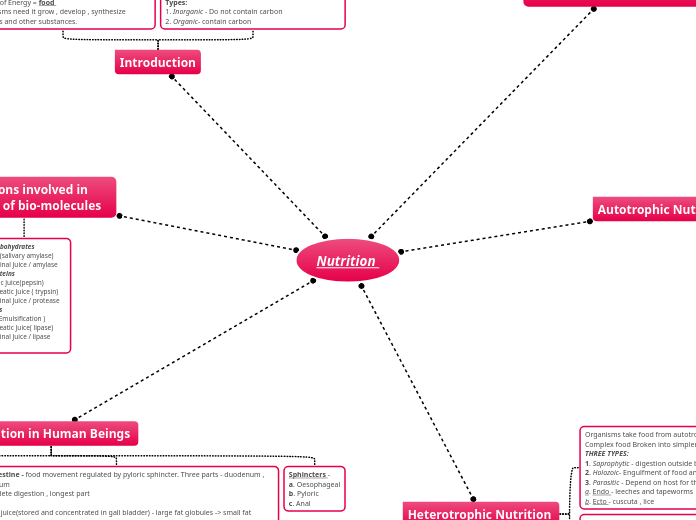
Organisms take food from autotrophs or other organic sources.
Complex food Broken into simpler.
THREE TYPES:
1. Saprophytic - digestion outside body + nutrients absorbed. Eg- Fungi , Rhizopus
2. Holozoic- Engulfment of food and then digestion inside. Eg - Amoeba , Humans
3. Parasitic - Depend on host for their nutrition .
a. Endo - leeches and tapeworms
b. Ecto - cuscuta , lice
NUTRITION IN AMOEBA -
1. Ingestion: takes in food using pseudopodia
2. Assimilation - food particle fuse over the vacuole forming food vacuole
3. Digestion - complex to simpler substances in food vacuole
4. Absorption - Diffusion of simpler substances into cytoplasm
5. Egestion - remaining undigested material - moved to cell surface and thrown out
NURITION IN PARAMECIUM - food moved to specific entering spot through cilia present on cell surface.
Process of intake of nutrients and their utilization by an organism.
Source of Energy = food
Organisms need it grow , develop , synthesize proteins and other substances.
Nutrients:
Substances required by an organism to use them as a source of energy and to synthesize their body constituents required for growth and repair.
Types:
1. Inorganic - Do not contain carbon
2. Organic- contain carbon
1. Carbohydrates
Saliva(salivary amylase)
Intestinal Juice / amylase
2. Proteins
Gastric Juice(pepsin)
Pancreatic Juice ( trypsin)
Intestinal Juice / protease
3. Fats
Bile ( Emulsification )
Pancreatic Juice( lipase)
Intestinal Juice / lipase
Alimentary Canal - long tube extending from mouth to anus .
MOUTH -> PHARYNX -> OESOPHAGUS-> STOMACH -> SMALL INTESTINE -> LARGE INTESTINE -> ANUS
1. MOUTH - teeth + tongue .
Teeth - chew food , Tongue - mix food with saliva(bolus) , taste
Saliva - liquid secreted by salivary glands .- Enzyme - salivary amylase : Starch - Maltose
2. Pharynx - common passage for food and air .
3. Oesophagus - food pipe - peristaltic movements ( rhythmic contraction and relaxation )- push food forward
4. Stomach - three parts: cardiac , fundus , pyloric
Muscular walls help to mix the food with gastric/digestive juices.
secretions - gastric juices by gastric glands ->
a. HCL - kills germs , activates pepsinogen->pepsin , creates acidic medium for pepsin .
b. Pepsinogen -> Pepsin - converts proteins -> peptides
c. Mucus - Protects inner lining from HCL
5. Small Intestine - food movement regulated by pyloric sphincter. Three parts - duodenum , jejunum , ileum
Site of complete digestion , longest part
secretions
1. Liver - bile juice(stored and concentrated in gall bladder) - large fat globules -> small fat globules (Emulsification for efficiency)+ creates alkaline medium for pancreatic enzymes to act .
2. Pancreas - a. trypsin- proteins-> peptides and peptones
b. lipase - emulsified fats- fatty acids and glycerol .
3. Intestinal glands - intestinal juices ( carbs - glucose, proteins - amino acids, fats - fatty acids and glycerol)
Absorption in Small Intestine -
Modification in walls -
a. villi : numerous finger like projections to increase surface area.
b. villi supplied with blood vessels which take absorbed food to each and every cell for obtaining energy , building and repair of tissues.
6. Large Intestine - absorbs water
7. Anus - undigested material removed - anal sphincter
Sphincters -
a. Oesophageal
b. Pyloric
c. Anal