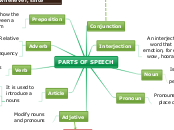
PARTS OF SPEECH
Conjunction
Interjection
An interjection is a word that shows emotion, for example: wow, hooray, hmm
Noun
Is a word that names a person place or thing
Pronoun
Pronouns take the place of nouns
Preposition
Are words that show the relationship between a noun or a pronoum
example: wiht, across
Adverb
Relative
example:what, where, when, why
Frequency
example: always, never, sometimes
Verb
Verbs show actions or states of being
Article
It is used to introduce a nouns
a: consonant
an:vocal
the
Adjetive
Modify nouns and pronouns
This is the best
Relative
Absolute
Names:
Ángel Morales
C.I.: 25402186
Barbara Velazco
C.I.: 25126044
Nathaly Murillo
C.I.:24525790
Section: II
Semester: II
Type
Possesive nouns
example: peter´s car
Common nouns
example: the child, the pear
Compound nouns
Proper nouns
example:Asia, Canada, Albert
Collective nouns
example: army, jury, class

Type
Main verb
They carry the main meaning
Auxiliary Verbs and Auxiliary Modals
Auxiliary: be, have, do
Modals: shall, will
Transitive
A verb that has a direct object
Intransitive
A verb that does not have a direct object over which the verb action falls down:She laughed
Degrees
Superlatives
which is better?
Comparative
Inferiority
Equality
Superiority
Conencting words
Copulative conjunctions: but also,as well.
Correlative conjunctions: either,neither,whether
Coordinating conjunctions: for, and, nor, but, yet, so
Subordinating conjunctions: unless, whenever, since
Type
Reflexive Pronouns
example: yourself, myself, himself, herself,itself, ourselves, themselves
Relative pronouns
Are words that introduce adjetive clauses, example: who, whom, whose, that
Possesive pronouns
mine, my, yours, his, hers, ours, theirs
Object pronouns
me, you, him, her, it, them, us