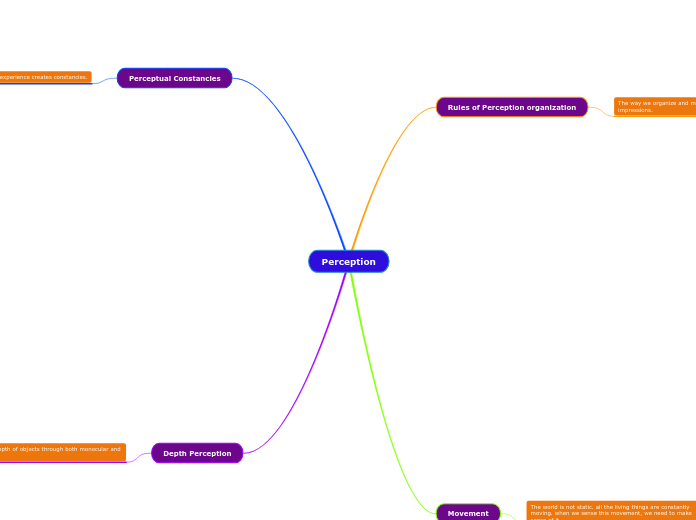
Perception
Rules of Perception organization
The way we organize and make sense of of all our sensory impressions.
Closure
The tendency to perceive a complete or whole figure even when there are gaps in what your senses tell you.

Figure ground perception
The perception of figures against a background.
Proximity
The nearness of some of the lines to each other in a figure.
Similairity
Grouping lines forming a pattern.
Continuity
The perceptual tendency to group stimuli into continuous patterns.
Common Fate
The tendency to perceive objects that are moving together as belonging together.
Movement
The world is not static. all the living things are constantly moving. when we sense this movement, we need to make sense of it.
Perception of Movement
When humans need to see an object change its position relative to other objects.
Stroboscopic Motion
A visual illusion in which the perception of tin is generated by the rapid progression of images or objects that are not actually moving at all.
Perceptual Constancies
Each persons experience creates constancies.
Size Constancy
The tendency to perceive an object as being of one size no matter how far away the object is.
Color Constancy
Perceive objects as keeping their color even though different light might change the appearance of their color.
Shape Constancy
The knowledge that an item has only one shape no matter what angle you view it from.
Brightness Constancy
Perceive an object as being equally bright even when the intensity of the light around change it
Depth Perception
You perceive the depth of objects through both monocular and binocular cues.
Monocular Cues
Cues for distance that need only one eye to perceive.
Binocular Cues
Visual cues for depth that require the use of both eyes.
Retinal Disparity
A binocular cue to perceiving depth based on the difference between the two images of an object that the retina receives as the object moves closer.