-A procedure is a series of interrelated sequential steps
that can be used to respond to a structured problem.
- A rule is an explicit statement that tells managers what
they can or cannot do.
-A policy is a guideline for making decisions.
Problem solving and decision making are
crucial skills of effective managers.
The sport industry is not immune to bad
decisions.
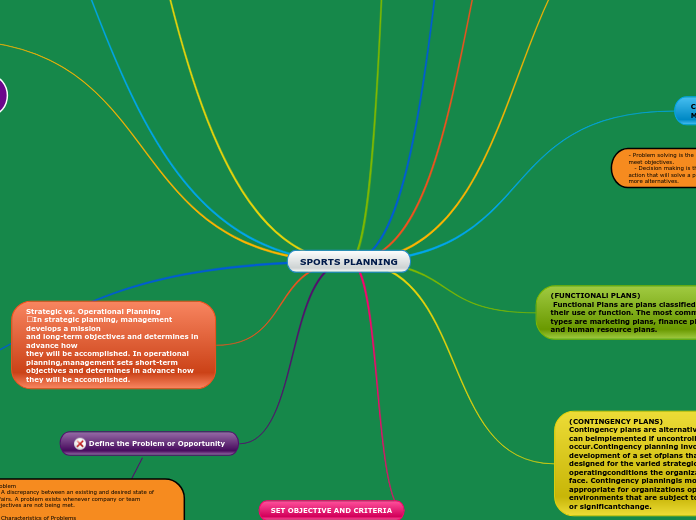
- Problem solving is the process of taking corrective action to meet objectives.
- Decision making is the process of selecting a course of action that will solve a problem/ Making a choice from two or
more alternatives.
Good planning becomes the standard, which can be reviewed, as the plan proceeds to help guide and control performance.
Poor planning on the other hand, is generally considered to be the number one reason why individuals and organizations fail
to achieve their desired end result.
Failure to survive
failure to reach desired objectives
failure to operate within budget
failure to maximize the use of resources
(A ROAD MAP ) Planning establishes coordinated effort. It gives direction to managers and non-managers alike. “If you don’t know where you are going, any road will take you there”.
(BETTER COORDINATION) Most organizations consist of multiple work groups, each of
which is responsible for contributing to the accomplishment of
the goals of the organization. When work activities are coordinated around established plans, wasted time and
resources and redundancy can be minimized.
(FOCUS ON FORWARD THINKING)
Planning reduces uncertainty by forcing managers to look
ahead, anticipate change, consider the impact of change, and
develop appropriate responses. It also clarifies the
consequences of actions managers might take in response to
change. Even though planning can’t eliminate change, managers plan in order to anticipate changes and develop the most effective response to them.
(MORE EFFECTIVE CONTROL SYSTEMS)
Planning establishes goals or standards that are used in
controlling. If managers are unsure of what they are trying to
accomplish, they will be unable to determine whether or not
the goal has actually been achieved. In planning, goals and
plans are developed. Then, through controlling, actual
performance is compared against the goals, significant
deviations are identified, and necessary corrective action is
taken. Without planning, there would be no way to control.
(STRATEGIC PLANNING) Strategic plans apply to the entire organization. Strategic plans is
the process of determining an organization’s long term goals (with time frames extending beyond five years)
The Strategic Planning Process
In the strategic process managers:
1. Develop the mission,
2. Analyze the environment,
3. Set objectives,
4. Develop strategies, and
5. Implement and control the strategies
(SWOT ANALYSISSWOT ANALYSIS)
Strengths
Weaknesses
Opportunities
Threats
-Unstructured problems
#Problems that are new or unusual and for which
information is ambiguous or incomplete. These problems
are best handled by a non -programmed decision that is a
unique decision that requires a custom-made solution.
Problem
A discrepancy between an existing and desired state of affairs. A problem exists whenever company or team objectives are not being met.
Characteristics of Problems
You must be aware of the problem. Be sure to identify the actual
problem rather than a symptom of the problem.
You must be under pressure to act. A true problem puts pressure on
the manager to take action; a problem without pressure to act is a
problem that can be postponed.
You must have the authority or resources to act. When managers
recognize a problem and are under pressure to take action but do
not have necessary resources, they usually feel that unrealistic
demands are being put upon them.
Objectives state what the individual, group, or organization intends to
accomplish.
Objectives can address a problem of long or short standing, or they can
address opportunities in the marketplace
Criteria are the standards that must be met to accomplish the objective.
You need to know between must and want
Must criteria have to be met in order to achieve the objectives.
Want criteria are desirable but not absolutely necessary.
Example: hire a coach
Must criteria seven years’ experience,
Want criteria age below 35 years old