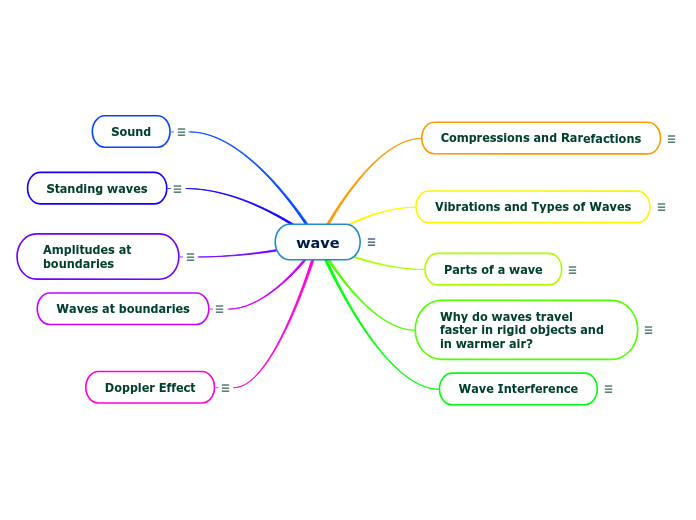
A wave is a kind of oscillation disturbance that travels through space and matter. Wave motions transfer energy from one place to another that requires a vibrating source.
Compressions are regions of high pressure due to particles being close together. Rarefactions are regions of low pressure due to particles being spread further apart. A longitudinal vibration in a gas results in regions where the particles are closer together, called compressions, and regions where they are farther apart, called rarefactions.
Vibrations: If the particles in an object are disturbed, the vibrations created by the disturbance are transferred throughout the object. This transfer of energy by particle vibration is called a mechanical wave. Medium: The material through which a mechanical wave travels. A medium can be a solid, a liquid, or a gas. The medium has to be disturbed by a vibration to set up a mechanical wave. Transverse waves: a wave in which particles vibrate perpendicular to the direction of the flow of energy. For example, an object floating on waves moves up and down. This direction is perpendicular to the direction of the flow of energy which is horizontal. Longitudinal waves: a wave in which the particles vibrate in the same direction as the energy flow. An example of longitudinal waves is sending pulses through a slinky toy.
Wavelength is the distance between corresponding points of two consecutive waves. It is usually denoted by the Greek letter lambda (λ); it is equal to the speed (v) of waves in a medium divided by its frequency (f): λ = v/f. Phase Shift: Two waves can be identical to each other but shifted along the x-axis with respect to each other. A phase shift is a shift of an entire wave with respect to an identical wave along the x-axis, usually by some fraction of a single wavelength. Amplitude: Amplitude is the maximum distance a vibrating particle moves from its equilibrium point or rest axis. Crests and Trough: The crest of a wave is the highest point that it reaches, while the trough of the wave is the lowest point. These are respectively the maximum and minimum amplitudes.Frequency (Hertz/Hz): The number of complete cycles per unit time, usually 1 s. A wave has the same frequency as the vibrating particles that create and sustain it. Frequency is defined as one cycle per second or How many cycles you get in one second.Period (T): the time it takes for any of the vibrating particles in a wave to complete one cycle is called the period (T). or How long it will take for one cycle. Frequency =(number of cycles) /T (in seconds) Period =(number of cycles)/frequency Wave speed: the rate at which a wave is travelling through a medium; also a measure of how fast the energy in the wave is moving. (v=fλ)
Why do waves travel faster in warmer air? • Waves travel faster in hotter gases than in cooler gases because of the increased molecular motion caused by the higher temperature in a hotter gas.Why do waves travel faster in rigid objects? A short answer : More rigid intermolecular forces allow for a faster transfer of energy, and therefore a higher wave speed in a medium. The distances between molecules in solids are very small, it is because solids are more dense as compared to liquids and gases. Because they are packed and close to one another, molecules easily collide/bump into its surroundings. The distances in liquids are shorter than in gases, but longer than in solids. Liquids are more dense than gases, but less dense than solids, so sound travels the second fastest in liquids. The molecules in gases are very far apart, hence, travels the slowest.
Wave Interference: is the phenomenon that occurs when two waves meet while traveling along the same medium. Principle of Superposition: at any point the amplitude of two interfering waves is the sum of the amplitudes of the individual wavesConstructive interference: occurs when two or more waves combine to form a wave with an amplitude greater than the amplitudes of the individual waves. Two sound waves of the same frequency that are perfectly aligned have a phase difference of 0 and are said to be “in phase.” Two waves that are in phase add to produce a sound wave with an amplitude equal to the sum of the amplitude of the two waves. This process is called “constructive interference.”Destructive interference: occurs when two or more waves that are out of phase combine to form a wave with an amplitude less than at least one of the initial waves. If one of the two sound waves of the same frequency is shifted by one-half cycle relative to the other, so that one wave is at its maximum amplitude while the other is at its minimum amplitude, the sound waves are said to be “out of phase.” Two waves that are out of phase exactly cancel each other when added together. This principle, which is used in noise-cancelling headphones, is called “destructive interference.” Both constructive and destructive interference explain many properties of sound in the ocean.
A sound wave, like any other wave, is introduced into a medium by a vibrating object. The vibrating object that creates the disturbance could be the vocal cords of a person, the vibrating string of a guitar or violin. The particles of the medium through which the sound moves vibrates back and forth at a given frequency.The sensation of a frequency is commonly referred to as the pitch of a sound. A high pitch sound corresponds to a high frequency sound wave and a low pitch sound corresponds to a low frequency sound wave. Our ears are capable of detecting sound waves with a wide range of frequencies, ranging between approximately 20 Hz to 20 000 Hz. Any sound with a frequency below the audible range of hearing (i.e., less than 20 Hz) is known as an infrasound and any sound with a frequency above the audible range of hearing (i.e., more than 20 000 Hz) is known as an ultrasound.
Standing waves: an interference pattern produced when incoming and reflected waves interfere with each other; the effect is a wave pattern that appears to be stationary. For example, if you pluck a guitar string, the waves travel back and forth but it looks like it's just moving up and down. The frequency of the wave that produces the simplest standing wave is called the fundamental frequency (f0) or the first harmonic. All standing waves after this require frequencies that are multiples of the fundamental frequency. These additional standing wave frequencies are called the nth harmonic of the fundamental frequency, where n=1 for the fundamental frequency. When a string, such as a violin string, vibrates with more than one frequency, the resulting sounds are called overtones. Points along the medium that appear to be standing still, sometimes described as points of no displacement, are referred to as nodes. There are other points along the medium that undergo vibrations between a large positive and large negative displacement. In other words, these are the points that undergo the maximum displacement during each vibrational cycle of the standing wave. In a way, these points are the opposite of nodes, and so they are called antinodes. First overtone is equal to the second harmonic. When a standing wave is produced in a medium with two fixed ends or open ends, the length of the medium is a whole-number multiples of lambda/2, the first harmonic. When a standing wave is produced in a medium where the medium is fixed at one end and open at the other, the length of the medium is determined by Ln=(2n-1)/4 lambda.
Amplitudes at neither free end nor fixed end boundaries:At boundaries that is neither free-end nor fixed-end, the original wave splits into two waves. If the wave moving along the rope encounters a medium that has a faster wave speed, then the wave splits into two. One wave is reflected and the other is transmitted. The reflected wave and the transmitted are the same but travel at opposite directions. When a wave moves into a slower medium, then the wave splits into two, and one wave is reflected and the other is transmitted. However, the reflected wave in this situation is inverted. Like wise, lets suppose that a wave is passing through
Free end reflections: Ex. a rope loosely tied to a pole. When a crest comes to a free end, the waves reflect back a crest. Similarly if a trough comes to a free end, another trough is reflected back. When the trough reflects back as a trough after the free end, we call it an in phase.Fixed ( or closed ) end reflections: Ex. tying a rope to a pole and holding it where the wave reflects back. When a crest of a wave hits a fixed end, it returns back as a trough after the contact. Likewise, if a trough hits a fixed end, it reflects back as a crest. When it goes and and comes back as the opposite part of the wave, we call it out of phase. A very resourceful video: https://www.youtube.com/watch?v=0mZk2vW5rWU
aWhen the source of waves moves in relation to an observer, the Doppler effect is noted. The Doppler effect is defined as the effect created by a moving source of waves that causes an apparent upward shift in frequency for observers towards the source and an apparent downward change in frequency for observers away from the source. The Doppler effect can be observed for any type of wave - water wave, sound wave, light wave, etc. We are most familiar with the Doppler effect because of our experiences with sound waves. Suppose a police car or emergency vehicle was traveling towards you on the highway. As the car approached with its siren loud, the pitch of the siren sound (a measure of the siren's frequency) is high; and then suddenly after the car passed by, the pitch of the siren sound is much lower. This is an example of the Doppler effect.