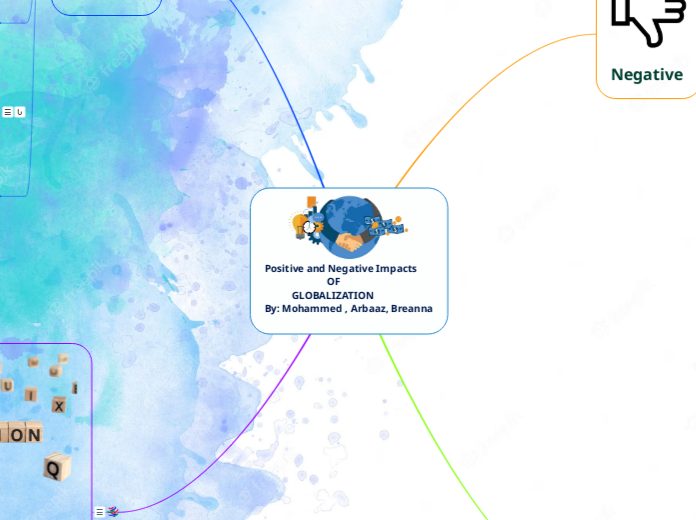
Positive and Negative Impacts
OF
GLOBALIZATION
By: Mohammed , Arbaaz, Breanna
Positive
Increased Trade and Investment
Boosting EconomiesGlobalization has led to increased trade and investment among countries, allowing for the growth and development of economies. Example: The North American Free Trade Agreement (NAFTA) between the United States, Canada, and Mexico has increased trade among the three countries and has resulted in economic growth for all parties involved.
dCultural Exchange
Bridging Cultural Gaps - Globalization has facilitated cultural exchange, allowing people from different parts of the world to learn about each other's cultures, values, and traditions. Example: The rise of social media has made it easier for people from different countries to connect and exchange cultural experiences.
dImproved Technology
Technological AdvancementsGlobalization has led to an increased transfer of technology and knowledge, which has contributed to technological advancements and innovation. Example: The collaboration between international technology companies has led to the development of new and improved products such as smartphones and laptops.
dNegative
Increased Competition
Because of Globalization, local businesses and companies now have to compete with multinational businesses that sell the same or cheaper products at a lower price. The increase in competition can also be related to the target market and production from the company.
dJOB LOSSES
Globalization has led to the outsourcing of jobs to countries with lower labor costs, resulting in job losses in developed countries. Example: The closure of manufacturing plants in the United States and the relocation of these plants to countries with lower labor costs, such as China and India, has led to job losses for American workers.
dWidening Income Inequality
The Rich-Poor Gap - Globalization has led to an increase in income inequality between developed and developing countries, as well as within countries. Example: The increasing income gap between the top 1% of the population and the rest of the population in the United States is an example of the widening income inequality caused by globalization.
dEnvironmental Degradation^
The Cost of Progress - Globalization has led to increased industrialization and production, which has had a negative impact on the environment, including air and water pollution, deforestation, and climate change.Example: The heavy industrialization in China has led to severe air pollution in major cities, such as Beijing and Shanghai.
dOUR OPINION
Globalization refers to the increasing interconnectedness of the world's economies, societies, and cultures through the growth of international trade, investment, and communication. Many people view globalization as a positive phenomenon for several reasons:Economic benefits: Globalization allows countries to specialize in their areas of comparative advantage and trade with other countries, leading to greater efficiency and economic growth. It also attracts foreign investment, creates new job opportunities, and raises living standards.Increased cultural exchange: Globalization promotes cultural exchange and understanding, leading to greater tolerance and respect for different cultures.Improved technology and communication: Globalization has led to rapid advances in technology and communication, making it easier for people to access information and connect with others around the world.Access to a wider range of goods and services: Globalization allows people to access a wider range of goods and services, including exotic and unique products that may not be available in their own countries.Political benefits: Globalization can promote peace and stability by increasing economic interdependence and fostering greater understanding and cooperation between nations.Of course, globalization also has its challenges, such as cultural homogenization, income inequality, and environmental degradation, but overall, many people believe that the benefits of globalization outweigh its costs
CITATION
World Trade Organization (WTO). "WTO." World Trade Organization, www.wto.org/.United Nations Development Programme (UNDP). "UNDP." UNDP, www.undp.org/.International Monetary Fund (IMF). "IMF." International Monetary Fund, www.imf.org/.World Bank. "World Bank." World Bank, www.worldbank.org/.The Globalization Institute. "The Globalization Institute." The Globalization Institute, globalization.org/.Organisation for Economic Cooperation and Development (OECD). "OECD." Organisation for Economic Cooperation and Development, www.oecd.org/.Stiglitz, Joseph E. The Globalization and Its Discontents. W.W. Norton & Company, 2002.
a