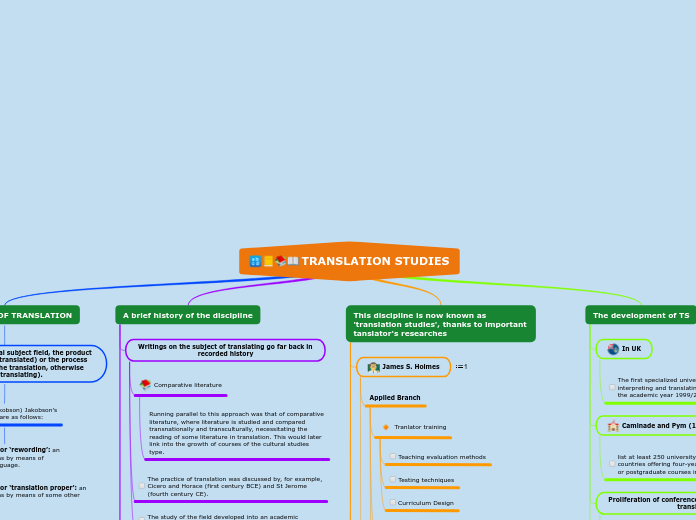
It can refer to the general subject field, the product (the text that has been translated) or the process (the act of producing the translation, otherwise known as translating).
(Roman Jakobson) Jakobson’s
categories are as follows:
Intralingual translation, or ‘rewording’: an interpretation of verbal signs by means of
other signs of the same language.
Interlingual translation, or ‘translation proper’: an interpretation of verbal signs by means of some other language.
Intersemiotic translation, or ‘transmutation’: an interpretation of verbal signs by means of signs of non-verbal sign systems.
References
Writings on the subject of translating go far back in recorded history
Comparative literature
Running parallel to this approach was that of comparative literature, where literature is studied and compared transnationally and transculturally, necessitating the reading of some literature in translation. This would later link into the growth of courses of the cultural studies type.
The practice of translation was discussed by, for example, Cicero and Horace (first century BCE) and St Jerome (fourth century CE).
The study of the field developed into an academic discipline only in the second half of the twentieth century.
Procedures and methods
The translation workshop
Based on I. A. Richards's reading workshops and practical criticism approach that began in the 1920s , these translation workshops were intended as a platform for the introduction of new translations into the target culture and for the discussion of the finer principles of the translation process and of understanding a text.
The direct method or communicative approach
This approach places stress on students' natural capacity to learn language and attempts to replicate 'authentic' language learning conditions in the classroom.
The grammar-translation method
This method centered on the rote study of the grammatical rules and structures of the foreign language. These rules were both practiced and tested by the translation of a series of usually unconnected and artificially constructed sentences exemplifying the structure(s) being studied, an approach that persists even nowadays in certain countries and contexts.
Contrastive analysis
The contrastive approach heavily influenced other studies, such as Vinay and Darbelnet's (1958) and Catford's (1965), which overtly stated their aim of assisting translation research. Although useful, contrastive analysis does not, however, incorporate sociocultural and pragmatic factors, nor the role of translation as a communicative act.
References
James S. Holmes
Applied Branch
Tranlator training
Teaching evaluation methods
Testing techniques
Curriculum Design
Translation aids
Grammars
Dictionaries
CAT tools
Machine translations
Translation software
Online databases
Use of internet
Translation criticism
Revision
Evaluation of translations
Reviews
Pure Branch
Descriptive
Product oriented
Process oriented
Function oriented
Theoretical
General
Partial
Subtopic
Subtopic
Subtopic
Subtopic
Mary Snellin
In the first edition of her Translation Studies: An Integrated Approach, was writing that 'the demand that translation studies should be viewed as an independent discipline . . . has come from several quarters in recent years' (Snell-Hornby 1988).
In the breathtaking development of translation studies as an independent discipline' and the 'prolific international discussion' on the subject.
Mona Baker
In her introduction to The Routledge Encyclopedia of Translation (1997a), talks effusively of the richness of the 'exciting new discipline, perhaps the discipline of the 1990s'
Linguistic-oriented approach to the study of translation
Jean-Paul Vinay and Jean Darbelnet (1958) produced a contrastive approach that categorized what they saw happening in the practice of translation between French and English
Alfred Malblanc (1963) did the same for translation between French and German
Georges Mounin's (1963) examined linguistic issues of translation
Eugene Nida (1964a) incorporated elements of Chomsky's generative grammar as a theoretical underpinning of his books, which were initially designed to be practical manuals for Bible translators
References
In UK
The first specialized university postgraduate courses in interpreting and translating were set up in the 1960s. In the academic year 1999/2000
Caminade and Pym (1995)
list at least 250 university-level bodies in over sixty countries offering four-year undergraduate degrees and/ or postgraduate courses in translation
Proliferation of conferences, books and journals on translation
Long-standing international translation studies journals such as Babel (the Netherlands), Meta (Canada) have now been joined by, amongst others, Across Languages and Cultures (Hungary), Literature in Translation (UK), Perspectives (France), Target (Israel/Belgium), The Translator (UK). Turjuman (Morocco).
References