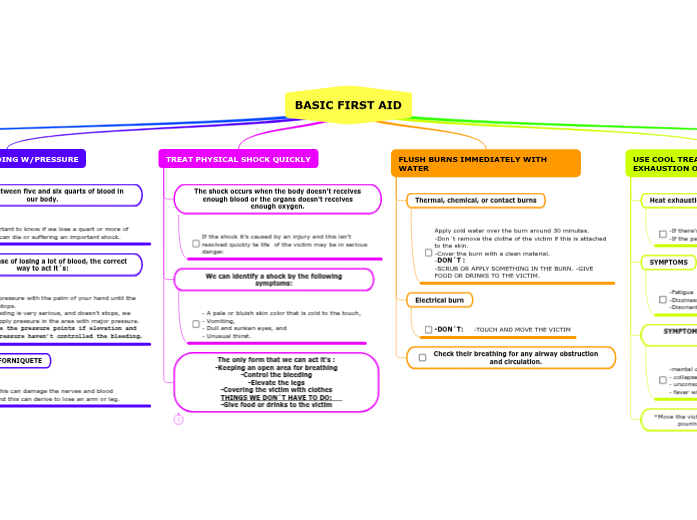
BASIC FIRST AID
FIRST AID KIT CHECKLIST
It's important put the adequate things/instrumental in each aid kit.
These kits can be made or can be buy it ready-made.
In these kits we can found:
Medical exam gloves;
• Adhesive bandages available in a large range of sizes for minor cuts, abrasions
and puncture wounds ;
• Butterfly closures to hold wound edges firmly together;
• Rolled gauze for securing dressings and/or pads to hard-to-bandage
wounds and allow freedom of movement;
• Nonstick sterile pads which are soft and super absorbent for bleeding and
draining wounds, burns, and infections;
• First aid tapes which are adhesive, waterproof and clear. Cloth and paper
first aid tapes recommended for sensitive skin, because they are less
irritating than adhesive tapes;
• Tweezers;
• First aid cream;
• thermometer;
• an analgesic or equivalent; and an ice pack.
CONTROLBLEEDING W/PRESSURE
We have between five and six quarts of blood in our body.
It´s important to know if we lose a quart or more of blood we can die or suffering an important shock.
If it is the case of losing a lot of blood, the correct way to act it´s:
Applying pressure with the palm of your hand until the bleeding stops. If the bleeding is very serious, and doesn't stops, we have to apply pressure in the area with major pressure. *Only use the pressure points if elevation and direct pressure haven’t controlled the bleeding.
NEVER USE A FORNIQUETE
Because this can damage the nerves and blood vessels.And this can derive to lose an arm or leg.
TREAT PHYSICAL SHOCK QUICKLY
The shock occurs when the body doesn't receives enough blood or the organs doesn't receives enough oxygen.
If the shock it's caused by an injury and this isn't resolved quickly te life of the victim may be in serious danger.
We can identify a shock by the following symptoms:
- A pale or bluish skin color that is cold to the touch,
- Vomiting,
- Dull and sunken eyes, and
- Unusual thirst.
The only form that we can act it's : -Keeping an open area for breathing -Control the bleeding -Elevate the legs -Covering the victim with clothes THINGS WE DON´T HAVE TO DO: -Give food or drinks to the victim
FLUSH BURNS IMMEDIATELY WITH WATER
Thermal, chemical, or contact burns
Apply cold water over the burn around 30 minutes. -Don´t remove the clothe of the victim if this is attached to the skin. -Cover the burn with a clean material. -DON´T : -SCRUB OR APPLY SOMETHING IN THE BURN. -GIVE FOOD OR DRINKS TO THE VICTIM.
Electrical burn
-DON´T: -TOUCH AND MOVE THE VICTIM
Check their breathing for any airway obstruction and circulation.
USE COOL TREATMENT FOR HEAT EXHAUSTION OR STROKE
Heat exhaustion can be caused:
-If there's poor air circulation. -If the person poorly adjusts to very warm temperatures
SYMPTOMS
-Fatigue -Dizziness -Disorientation
SYMPTOMS IF the heat stroke is a much more serious
-mental confusion - collapse,
- unconsciousness,
- fever with dry, mottled skin.
*Move the victim to a cool place out of the sun and begin pouring cool water over the victim’s body.
RESPOND APPROPRIATELY TO THE FORM OF POISONING
Get the victim away from the poison
Give the treatment appropriate depends the tipe of poison.
poison in solid form: remove it from the victim’s mouth using a clean cloth. If the poison is gas: protect ourselves and give them fresh air. If the poison is corrosive to the skin: removes the clothes. IMPORTANT KEEP THE CALM.