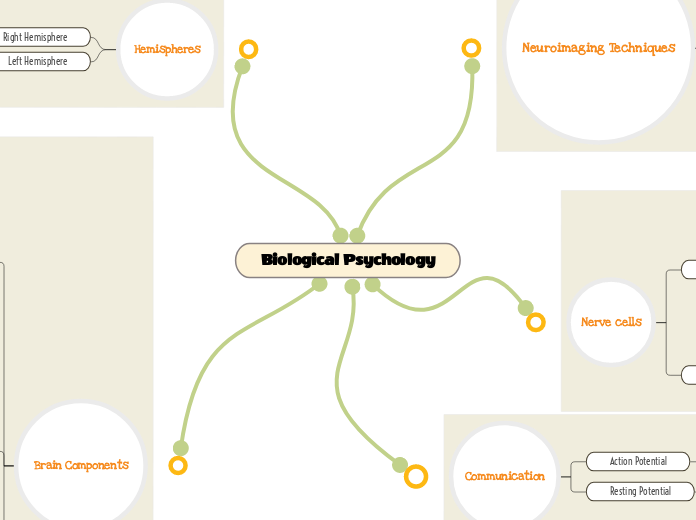
Neuroimaging Techniques
CAT/CT Scans
Series of x-rays used to assess a brain injury.
MRI
Detailed 3D images of the brain that allows precise mapping of the physical shape of the brain.
PET
Allows neuroscientists to view the structures of the brain and see which parts of the brain are active during specific events.
fMRI
Nerve cells
Neurons
Cells that specialize in communication.
Soma: The body of the nerve cell. Within the soma contains a nucleus where the proteins that make up our cells are manufactured.
Dendrites (Receptors): Branches coming off from the soma. They act as receptors for signals traveling from other neurons.
Axon (Senders): Sends information to other cells. The axon is covered by a fatty tissue called myelin sheath.
Myelin sheath: Glial cells wrapped around axons that act as insulators of the neurons signal.
Glial Cells
Also known as neuroglia. They guide neurons towards making connections. They do not make connections themselves. They promote neuronal health and influence the function of the brain.
Communication
Action Potential
When neurons are firing and creating synapses.
Resting Potential
When neurons are not firing and creating synapses.
Hemispheres
Right Hemisphere
Creative, artistic, emotional
Left Hemisphere
Academic, verbal, analytical
Brain Components
The Hind Brain
Brain Stem
- Brain stem consists of medulla oblongata, pons, and the mid brain.
- The medulla oblongata is where the spinal cord meets the brain stem. This is responsible for functions such as heartbeat and respiration.
- Pons (acts as a bridge form the medulla oblongata to other brain regions. Responsible for motor control and other sensory analysis)
- The mid brain is responsible for processing vison, for hearing, and for eye movement.
Cerebellum
- The cerebellum is Greek for little brain and it coordinates movement and balance.
The Limbic System
Thalamus
Conveys sensory information to the cortex and integrates or senses. Smell goes straight to the cortex.
Hypothalamus
Oversees hormone release and the automatic nervous system (The 4 Fs – Fight, flight, feed, and fornicate)
Amygdala
Brains alarm system, fight or flight response, plays a major role in the control of emotions, forms unconscious memories based on emotional responses.
Hippocampus
Holds memories from the immediate past and dispatches memory to cortex. Long term memory. Short term to turned into long term. Hippocampus is no longer needed. Procedural things,
The Cerebral Cortex
Occipital Lobe
Processes visual information.
Temporal Lobe
Processes auditory stimuli.
Parietal Lobe
Processes touch information and integrates the senses.
Frontal Lobe
Responsible for motor planning, language, decision making, and many other things.
Prefrontal Cortex
Not fully developed until 25 years old, responsible for impulse control and executive functions.