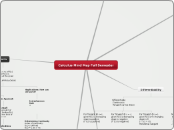
Calculus Mind Map Fall Semester
Drawing Tangents
Can Draw Tangent
- Continuous on f(x)
Not Differentiable
& can draw tan.
Slope is Undefined
f(x) is not changing
f'(x) is undefined
Differentiable
& can draw tan.
Positive Slope
f(x) is increasing
f'(x) is positive
Negative Slope
f(x) is decreasing
f'(x) is negative
Slope = 0
f(x) is not changing
f'(x) = 0
Cannot Draw Tangent
- Discontinuous on f(x)
(Both Non-Removable
& Removable)
Can't draw tangent
anywhere f(x) is undefined
Integrals
Indefinite Integral
Notation
f(x) dx
Anti-Derivatives are
typically denoted as F(X)
Relationship To Derivative
Integrals are also known as
anti-derivatives, because say f(x) dx = g(x)
then f(x) is the derivative of g(x)
Integral Rules
Constant Term: a dx = ax + C
Power Term: axn dx = axn+1 / (n+1) + C
eu du = eu + C
1 / u du = lnlul + C
au du = (au / ln(a)) +C
du / lulSQRT(u2-a2) = (1/a) sec-1(lul/a) +C
du / SQRT(a2-u2) = sin-1(u/a) +C
1 / (u2+a2) du = (1/a)tan-1(u/a) +C
cosx dx = sinx +C secxtanx dx = secx +C
sinx dx = -cosx +C cscxcotx dx = -cscx +C
sec2x dx = tanx +C csc2x dx = -cotx +C
Why +C?
Consider the derivative of 2x + 2,
it is just 2. The constant ( + 2)
became a 0 when we took the
derivative, we’d get the same
result if it were +3 or +4596.
So when we take the
ANTI-DERIVATIVE, we have to
account that the constant can be
anything, and we do that with a +C.
Applications
Taking the integral of an acceleration
equation, gets you the velocity equation.
Taking the integral of a velocity equation,
gets you its position equation.
Taking the integral of any rate equation,
get you an equation where you can find
the exact amount at x.
Definite Integral
Notation
f(x) dx
Definite Integral vs. Indefinite Integral
The biggest difference between the two is
that an indefinite integral gets you an
equation, while a definite integral gets
you an actual numerical answer
How to Evaluate Definite Integrals
-Graphing the equation and creating
geometric shapes and using area
equations (like A of square = side^2)
to find the area under the curve.
However you must make sure that
these are actual, perfect geometric shapes,
and once you do this gets you an
EXACT answer.
- Riemann Summs: However, can be a
pain to evaluate w/o a calculator, and
also results in only an approximate answer.
- Fundamental Theorem of Calculus:
Must be given the equations to work
with, and can be near impossible/take
forever if the equations are extremely
complicated. However, produces an exact
value (unless there are decimals).
- Calculator FnInt: Obviously calculator
needs to be allowed, and equation must
also be given. Gives you an exact value.
Applications
Taking a definite integral of an
acceleration equation gets you
the net change in velocity from
a to b. Taking a definite integral
of a velocity equation gets you
the net change in position from
a to b. Taking the integral of a
rate equation (say for example
rate of water being pumped into
a tank), you get the exact
amount of water that was
pumped from time a to b.
Extensions
Average Value
Theorem
Avg Value
= 1/(b-a) * f(x) dx
This gets you the average
y-value on the interval
from a to b.
Area?
First off, a definite integral
of an equation, finds the
‘area under the curve’ that
we’ve heard so much of.
On top of that integrals
can be used to find the area
of a region between two
curves = (f(x) - g(x)) dx
(Top equation minus
bottom equation)
Volume
The Volume of a solid
resulting from a region
between curves being
rotated around an axis
can be found with
Disk Method: V = pi[r(x)]2 dx
where r(x) = f(x) - axis of rotation
Washer Method: V = pi[R2(x) - r2(x)]
where R(X) = (outer eqn) - (axis) &
r(x) = (inner eqn) - (axis).
OR Solids with geometric cross-sections
where V = (area of cross-section)dx
Derivative of Anti-Derivative
& FTC
Say we want to take the derivative
of the definite integral x dx. FTC
says the evaluation of that integral
would be F(X) - F(a), and we want
the derivative of that. Well since
F(a) is a constant that becomes zero,
and we’re left with just F’(x) which is
basically how we take the derivative
of an anti-derivative.
Applications
In addition to everything mentioned
in the other applications segments,
there are a couple more real life
applications. My personal favorite is
the amusement park-type problem
where you have two equations which
give the rate of people entering, and
people leaving (or like the raffle
question). Water being pumped into
a tank at a rate, and also pumped
out is another common situation.
Solving
Differentiable
Equations
What is it?
The 'undoing'
of implicit
differentiation
Steps to Solve:
Differential Equations
1. Separate the Variables
2. Integrate each side
(Only put +C on one side)
3. Rework equation around
until you get y = f(x)
Slope Fields
What are they?
Using a differential
equation, a graph of
miniature tangent lines
are made. This is the
slope field.
How can we
use them?
If enough miniature
tangents are plotted,
an image is formed!
This image is the
the shape of the
ORIGINAL
function! We know
what the original
function looks like
without actually
doing any actually
integration.
Differentiability
Differentiable
-Continuous
-Tangent can be drawn
For Tangent @ x=c,
given f(x) is increasing
slope is positive
(f '(c) is positive)
For Tangent @ x = c,
given f(x) is decreasing
slope is negative
(f '(c) is negative)
For Tangent @ x=c
given f(x) isn't changing
slope is 0
( f '(c) = 0)
Horizontal Tangent
Not Differentiable
-Tangents w/o
Numerical Slope
Not Differentiable
& Discontinuous
- Tangent cannot
be drawn
- f'(x) is undf.
Not Differentiable
& Continuous
For Tangent @ x=c
given f(x) isn't changing
slope is undf.
(f '(c) is undefined)
Vertical Tangent
Continuity & Discontinuity
Discontinuity
any rule of continuity violated
Removable Discontinuity
- Limit exists
- Hole in graph
Non-Removable Discontinuity
- No Limit Exists; NLE
- Step/Jump
- Vertical Asymptote
Continuity
Rules of Continuity:
f(a) is defined
limit of f(x) as x->a exists
f(a) = L where x->a
Limits
What is it?
The limit as x->c of f(x)
is the y-value f(x) is
approaching at the given
x-value, c.
KEY WORD: APPROACHING
How do we find it?
Graphical Approach
Looking at the graph
to determine L
Hole or Not
When there is a hole
or if the entire function
is continous, the #1 rule
is to 'Stay on the graph.'
If you follow this rule,
the y-value at c is L,
the limit.
Non-Removable
Discontinuities
If there is a non-
removable discon-
tinuity at c, then NO
LIMIT EXISTS (NLE)
Examples include:
Steps, Jumps &
Vertical Asymptotes
Horizontal
Asymptotes
If there is a HA
@ y = a, then we
know that the limit
as x -> infinity of
f(x) is equal to a.
No Limit Exists
The universal way to
tell if No limit exists, is
to check to see if the
right side limit is the same
as the left side limit. If they
are, then the limit exists,
if they aren't then no limit
exists.
Algebraic Approach
Simple Stuff
On the simplist of
graphs, finding f(c)
will find the limit of
f(x) as x->c
Complications
No Limit Exists
If when finding f(c)
you get an undefined
answer (ex. 4/0) then
no limit exists!
No Limit Exists
The universal way to
tell if No limit exists, is
to check to see if the
right side limit is the same
as the left side limit. If they
are, then the limit exists,
if they aren't then no limit
exists. This is important when
dealing with piece-wise
functions, where you have
equations for a left side &
a right side.
Indeterminant
However if you get
f(c) = 0/0, this is
an indeterminant case.
You must find the
extended function by
tweaking f(x) & then
finding the limit as x->c
of the adjusted function.
OR use L'Hopital's Rule:
Applications: How can
we use it?
Instantaneous
Rate
=
Determining Continuity
Rules of Continuity:
f(a) is defined
f(a) = L as x->a
limit as x-> a exists
Creating a Derivative
Definition of Derivative:
Defining e
Calculating a
Riemann Sum w/
infinite rectangles
Derivatives
Start with f(x)
Apply Definition of Derivative
or Derivative Rules (listed)
First Derivative f'(x)
-Equation denoted f'(x)
-Finds slope of tangent
at a point on f(x)
-Finds instant rate
When f'(x) = ?
f'(x) is positive
-f(x) is continuous
-f(x) is increasing
-can draw tangent
f'(x) is negative
-f(x) is continuous
-f(x) is decreasing
-can draw tangent
f'(x) = 0
-f(x) is continuous
-f(x) is not changing
-can draw tangent
f'(x) is undf.
f(x) is Continuous
-f(x) is not changing
-vertical tangent
When f'(a) = 0 or is undefined
there is an EVP @ x=a on f(x)
EVP: Extreme Value Point
EVPs are maxs or mins
also known as turning points
Use Derivative sign chart to
determine max or min
Gradual Change
-Horizontal Tan
-When f'(x) = 0
Abrupt Change
-Vertical Tan
-When f'(x) is undf.
f(x) is Discontinuous
-cannot draw tangent
Apply Definition of
Derivative a 2nd time
or Derivative Rules again
Second Derivative f''(x)
-Equation denoted f''(x)
-used to find shape of f(x)
either concave up or
concave down
When f''(x) = ?
f''(x) is positive
-f(x) is c.c. up
f''(x) is negative
-f(x) is c.c. down
When f''(a) = 0 or is undefined
there is a PI @ x=a on f(x)
PI: Point of Inflection
A point where f(x) changes shape
Use derivative sign chart to
determine the segments of f(x)
that are c.c. up & c.c. down