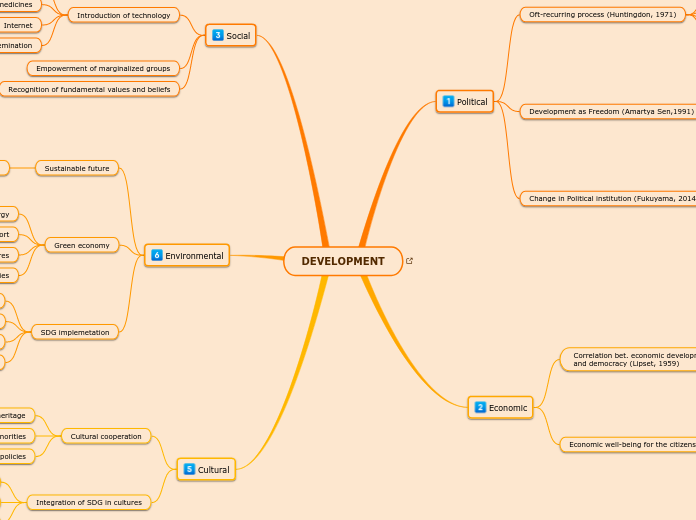
Oft-recurring process (Huntingdon, 1971)
Rationalization
National integration
Democratization
Mobilization or participation
Development as Freedom (Amartya Sen,1991)
Removes poverty
Removes tyranny
Removes poor economic opportunities
Removes neglect of public facillities
Removes overactivity of the repressive state
Change in Political institution (Fukuyama, 2014)
State is strong and modern
Follows rule of law
Accountable
Correlation bet. economic development and democracy (Lipset, 1959)
Increases the level of education
Shapes every segment of social stratification structure
Appearance of myriad interest organizations
Economic well-being for the citizens
Price stability
High- employment
Strong monetary and fiscal policies
Firm regulation of budgetary institutions, trade and tax policies
Introduction of technology
IT outsourcing
Advancement of medicines
Internet
Information dissemination
Empowerment of marginalized groups
Recognition of fundamental values and beliefs
Sustainable future
Resource efficient production
Managing raw materials in a sutainable manner
Managing energy and water to minimize waste
Reduce the cost of production
Green economy
Renewable energy
Low-carbon transport
Energy-efficient infrastructures
Clean technolgies
SDG implemetation
SDG 6: Clean and water sanitation
SDG 7: Clean and affordable energy
SDG 11: Sustainable cities and communities
SDG 13: Climate action
Cultural cooperation
Support art and heritage
Protect cultural minorities
Stable cultural policies
Integration of SDG in cultures
SDG 10: Reduced inequalities
SDG 16: Peace, justice and strong institutions
SDG 5: Gender equality