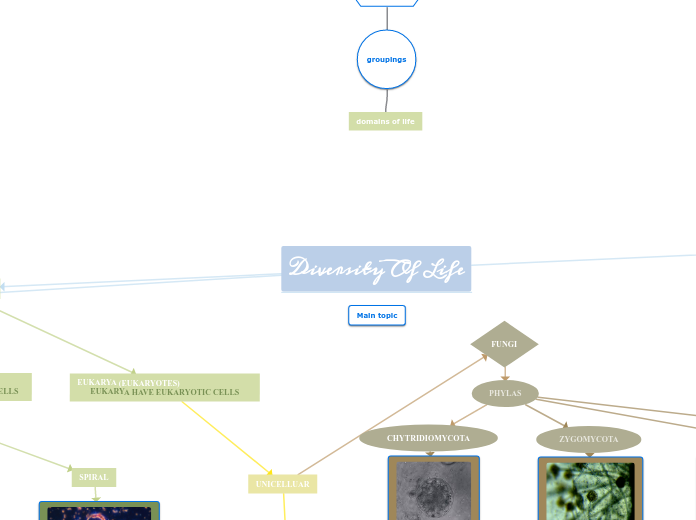
Diversity Of Life
Main topic
DOMAINS OF LIFE
ARCHAEA (ARCHEABACTERIA) ARCHAEA ARE PROKARYOTIC CELLS
EUBACTERIA EUBACTERIA ARE PROKARYOTIC CELLS
EUKARYA (EUKARYOTES) EUKARYA HAVE EUKARYOTIC CELLS
UNICELLUAR
ANIMAL LIKE PROTISTS
PROTISTA
Must "eat" or ingest food
PHYLAS
ZOOFLAGELLATES
Moves by beating long whip simililar to a flagella
SARCODINES
Moves using pseudopods "false feet"
stretch towards prey
CILIATES
Tiny hair like projections that beat through water
SPOROZOAN
TINTINNID
DIPLOMONAD
AMOEBA
PLASMODIUM
PLANT LIKE PROTISTS
Get energy from sunlight through photosynthesis
PHYLAS
FUNGUS LIKE PROTISTS
Digesting food externally then absorbing it
PHYLAS
ACELLUAR SLIME MOLDS
RED RASPBERRY SLIME MOLD
CELLULAR SLIME MOLDS
DICTYOSTELIUM
WATER MOLDS
WATER MOLD
EUGLENOIDS
EUGLENA
DINOFLAGELLATES
DINOPHYCEAE
DIATOMS
ACHNANTHES
RHYDOPHYTA
CORALLINE ALGAE
MORPHOLOGIES
SPHERES (COCCI)
STREPTOCOCCUS
RODS (BACILLI)
BACILLUS ANTHRACIS
SPIRAL
SPIRILLIUM
EURYARCHAEOTA
FUNGI
PHYLAS
CHYTRIDIOMYCOTA
CHYTRID
reproduces asexually, through the use of zoospores
ZYGOMYCOTA
RHIZOPUS (BLACK BREAD MOLD)
reproduce asexually by producing sporangiospores. Can reproduce sexually when environment conditions become unfavorable
ASCOMYCOTA
COOKEINA
Usually reproduce by budding (asexual)
BASIDIOMYCOTA
RUSSULA EMETICA
reproduce asexually by either budding or asexual spore formation
Rely on other organisms to distribute them
PLANTS
BRYOPHYTES
Waxy cuticle helps to protect the plants tissue from drying out
Gametangia provides protection for the plants gametes against drying out
PHYLAS
Marchantiophyta (LIVERWORTS)
LIVERWORT
Bryophyta (MOSSES)
SPHAGNUM MOSS
Anthocerotophyta (HORNWORTS)
SUNFLOWER
SEEDLESS VASCULAR
Plants that grow in dry areas often have deep root systems
Plants growing in areas with abundant water tend to have shallower root systems
PHYLAS
FERNS
BOSTON FERN
HORSETAILS
ROUGH HORSETAIL
LYCHOPHYTES
CLUB MOSSES
WHISK FERNS
WHISK FERN
GYMNOSPERMS
PHYLAS
CONIFEROPHYTES
JUNIPER JUNIPERUS
CYCADS
CYCAD
GINKOPHYTES
GINKGO BILOBA
GNETOPHYTES
EPHEDRA VIRDIS
ANGIOSPERMS
developed flowers and fruit as ways to attract pollinators and protect their seeds
RAFFLESIA- ASIA FLOWER
ANIMALS
PHYLAS
MULLUSCA
OCTOPUS
PORIFERA
SPONGES
CNIDARIA
BLUE JELLYFISH
PLATYHELMINTHES
TAPEWORM
NEMATODA
ROUNDWORM
ANNELIDA
EARTHWORM
ARTHROPODS
CRUSTACEANS
MYRIAPODA
CHELICERATA
ARACHNIDA
SUN SPIDER
DIPLOPODA
CHILOPODA
CENTIPEDE
MILLIPEDE
INSCETA
HEXAPODA
FLY
CHORDATES
VERTEBRATA
TUNICATA
CEPHALOCHORDATA
AMPHIBIANS
REPTILES
MAMMALS
BIRDS
FROG
replaced gills with another respiratory organ, the lungs
Eyelids adpat to vision outside of water
Skin that is able to retain moisture
MILK SNAKE
Dry skin covered in scales which minimizes water loss
Eggs have shells for protection on land
Strong body to catch prey
POLAR BEAR
Mammals in colder climates have insulating layers
Mammals in drier conditions have special adaptations to kidneys and sweat glands
Hibernation, Estivation
PELICAN
Some birds have long toes to help with weight distribution while walking over reeds or lilypads
Some birds have lobate feet with help both methods of locomotion
Foot structure that allows them to grab branches
MONOTREMES (LAY EGGS)
MARSUPIAL (BABIES ARE NOT FULLY DEVELOPED)
PLACENTAL MAMMALS(IN MOTHER UNTIL IT CAN FUNCTION ON ITS OWN )
marsupials carry young in pouch
completes embryo development inside mother, nourishes embryo using placenta
ORDERS
RODENTIA
gnawing mammals
SQUIRREL
ARTIODACTYLA
hoofed mammals, odd number of toes
SHEEP
PROBOSCIDEA
have trunks, tusks
AFRICAN ELEPHANT
LEGEND
kingdoms
phylas
subphyla
groupings
domains of life