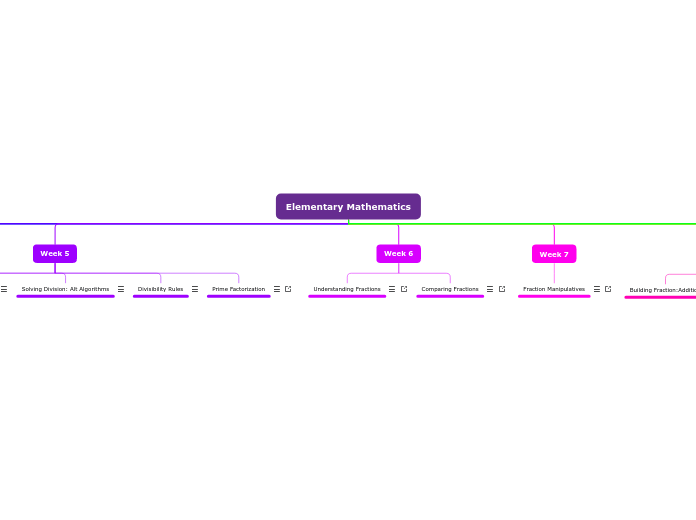
Elementary Mathematics
Week 1
Syllabus and learning material overview
Ploya's 4 Step Problem Solving Process
Pig and chicken problem solving questionUnDevCarLoUnderstand the problem. What does the problem say? Break it down.Develop a plan. Relate to prior knowledge. Find the similarities and the differences. Brainstorm.Carry out the plan. Look back to see if your answer makes sense. Check the answer key, is it reasonable? Solving methodsGuess/CheckDiagramsListsAlgorithms
aWeek 2
Build Addition with Blocks
Base Ten Blocks
Flats, Longs, UnitsHow to draw: Flats (100) are a square, longs (10) are a line, and units (1) are dots.
aConverting bases
We learned to convert base ten to other bases.Bases in any other number than 10:Base four means it takes four units to convert to a long and four units to convert to a flat.Base eight means it takes eight units to convert to a long and eight longs to convert to a flat.Example: 25 to the base of six25 is drawn as 4 longs and 1 unit = 41 base six14 to base twelve1 long and 2 units = 12 base twelve
aAddition solving
Examples:23 to base six + 14 to base six2 longs and 3 units + 1 long and 4 units= 3 longs and 7 units, since our base is six we can't have any numbers higher than six. It is then converted to 4 longs and 1 unit equaling 41.243 to base seven + 316 to base seven2 flats, 4 longs, and 3 units + 3 flats, 1 long, and 6 units= 5 flats, 5 longs, and 9 units. Nine is greater than 7 so it is converted to 5 flats, 6 longs, and 2 units equaling 562.
Week 3
Solve Addition Altern. Algorithms
Expanded formBased on mathExpandableNOT efficient36+13 30+6+ 10+3 40+9= 491368+2471000+300+60+8 + 200+40+7 1000+500+100+15= 1615Left-to-RightBased on mathExpandableEfficient45+2360+8=6847+2860+15=75243+146300+80+9=389Friendly Numbers- numbers that end in zero &Trading OffEfficientExpandableBased on Math32+58Take 2 from 32 and give it to 58 making 30+60=90or take 8 from 50 and give to 32 making 40+50=90364+136Take 4 from 364 and give it to 136 making 360+140Then give 40 from 140 and give it to 360 making 400+100=500ScratchEfficientExpandableSomewhat based on math6+7 16+ 73 13 154+ 393 93LatticeEfficientExpandableNOT based on math
aBuild Subtraction with Blocks
Tens Block
Best way to say a problem5-2 would be 5 take away 2*give a command 7-3 would be 7 take away 3on board 7 units off board 3 unitsIndividually take away units off board as well as units on the board till left with 4 units on the board = 456-23on board- 5 longs and 6 unitsoff board- 2 longs and 3 unitsLeft with 3 longs and 3 units on the board = 3323-8on board- 2 longs and 3 unitsoff board- 8 unitsTake away 3 units then have to exchange a long from 23 to 10 units then can take away additional 5 unitsLeft with 1 long and 5 units = 15227-145on board- 2 flats, 2 longs, and 7 unitsoff board- 1 flat, 4 longs, and 5 unitsTake away 1 flat and 5 units then have to exchange a flat for 10 longs then can take away 4 longsLeft with 8 longs and 2 units = 82
aOther Bases
4 base six - 1 base sixon board- 4 unitsoff board- 1 unitLeft with 3 units = 3 base six22 base five - 14 base fiveon board- 2 longs and 2 unitsoff board- 1 long and 4 unitsTake away 2 units and 1 long then have to exchange a long from 22 for 5 units since we are in base 5 then can take away 2 more units and are left with 3 units = 3 base five321 base six- 132 base sixon board- 3 flats, 2 longs, and 1 unitoff board- 1 flat, 3 longs, and 2 unitsTake away 1 flat then 1 unit, you then have to exchange a long from 321 to 6 units since we are base six then can take away 2 longs then need to exchange 1 flat from 321 for 6 longs then can take away 1 more long and are left with 1 flat, 4 longs, and 4 units = 144 base six
Week 4
Show Subtraction
Ten Blocks
To show subtraction, circle group you are taking away and draw an arrow.Arrow represents taking awayExample: 46-15Draw 4 longs and 6 units Circle 1 long and draw an arrow then circle 5 units and draw an arrowDraw a X through an object to show you had to exchangeExample 52-25Draw 5 longs and 2 unitsCircle 2 longs and draw an arrowPut a X on a long and draw 10 units in its placeThen circle 5 units and draw an arrow324-146Draw 3 flats, 2 longs, and 4 unitsCircle 1 flat, draw an arrowPut a X on a flat and draw 10 longs in its place, circle 4 longs and draw an arrowPut a X on a long and draw 10 units in its place, circle 6 units and draw an arrow
Other Bases
Same concept as ten blocks except you have to pay attention to what base you're inExample32 base six - 4 base sixDraw 3 longs and 2 unitsDraw a X on a long and exchange for 6 units since we're in base sixCircle 4 units and draw an arrowLeft with 24 base six421 base five - 143 base fiveDraw 4 flats, 2 longs, and 1 unitCircle 1 flat and draw an arrowDraw a X on a flat and exchange for 5 longs since we are in base fiveCircle 4 longs and draw an arrowPut a X on a long and exchange for five unitsCircle 3 units and draw an arrowLeft with 223 base five
Solving Subtraction Altern. Algorithms
Expanded FormExpandableBased on MathNOT efficientExamples46 - 24 40+3-(20+7) 20 40+6-(20+4) 20+2 = 2243 - 27 40+3-(20+7) 20 10+10+3 -7 10+3+3 = 16425 - 168 400+20+5-(100+60+8) 300 200+100+20+5 -60 200+40+20+5 10+10 -8 200+40+10+2+5 = 257Other Bases32 base six - 14 base six 30+2 base six-(10+4) 20 10+6+2 -4 10+2+2 = 14 base six421 base five - 243 base five 400+20+ 1 base five-(200+40+3) 200+50+20+1 100-40 100+10+20+1 100+5+20+1 -3 100+2+20+1 = 123 base fiveLeft-to-RightExpandableEfficientBased on MathExamples96-35 = 60+1= 61256-123= 100+20+4=124631-346 = 300-40 260-6=254+31=285Other Bases53 base seven - 25 base seven50-20= 30-5 20+7-5 20+2+5= 25 base seven320 base five - 142 base five300-100= 200 100+50 -40 100+10-2 5-2=3 100+0+3 = 103 base fiveEqual Addends ExpandableEfficientBased on MathExamples64 - 38Turn 2nd number to a friendly number64 - 38+2 +2 66 - 40 = 26600 - 143-1 -1 599 - 142 = 457Other Bases53 base seven - 25 base seven+2 +2 55 base seven - 30 base seven = 25 base seven320 base five - 142 base five+3 +3 323 base five - 200 base five = 123 base five500 base eight - 346 base eight -1 -1 477 base eight - 345 base eight = 132 base eight
aMultiply Using Base Ten Blocks
Best way to say problem:3 times 43 is the number of groups and 4 is what's insideGreater than 10 make a rectangle10 times 12Off board10 units high and 12 units longFill in on board and add all up
aShow Multiplication
Smaller than 10 use groupsExample3 times 4 3 circles with 4 units insideLarger numbers use an array12 times 14Along top 1 long and 4 units |___10____|_._|_._|_._|_._|Alongside 1 long and 2 units |___10____|_._|_._|Where there is a line, draw a line straight through the rectangle, shapes will appearAdd up shapes1 flat, 6 longs, and 8 units = 168
Multiplication Automaticity
Multiplication Order1st- 1, 2, 5, 102nd- 3, 9, doubles3rd- 4, 6, 7, 8Ways to practice:Flash cardsGroup 1- 1, 2, 5, 10Group 2- 3, 9, doublesGroup 3- 4, 6, 7, 8Times TablesTimed tests- if used, use results to show progress, not achievement.GamesConcentration- matching, pairs
Solve Multiplication Altern. Algorithms
Expanded FormExpandableBased on MathNOT efficientExamples23 times 45 20+3*40+5 800+120100+15 900+135 = 1035236 times 153 200+30+6*100+50+3 600+90+1810000+1500+30020000+6000+600 30600+7590+918 = 38208Left-to-RightExpandableEfficientBased on MathExamples38 times 26 38 *26 30(20)=60030(6)= 1808(20)= 1608(6)= 48 =988273 times 454200(400)=80000200(50)= 10000200(4)= 80070(400)= 2800070(50)= 350070(4)= 2803(400)= 12003(50)= 1503(4)= 12 123942Area ModelExpandableEfficientBased on MathLattice ExpandableEfficientNOT based on math
Week 5
Build Division Base Ten Blocks
Examples12 divided by 312 is the pile of units and 3 can be the number of groups or number of items inside of the group*Use number of groups for smaller numbers*Use number of items inside group for larger numbersYou will draw 3 circles and count an even amount of units in each oneThen see how many are in 1 group.The answer is 417 divided by 517 is number of items and 5 is the number of groupsDraw 5 groups and evenly distribute the 17 units You'll have 3 units in each circle with 2 left over as your remainderThe answer is 3 and 2 over 5With some problems will you have to exchange flats for longs or longs for units to be able to evenly distribute Example 63 divided by 1263 is the number of items and 12 is the number of items inside You'll need to break a long for 10 units to be able to make 4 groups of 12 and have 3 units as your remainderThe answer will be 4 and 3 over 12
aShow Division
Draw DiagramsExamples25 divided by 4Draw 4 circles and start counting to 25 by evenly distributing the unitsYou can evenly put 6 units in each circle and have 1 left as a remainderThe answer is 6 and 1 over 44 is the amount it would take to complete a group and 1 is what we have left79 divided by 12How many groups of 12?You'll make 6 groups of 12 with 7 units left as a remainderThe answer is 6 and 7 over 1212 is the amount it would take to complete a group but 7 is all we have left139 divided by 25You can make 5 groups of 25 with 14 units left as a remainderThe answer is 5 and 14 over 25
Solving Division: Alt Algorithms
Repeated SubtractionExpandableSomewhat EfficientBased on MathArea Model for DivisionExpandableSomewhat EfficientBased on MathUpwards DivisionExpandableEfficientNOT based on math (better than long division)Example372 divided by 9Write like you say it372 99 goes into 37, 4 times so you write 4 as the first number of your answer9 times 4 is 36 so you subtract 36 from 37 and get 1You put that 1 in front of the 2 in the numerator of the problem9 goes into 12, 1 time so you put 1 as the second number of your answer9 times 1 is 9 you subtract that from 12 and get a remainder of 3The answer is 41 and 3 over 9 This method is easier to set up since 9 is already on the bottom and your remainder is closer to the top
Divisibility Rules
2: Even (look at last digit) Ex. 8463: Sum of digits can be evenly divided by 3 Ex. 45754: Look at last 2 digits, can be evenly divided by 4 Ex. 753165: number ends in 5 or 0 Ex. 4215 or 36706: if 2 works and 3 works, then 6 works Ex. 42547: None8: Look at last 3 digits, can be evenly divided by 8 Ex. 74809: Sum of digits can be evenly divided by 9 Ex. 956710: Number ends in 0 Ex. 4730If possible, write a # that is at least 3 digits and divisible by:2 but not 5 - 346# and 10 - 17404 but not 3 or 8 - 12410 but not 5 - not possible9 - 52472 and 3 but not 6 - not possibleall the #s we have a rule for - 720
Prime Factorization
Factor Trees 48 / \4 12/ \ /\2 2 3 4 /\ 2 22*2*2*2*324*3 Upside Down DivisionLCD12 and 162|_12_ 162|6 /\ 3 4 42*2*3 /\ /\22 * 3 2 2 2 2 24Use largest exponent when finding LCDLCD= 24*3 = 4832*54*7 and 2*33*72 LCD = 2*33 *54*72
aWeek 6
Understanding Fractions
What do the parts of a fraction mean?2/5 Top number is the number of pieces we haveBottom number is the size of the pieceWhy are fractions hard?-Inverse meaning, smaller number in denominator means bigger pieceWhy do we have to have a common denominator in addition and subtraction but not multiplying and dividing?-Pieces have to be the same size to add or subtract since it is the amount of a circle.Don't have to with multiplication or division since it's the number of groups and what's inside of the group. Two different things.
aComparing Fractions
Describing what fraction is larger and how you know.Use reasoning.Anchor Fraction- numbers we can compare toAnchor Fraction of 1/2 11/20 or 7/15over half under half11/20 is the bigger fraction 8/25 or 8/35Bigger size Smaller sizeSame number of pieces, different sizes8/25 is the bigger fraction5 19/20 or 7 1/207 wholes are bigger than 5 wholes7 1/20 is the bigger fraction 15/16 or 39/40Missing bigger piece Missing smaller pieceBoth missing 1 piece from whole39/40 is the bigger fraction*Find common denominator if reasoning doesn't work
aWeek 7
Fraction Manipulatives
What are the different ways we can model fractions?Area Model- CircleIf you have a circle and a 1/4 tile is on there you would say 1/4 of the area of the circle is colored inIf you have a circle with a 1/6 tile on it, you would first need to find out it takes 6 of those size tiles to fill in the whole if it's not obvious it's a 1/6 tile, you'd then say 1/6 of the area of the circle is colored in. Linear Model- LineYou'll have a strip and if 2 boxes are colored in, you'd say 2/12 of the area of this strip is colored in, or 10/12 of the area of this strip is white.You can do this with anything you can put in a line that is the same size.Set Model- describe what is in a setif you have 6 circle tiles and 2 are colored in, you'd say 2 out of 6 tiles are colored in.Anything can be in a setFraction tiles-|_______1/2______||__1/4__|__1/4___|= 2/4|1/8|1/8|1/8|1/8|=4/8|_1/6_|_1/6_|_1/6|=3/6Need context to be able to tellNeed to see the wholeSame size whole, different size pieces
a
Building Fraction:Addition
2/3 + 1/6Build this length using same color|__1/3__||__1/3__||1/6||1/6|1/6|1/6|1/6||1/6|= 5/62/5 + 1/2|____1/5____|____1/5____|___________1/2___________|1/10|1/10|1/10|1/10|1/10|1/10|1/10|1/10|1/10| = 9/101/3 + 1/2Put 1/3 circle fraction tile and 1/2 circle tile together Guess and Check which pieces will cover all5 one-sixth pieces cover all = 5/6
aBuilding Fractions:Subtraction
Convert to same color pieces2/3 - 1/3on board off board 2/3 1/3Pull away 1/3 = 1/32/3 - 1/6on board off board 2/3 1/6 |exchange into four 1/6th pieces = 4/6Pull away 1/6 = 3/6 or 1/21/2 - 2/5on board off board 1/2 1/5 ,1/5Guess and CheckFive 1/10th pieces line up with 1/2 = 5/10Four 1/10th pieces line up with the two 1/5 piecesPull away four 1/10 pieces = 1/103/4 - 1/3on board off board 3/4 1/3Guess and CheckNine 1/12th pieces line up with 3/4Four 1/12th pieces line up with 1/3Take away four 1/12th pieces = 5/12
aBuilding Fractions:Multiplication
4(2) - 4 groups of 2 . . . . . . . .1/2(4) - Half of a group of 4 unitsUse Context1(4). . . .1/2 of a group of 4 are red = 24(1/2) - 4 groups of 1/2Context4(1) - 4 groups of 1. .. .Half of these circles will be colored red= 2 whole reds*Use what is easy to demonstrate3/4(1/2) - 3/4 groups of 1/2Multiply denominatorsTake 1/4 then take 1/2 of the 1/4 left. .. .. .. .= 3/8 are red2/3(1/4)Multiply denominatorsTake 1/3 then take 3/4 of the 2/3 left. . . .. . . .. . . .= 2/12
aWeek 11
Building Integers & Addition Problems
Building Integers2 colored countersYellow - positive - top rowRed - negative - bottom rowBuild 4 using 10 tilesSay 4 positives instead of 4. . . . . . . . . . Zero pair- cancels each other out Zero bank- shows zeroBuild -5 using 9 tilesSay 5 negatives instead of negative 5 . .. . . . . . . | zero bankBuilding Addition2 + 5 - start building 1st number always 1 row needed if they have the same sign. . . . . . . =7-5 +(-3). . . . . . . . = -84 + (-3) - 2 rows needed for different signs. . . . . . . =1 | zero bank
aShow Adding Integers
Show 4: + + + +Show -3: - - -Show 5 using 8 tiles: + + + + + - - | zero bank3 + 4 = 7+ + + + + + +5 + (-2) = 3+ + + + + - - | zero bankwhat is left outside zero bank is the answer
aMain topic
Main topic
Week 12
Solving Integers:Addition
Hector's Method -30 + 27 - - +Bigger pile of integers get 2 symbols, smaller pile gets 1 symbolCircle the inner symbolsIf symbols are the same we add, if symbols are different we subtractSymbol left on the outside is the sign for the answerSigns are different so we subtract 30 - 27 = 3The symbol left out is negativeAnswer is -3 -35 + (-21)- - -Cicled signs are the same so we add35+21= 56The symbol left out is negativeAnswer is -56
Building Integer Subtraction
Reinforce that subtraction is best said using the term take away.-6 - (-2)6t negatives take away 2 negatives. . . . . .circle 2 of the negatives and draw an arrow to represent taking it awayAnswer is -44 - (-3). . . . . . . . . .use a zero bank if you don't have what you need to take awaycircle 3 negativesanswer is 7
aShow Subtracting Integers
Use + symbol for positive numbersUse - symbol for negative number6 - 4+ + + + + +circle 4 and draw an arrow to represent taking away-5 - (-2)- - - - -circle 2 and draw an arrow-3 - (-6) - - -draw a zero bank so we have take away 6 negatives + + +- - - - - -circle 6 negatives and draw an arrow answer is 3
Solving Subtracting Integers
Hector's method doesn't work for subtraction until you change the signYou change the sign because of how a zero bank worksTaking away negatives is the same thing as adding the opposite-18 - (-15)Change the sign to do the oppositeThen do Hector's method-18 + +15 - - +Different signs mean subtract18 - 15 = 3Outside sign is negativeAnswer is -3
aWeek 13
Building Mult. Integers
2(6) 2 groups of 6 positivesUse 2 colored counters to build 2 groups with 6 yellow in eachEquals 12 positives3(-5) 3 groups of 5 negativesBuild 3 groups with 5 red in eachEquals 15 negatives or -15-4(3) 0 take away 4 groups of 3 positives 0-4(3)Need to represent zero by building a zero bankLay out as many as needed to be big enough12 yellows and 12 reds Circle 4 groups of 3 Left with 12 negatives or -12-3(-2) 0 take away 3 groups of 2 negatives0-3(-2)Lay out 6 yellows and 6 redsCircle 3 groups of 2 negativesLeft with 6 positives or 6
aShow Mult. Integers
6(4)Draw 6 groups with 4 positive signs in eachEquals 245(-2)Draw 5 groups with 2 negative signs in eachEquals 10 negatives or -10-3(2) Zero take away 3 groups of 2 positivesDraw 6 positive signs and 6 negative signsCircle 3 groups of 2 negativesDraw arrow to represent taking awayLeft with 6 negatives or -6-2(-4)Zero take away 2 groups of 4 negativesDraw 8 positive signs and 8 negative signsCircle 2 groups of 4 negativesDraw arrowLeft with 8 positives or 8
Solving Integers: Mult/Division
If signs are the same it's positiveIf signs are different it's negative-5(8) Diff signs = neg= -40-25(-30) Same signs = positive= 750130(-20) Diff signs = neg= -2600-50/(-5) Same signs = positive= 10-100/20 Diff signs = neg= -5
aWeek 14
Order of Operations
How do we know what to do and when?Teach GEMDAS instead of PEMDASPEMDAS can be confusing since parenthesis are used in multiplication as wellG - grouping, bring down add/sub symbolsE - exponentsM/D - multiply and divide - left to rightA/S - add and subtract - left to right-12-4(2)+5Bring down add/sub signs- - + this creates groups-12 - 8 + 5 use hectors method if needed for students-20 + 5 = -15*Note(-7)2 = 49-(72) = -49(-72) = -49-72 = -49
aWeek 15
Understanding & Solving Percents
What does the word percent mean?Percent = ratioPer means fraction Cent mean of 100Per 100 or divided by 100How can we demonstrate percents with diagrams?Box divided into 10 partsEach box is 10%Use concept to solve problems20% of 40Each box will be labeled with a 4Circle 2 boxesEquals 2 times 4 = 845% of 80Label each box with 8Circle 4 boxesCut one box in half and label with two 4sEquals 4 times 8 + 4 = 3627% of 62Start with 10% then continue to break it down10% = 6.2 5% = 3.1 1%= 0.6220% = 6.2 times 2 = 12.41% = 0.62 times 2 = 1.246.2 + 3.1 + 1.24 = 16.74
a