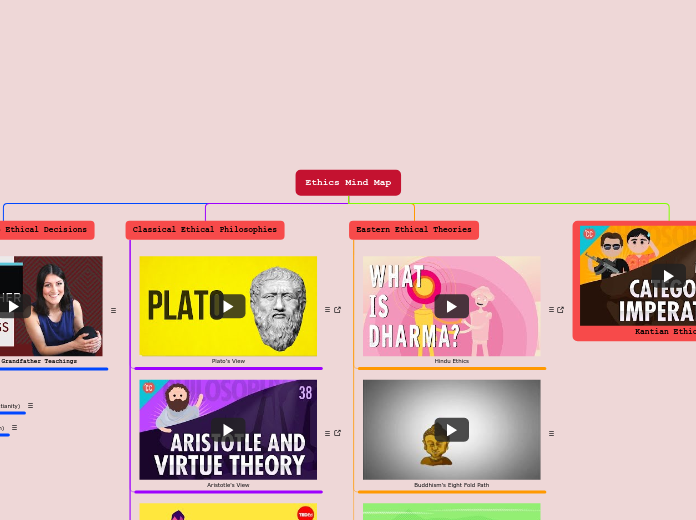
Anishinaabe 7 Grandfather Teachings
The 7 grandfather teachings come from a story of the Anishinaabe Ojibway people, which told of seven Grandfathers (spiritual beings) that were responsible for taking care of those living on mother earth and bestowed upon them seven gifts, or principles: Nibwaakawin - Wisdom. Wisdom is essential when trying to use your inherited gifts in a respectful and wise way.Zaagidiwin - Love. Self love is very important in this culture; if you cannot love yourself, how can you love God, who you are supposed to love first and foremost? Minwaadendamowin - Respect. Human's are not the center of Creation in this culture. Respect must be shown for all forms of life and their contributions to Mother Earth. Debwewin - Truth. This gives us the ability to act without having regret, knowing who you are in your heart and not letting truth lead us to lies. It's about having a firm grip on who you are Zoongidi’ewin - Courage. This means to have the bravery to do what is right despite the consequences, and to have confidence in your speaking and in your beliefs. Dabasendizowin - Humility. Recognize that we are all a part of creation, and not one of us is better than the other. Gwayakwaadiziwin - Integrity. Do not try to be anyone you're not. We must accept and know who we are.
7 Laws of Noah
The seven laws of Noah, otherwise known as the seven Noahide laws, are the binding universal laws that God gave to man, and they must be adhered to regardless of who you are so that mankind can have true balance and harmony. The laws are as follows: Do not worship false Gods - You must accept and give worship to the one and true GodDo not curse God - You must not take out your anger on God and curse by his name. Do not murder - You must not take another human life, as it is something that cannot be given a measurable value. Do not be sexually immoral - the act of intercourse is a gift from God to be shared between a married couple, and so to abuse this would be to abuse a holy act. Sexual immorality includes more than just promiscuity; homosexuality, adultery and rape are also included in this. Do not steal - what you earn in this world must be earned fairly and not taken, or gotten at the expense of another person. Do not eat a limb removed from a live animal - being a part of creation, you have an obligation not to cause undue harm to other parts of creation, and this includes other animals. Set up courts and bring offenders to justice - set up laws to create stability and harmony.
Ten Commandments (Christianity)
The ten commandments in Christianity are quite similar to the laws of Noah (I took these scriptures from the new world translation that is used by Jehovah's witnesses, so the text might use different language than some other translations): Do not worship false Gods : "I am Jehovah your God, who brought you out of the land of Egypt, out of the house of slavery. You must not have any other gods besides me". (Exodus 20 : 2-3)Do not worship idols : "You must not make for yourself a carved image or a form like anything that is in the heavens above or on the earth below or in the waters under the earth. You must not bow down to them nor be enticed to serve them, for I Jehovah your God, am a God who requires exclusive devotion..." (Exodus 20 : 4-5) Do not take the lords name in vain : "You must not take up the name of Jehovah your God in a worthless way, for Jehovah will not leave unpunished the one who takes up His name in a worthless way". (Exodus 20 : 7) Remember the Sabbath day and keep it holy : "Remember the Sabbath day to keep it sacred. You are to labor and do all your work for six days, but the seventh day is a sabbath to Jehovah your God." (Exodus 20 : 8-10) Honor your parents : "Honor your father and your mother, so that you may live a long time in the land that Jehovah your God is giving you". (Exodus 20 : 12) "You must not murder". (Exodus 20 : 13) "You must not commit adultery". (Exodus 20 : 14) "You must not steal". (Exodus 20 : 15) "You must not testify falsely when you are a witness against your fellow man". You must not harbor any desire for what is belonging to someone else : "You must not desire your fellow man's house. You must not desire your fellow man's wife nor his slave man nor his slave girl nor his bull nor his donkey nor anything that belongs to your fellow man". (Exodus 20 : 17)
Ten Commandments (Islam)
The ten commandments of Islam are very similar to the seven Laws of Noah and the ten commandments of Christianity, though in the ten commandments of Islam the guidelines extend a little farther and they're even more direct. Do not associate anything with him - believing that any other deity shares reign with Allah is considered to be a major sin. Be kind to your parents - in Islam there is a concept called Ihsan, meaning perfection of excellence. Ihsan is 'a matter of taking one's inner faith and showing it in both deed and action. This would include showing due respect and honor to your parents.Do not kill your children in fear of poverty - Allah provides for all those in need, and so the right to life that children hold should not be disregarded due to fear of poverty. *This is not the only commandment in Islam that deals with murder, which I found to be interesting because in the ten commandments of Christianity it is only mentioned once*Do not indulge in shameful acts, openly or secretly - All sins must be avoided, whether you're out in public or at home and in private, as you are always under the watch of Allah.Do not kill any person whom God has forbidden except through due process of law - letting your hate an anger take over to the point of overruling the justice system is prohibited, as this would be "going against the dictates of reason and common sense". Protect the orphans' property - This doesn't just mean literal orphans; it means that we must protect the rights of the strong AND the weak, as they get frequently overlooked. Grant full measure and weight in all fairness - all business must be conducted in honesty and civility.You must always speak justly and without bias, even if it concerns those you are close to. Your speech must always be impartial. All promises you make must be fulfilled, especially those that you make to God.Follow the straight path to God, and it will lead you to salvation.
Golden Rule
Do unto others as you would have them do unto you.I believe that there is a sort of universal ethics system. It's evident in similarities between these four subsections; all of these cultures have a different view on these guidelines, but the majority of it is the same:Do not murderDo not act indecentlyLook out for your fellow man Have integrity Have faith What makes these basic guidelines subject to change is the culture it is applied into. How some of these guidelines look in one country might not look the same in the other.
Plato's View
Plato believed that even if we were facing a tough decision and no one was watching, we would still choose to do the right, ethically sound thing. He believed that we are made up of three components: the physical body, our intellect and our spirit. According to Plato, these three things must be balanced in order to have a healthy soul. It is the unbalance of these things which leads to unethical decisions. One must not let their emotions overpower their reasoning skills, or neglect their physical health because this would cause harm to the spirit. Plato also believed in ethical absolutes. He believed that there were a few concrete pieces to behaving ethically that do not change depending on the individual’s circumstances or culture.Ultimately though, his main idea was the importance of self-knowledge, because if we know whowe are and what we believe we are far less likely to make rash, impulsive, and very ofte
aAristotle's View
Aristotle’s view was different from plato’s in the sense that he believed ethics was relative to the individual and their circumstances; this would include culture, upbringing, and so on. Rather than adopt Plato’s idea of the three components and the importance of them being balanced, he believed that we become ethical people as a result of two things: what we learn and the habits we pick up. He thought that we must look at the actions and behaviours of others in the world to discover what was truly ethical. He also did not believe in ethical absolutes like Plato did ;“If ethical ideas vary from one social group to another, asked Aristotle, are there any of these ideas upon which all people can agree”?
aStoicism
Stoicism was essentially the precursor to determinism. it was based on the idea that every event in this world, including the acts of humans, are all predetermined. it was a very influential concept in early Western culture. According to the Stoics, the only thing that we can control is how we react to events.There are 4 virtues to stoicism: Practical wisdomCourageTemperance Justice There are two points to be brought up in regards to stoicism and its influences; One being that It's quite possible these virtues could have been taken from any number of religions, as they are comparable to the 7 laws of Noah and the Anishinaabe 7 Grandfather teachings. The second point is that stoicism has similarities to the views of Plato, in the sense that it also focuses on balance.
Cynicism
Cynisism was, essentially, the early stages of minimalism. it began as a rejection of all things materialistic, and Cynics believed that the key to living a happy life was to live simply. They rejected extravagance and wealth in favour of pursuing a more frugal lifestyle. It went on to becoming the term for someone who looked at humanity and social interactions negatively and with disdain, as cynics of ancient times would tend to be against the institutions that society had set up, such as government, marriage and so on.
aEpicureanism
Epicureanism was centered around the claim that the universe has no rhyme or reason to it, and if it has no plan or rationality then the goal of life should simply be to live for pleasure. What's interesting about this though, is that while epicureanists believed in living for the pleasures of life, they did not advocate for excession or over indulgence. This was because any over indulgence in the things we get pleasure from - eating, drinking, partying - can lead to things that bring long-term pain like addiction and other health issues, and this would be going against the Epicurists goals.
aHindu Ethics
There is a collection of hymns, texts, and idea's about the purpose of life and reality called Vedas. The Western world gave Hinduism its name, but like many religions (like Christianity) there are many branches of Hinduism, with diverse practices and beliefs. These are called Vaidika, after the texts of Vedas.Unlike Christianity though, those who practice Hinduism do not try to convince others to believe in their ideas or practice their religion. Hindu philosophy is based on Karma, which itself is based on two principles :Everything is predetermined (similar to Stoicism) andIndividual souls are eternal (Reincarnation) So they believed in karmic determinism, which meant that any suffering you might be experiencing today is a direct result of how you acted in a past life.There idea was that if you behaved ethically, you could be released from your earthly ties after death. If not, you would be reincarnated into whatever would be appropriately deserved, given your past actions and mistakes.
aBuddhism's Eight Fold Path
This was the eight fold path that would supposedly lead to Nirvana, or freedom from suffering:Right viewRight intentionRight speechRight action Right livelihoodRight effort Right mindfulnessRight concentrationthe 'right' way is not meant to be the same for everyone though; this eightfold path does not try to be universally absolute as Christianity or other religions do. The right way is really just to focus on enlightenment, and that's what this branch of beliefs is really all about; the right way to live is to gain the knowledge and insight that enables us to look past the concept of 'self', which is what they believed to be trapping us in suffering. By following this eightfold path and eliminating selfish desires and habits, we will theoretically be free from the suffering cause by seeking out our own interests.
Confucius
Confucius was a Chinese poet and teacher, who was mainly focused on the connection between politics and ethics. Confucians believe that the cultivation of oneself, having strong character and integrity, and overall having sound ethical beliefs were vital to those living a public life. This was one of Confucius' main relationships he spoke of to his early students: Father to son—There should he kindness in the father, obedience and respect (filial piety) in the son.Elder brother to younger brother—There should he gentility in the elder brother and humility in the youngerHusband to wife—There should be righteous behavior in the husband and obedience in the wifeElder to junior—There should be consideration among the elders and deference among the juniors.Ruler to subject—There should be benevolence among the rulers and loyalty among the subjects( this would include modern day politicians to the citizens.Confucius had his own set of guidelines to living an ethical life, which included: Tao and Te - Referring to such qualities as humility and generosityJen - A sensitivity to the wellbeing of others (goodness, humanity, etc.).Li - The importance of propriety and decorum And Yi - The ability to weigh ones options before making the right decision
Emanuel Kant was a strict moral absolutist. The difference between him and many other philosophers is that he did not in any way connect religion and ethics. He believed that if people tried to live an ethical life by looking to religion, not everyone will find the same answer, and in his eyes if something can not be 'universalized', then it is not truly ethical. He believed in what is called the categorical imperatives.These categorical imperatives are what Kant believed drove our moral obligations, and they must be able to be universalized: “Act only in accordance with that maxim through which you can at the same time will that it become a universal law.” - Emanuel Kant. For example, you may try to rationalize that if you are starving then it is okay to steal food to be able to feed yourself. However, if we follow the universalization principle, then you must be saying that if YOU can steal in this scenario, then you are essentially saying that it is okay to steal all the time. Therefore, stealing cannot be universalized (Hank will explain this better). His work was highly influential, which could be a result of the lack of spirituality involved in his ideas. This makes his ethical code of conduct more universal, applicable to all people regardless or religious or non-religious background, just as he intended.