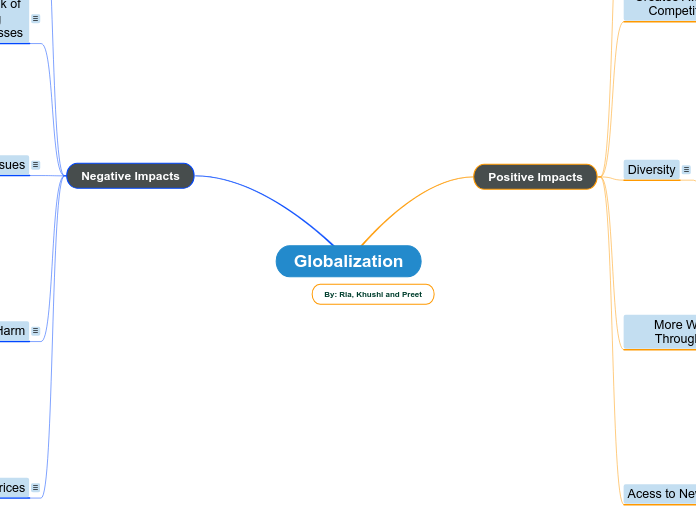
Globalization
Positive Impacts
Companies Collaborating
When companies collaborate, they learn new skills, techniques, strategies, etc. from each other. These strategies can then be used to maintain current customer as well as bring new customers to each of those companies.
Example
When companies collaborate, they learn new skills, techniques, strategies, etc. from each other. For example, the collaboration of Apple and MasterCard. when Apple released the Apple pay app, it allowed people to store their credit or debit card data on their phone, so they could use them without physically having the card. But for this app to work they needed credit card companies to inter grade with this technology. Which then later MasterCard became the first credit card company to allow its users to store their credit and debit cards on Apple Pay.
Creates Awareness of Other Competition Companies
A positive effect of globalization is the improved quality in products because of global competition. Domestic companies have to fight out foreign competition by raising the standards of their products to meet customer satisfaction.
Example
For example, Apple is constantly releasing new products and innovating their current ones to keep up with competition companies such as Samgsung. Apple uses strategies like having products with interrelationships, this encourages customers who purchase one Apple product to buy more.
Diversity
As globalization becomes more prevalent, companies deal with increased cultural diversity within the workforce. This increased cultural diversity also has produced many benefits as companies gain new insights into different cultures from a management and a marketing standpoint.
Example
Middle East and North Africa empowerment of civil society networks that were developed through the availability of technology, have afforded the possibility to overcome political and geographical boundaries resulting in international support for democracy, health, environment and development issues.
More Wealth Equality Throughout the World
A good side to globalization is that hundreds of thousands of people around the world are getting jobs that have the ability to provide for their families. When a company expands internationally, it also means that the locations in those countries will need employees.
Example
For example, when you purchase a car, the parts of that car a coming from places all over the world. Manufacturing each of the parts for that car is providing different types of jobs all around the world.
Acess to New Talent
Globalization allows companies to find new, specialized talents that are not available locally. These new talents allow for the company to have new ideas as well as new innovation. This can help the company grow and expand further.
Example
For example, tech companies can always use new talent to innovate their products and services. If you had a tech company in a developing country, you may want to expand to a country like the United States because their technology is more advanced.
Negative Impacts
Job Insecurity
Developed countries are outsourcing the materials needed for their company by using imported materials from underdeveloped countries. Companies outsource to countries because the cost of manufacturing and wages are lower. China and India are the most popular countries that companies outsource to.
Example
In September 2015, MillerCoors closed their brewery and approximately 500 people got a lay off. It was later announced that the company would be merging with Anheuser-Busch as an effort to make a more efficient company.
Increases Risk of Spreading Disease/Illnesses
Goods and raw materials are moving around the world constantly, and could be carrying disease/virus causing agents on them. Goods or materials that carry diseases can be imported to countries that have not dealt with the disease before or do not have the requirements and ability to contain the disease/virus.
Example
For example, between 1996 and 2014, a total of 195 outbreak investigations were implicated on imported food. This resulted in thousands of illnesses and hospitalization. The average number of outbreaks associated with food imports each year during the late 90's was 3 and then rose to 18 in the early 2000's. The most common agent associated with food import outbreaks was salmonella.
Safety Issues
Globalization has lead to labor in the workplace. Basic safety standards such as taking regular breaks, wearing protective equipment and many more are ignored to produce cheap goods. Employers do this to increase the rate at which goods are being produces and to put any money towards producing the goods, rather than keeping the workers safe.
Example
On April 24, 2013, a garment company in Bangladesh, Rana Plaza, collapsed killing more than a thousand people and injuring many more. The collapse happened because the employers did not put any money towards safety precautions, but rather towards the goods that were being produced.
Environmental Harm
globalization has led to an increase in the consumption of products, which has impacted the ecological cycle. increased consumption leads to an increase in the production of goods, which in turn puts stress on the environment.
Example
For example, in 2007, the U.K.-based supermarket chain Tesco decided to ban rose imports from Kenya in a bid to save on emissions. But research revealed that the Dutch roses it relied on instead generated six times as much in the way of greenhouse gases, largely because they were literally grown in greenhouses.
Fluctuation in Prices
Globalization has led to a fluctuation in price. Developed countries are forced to decrease the prices of their products, because other countries are producing their goods at lower cost. Developed countries reduce their prices to maintain their customers, but this also reduces the ability for that country to sustain social welfare.
Example
China is much cheaper compared to countries like the United States. This is because China's labor is lower than 20% of the total cost. They also use materials that are cheaper and require less hand work. In addition, the low price is because China orders a high volume of materials. Also, the cost of compliance to health and safety regulation and lower in China than in America.