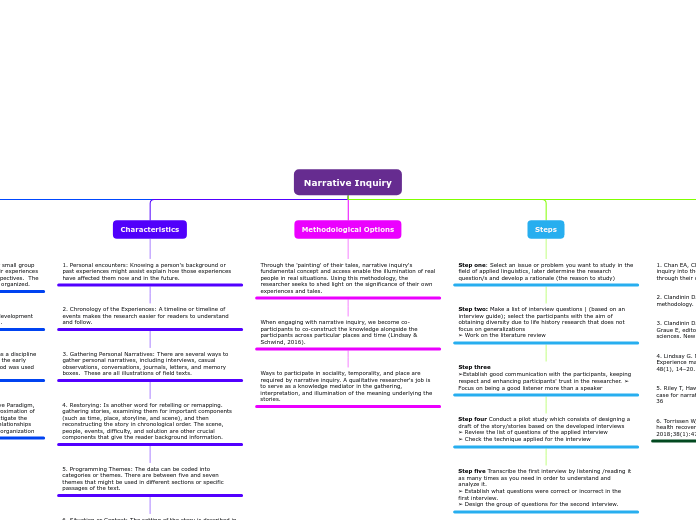
When conducting a narrative inquiry, a person or small group of people are interviewed in order to capture their experiences and reveal their lived experiences or unique perspectives. The interviews are then recorded and chronologically organized.
Narrative inquiry allows all those involved in its development to live, tell, retell and relive stories of experience.
Narrative inquiry or narrative analysis emerged as a discipline within the broader field of qualitative research in the early 20th century, as there is evidence that this method was used in psychology and sociology.
Narrative research is located within the Qualitative Paradigm, which supposes a natural and interpretative approximation of subjectivity and offers many possibilities to investigate the self, the personal and the social, as well as the relationships between identities, cultures and the structure or organization
1. Personal encounters: Knowing a person's background or past experiences might assist explain how those experiences have affected them now and in the future.
2. Chronology of the Experiences: A timeline or timeline of events makes the research easier for readers to understand and follow.
3. Gathering Personal Narratives: There are several ways to gather personal narratives, including interviews, casual observations, conversations, journals, letters, and memory boxes. These are all illustrations of field texts.
4. Restorying: Is another word for retelling or remapping. gathering stories, examining them for important components (such as time, place, storyline, and scene), and then reconstructing the story in chronological order. The scene, people, events, difficulty, and solution are other crucial components that give the reader background information.
5. Programming Themes: The data can be coded into categories or themes. There are between five and seven themes that might be used in different sections or specific passages of the text.
6. Situation or Context: The setting of the story is described in great detail.
7. Working Together with Participants: The participant and the researcher collaborate to close the gap between the narrative told and the narrative reported during the research process.
Through the 'painting' of their tales, narrative inquiry's fundamental concept and access enable the illumination of real people in real situations. Using this methodology, the researcher seeks to shed light on the significance of their own experiences and tales.
When engaging with narrative inquiry, we become co-participants to co-construct the knowledge alongside the participants across particular places and time (Lindsay & Schwind, 2016).
Ways to participate in sociality, temporality, and place are required by narrative inquiry. A qualitative researcher's job is to serve as a knowledge mediator in the gathering, interpretation, and illumination of the meaning underlying the stories.
Step one: Select an issue or problem you want to study in the field of applied linguistics, later determine the research question/s and develop a rationale (the reason to study)
Step two: Make a list of interview questions | (based on an interview guide); select the participants with the aim of obtaining diversity due to life history research that does not focus on generalizations
➢ Work on the literature review
Step three
➢Establish good communication with the participants, keeping respect and enhancing participants' trust in the researcher. ➢ Focus on being a good listener more than a speaker
Step four Conduct a pilot study which consists of designing a draft of the story/stories based on the developed interviews
➢ Review the list of questions of the applied interview
➢ Check the technique applied for the interview
Step five Transcribe the first interview by listening /reading it as many times as you need in order to understand and analyze it.
➢ Establish what questions were correct or incorrect in the first interview.
➢ Design the group of questions for the second interview.
1. Chan EA, Cheung K, Mok E, Cheung S, Tong E. A narrative inquiry into the Hong Kong Chinese adults’ concepts of health through their culture. Int J Nurs Stud. 2006;43(1):301-9
2. Clandinin DJ. Handbook of narrative inquiry: Mapping a methodology. Canada: Sage Publications; 2006
3. Clandinin DJ, Caine V. Narrative inquiry. En: Trainor AA, Graue E, editores. Reviewing qualitative research in the social sciences. New York: Routledge; 2012
4. Lindsay G. M., Schwind J. K. (2016). Narrative inquiry: Experience matters. Canadian Journal of Nursing Research, 48(1), 14–20.
5. Riley T, Hawe P. Researching practice: the methodological case for narrative inquiry. Health Educ Res. 2005;20(2):226-36
6. Torrissen W, Stickley T. Participatory theatre and mental health recovery: a narrative inquiry. Perspect Public Health. 2018;38(1):47-54