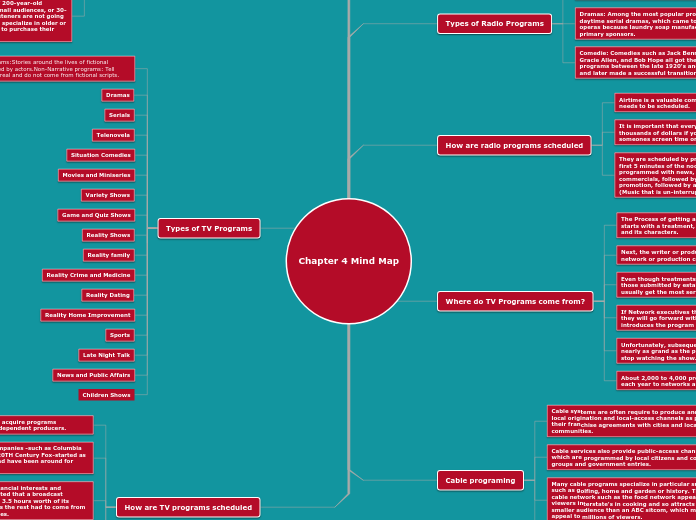
Music: By the late 1920's, music was the main source of radio pro-gaming, For example, NBC Blue and NBC Red Network-affiliated stations in New York devoted about three-quarters of programming to music.
Dramas: Among the most popular programs were daytime serial dramas, which came to be known as soap operas because laundry soap manufactures were the primary sponsors.
Comedie: Comedies such as Jack Benny, George Burns, Gracie Allen, and Bob Hope all got their start in radio programs between the late 1920's and the mid-1940's and later made a successful transition to television.
Airtime is a valuable commodity, and so every second needs to be scheduled.
It is important that every second counts. You could pay thousands of dollars if you miss a couple of seconds of someones screen time or commercial time in this case.
They are scheduled by program clocks. For example, the first 5 minutes of the noon-to-1:00P.M. hour may be programmed with news, followed by 2 minutes of commercials, followed by a 15- second station promotion, followed by a 10-minute music sweep. (Music that is un-interrupted for 10 min).
The Process of getting a program on the air usually starts with a treatment, a description of the program and its characters.
Next, the writer or producer pitches the treatments to a network or production company.
Even though treatments are accepted from anyone, those submitted by established writers and producers usually get the most serious consideration.
If Network executives think the project is worthwhile, they will go forward with a pilot, a sample episode that introduces the program and characters to viewers
Unfortunately, subsequent episodes are not always nearly as grand as the pilot, and disappoint viewers stop watching the show.
About 2,000 to 4,000 program proposals are submitted each year to networks and production companies.
Cable systems are often require to produce and provide local origination and local-access channels as part of their franchise agreements with cities and local communities.
Cable services also provide public-access channels, which are programmed by local citizens and community groups and government entries.
Many cable programs specialize in particular subjects, such as golfing, home and garden or history. Thus a cable network such as the food network appeals to the viewers interstate's in cooking and so attracts a much smaller audience than an ABC sitcom, which might appeal to millions of viewers.
Looking for ways to maintain their audience, television programmers devised programming strategies to control audience flow from one program to another.
Some radio stations produce their own newscasts, weather and traffic reports, and sports shows featuring university and high school coaches, local sporting events, and other types of community programs.
Radio stations generally foot the bill for their own local programming.
There is little financial incentive for recording companies to send out free CD's of 200-year-old classical pieces, which will draw small audiences, or 30-year-old classic rock 'n' roll that listeners are not going to rush out to buy, so stations that specialize in older or more specialized music often have to purchase their own music libraries.
Narrative Programs:Stories around the lives of fictional characters played by actors.Non-Narrative programs: Tell stories that are real and do not come from fictional scripts.
Dramas
Serials
Telenovela
Situation Comedies
Movies and Miniseries
Variety Shows
Game and Quiz Shows
Reality Shows
Reality family
Reality Crime and Medicine
Reality Dating
Reality Home Improvement
Sports
Late Night Talk
News and Public Affairs
Children Shows
Networks and local stations acquire programs broadcasting rights from independent producers.
mOST major Production Companies -such as Columbia TriStar, Warner Bros., and 20TH Century Fox-started as movie production houses and have been around for years.
The FCC in 1970 enacted financial interests and syndication rules, which stated that a broadcast network could produce only 3.5 hours worth of its weekly prime time programs the rest had to come from outside production companies.
In contrasts to the huge conglomerates with ties to the networks, there are small independent production houses.
Independent producers are also distribute their programs on cable networks such as HBO and Showtime, and along with pay-per-view and video-on-demand channels, they offer movies, sports, and special events.