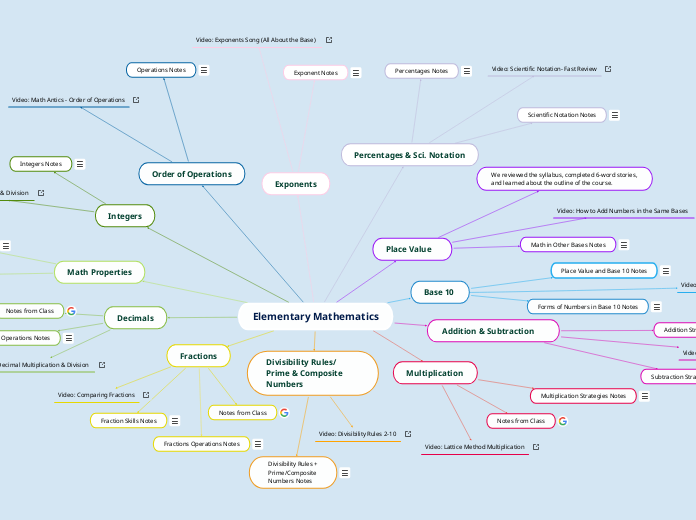
Elementary Mathematics
Place Value
We reviewed the syllabus, completed 6-word stories, and learned about the outline of the course.
Video: How to Add Numbers in the Same Bases
Math in Other Bases Notes
Basics:Regardless of the base we work in, there will always be a "ones" place since x0 will equal 1 x= any number that isn't equal to 0There can never be a "oneths" place because when working with money, a dime is 1/10 of $1 and a penny is 1/100 of $1. There can never be a unit that equals 1/1 because that just equals 1Any place can not exceed the amount of units that there are in the base we are working withEx: in base 5, only 4 units can be in any given place.Each grouping when working in base x would look like x0, x1, x2, etc.Problem Example: 10 base 4 The groups would be 40 41 42 ...etcWhich when translated to whole numbers, would look like: 1, 4, 16...etcWhen we group the units, we cannot have more than 3 in any given place value since we are working in base 4, and if there are 4+ units, we would have to relocate them to another place.With 10 units, we can make 2 groups of 4 units with 2 units leftover. When written out, this would be 22 B4 and said as "two two base 4".Addition:Add the numbers as you would in base 10 addition.Depending on the base you're working in, that defines how many units will be in each group.When adding and carrying over, work in groups of that baseEx: in base 3, work in groups of 3 (in any place, the digit cannot exceed 2)Problem Example: 4+12 base 6 =16 base 6Because we can make 2 groups of 6 units with 4 units leftover, the answer would look like 24 B6.Subtraction:Subtract numbers similar to base 10, but when borrowing, borrow the amount of the base from the number neighbor. Ex: if you have to borrow in base 8, take 8 from the number neighbor to the left and subtract the number being borrowed from by 1.
Base 10
Place Value and Base 10 Notes
Vocabulary:Place- location of a digit within a numberValue- how much a digit is worthDigit- one numerical symbolNumber- 1+ digits togetherExamples: 74.8928 is in the tenths placeIts value is .8 or 8/10456.3214 is in the hundreds placeIts value is 400In the number 642,538.179...6 is in the hundred thousands place4 is in the ten thousands place2 is in the thousands place5 is in the hundreds place3 is in the tens place8 is in the ones place1 is in the tenths place7 is in the hundredths place9 is in the thousandths placePowers of 10:Each power is 10 times larger than the place to its rightExamples:2x1=22x10=202x100=200
Video: Decimal Place Value
Forms of Numbers in Base 10 Notes
Expanded Form: Each number is represented by showing the value of each digitExample:642,538.179600,000+40,000+2,000+500+30+8+0.1+0.07+0.009Expanded Notation Example:642,538.179(6x10⁵)+(4x10⁴)+(2x10³)+(5x10²)+(3x101)+(8x100)+(1x10⁻¹)+(7x10⁻²)+(9x10⁻³)Standard Form Example:642,538.179Word Form:Representation of a number through written wordsExample:642,538.179Six hundred forty-two thousand, five hundred thirty-eight AND one hundred seventy-nine thousandthsRounding:Find the place being roundedLook at the digit to the RIGHTIf the number to the right is 0-4, the number being rounded stays as is. If the number is 5 or greater, we round up.Example:Round 342.178 to the nearest hundredth.Rounding the 7 in the hundredths placeDigit to the right is the 8 in the thousandths placeBecause the 8 in the thousandths place is greater than 5, we round up.Answer: 342.180
Addition & Subtraction
Addition Strategies Notes
Addition Strategies:Base 10 blocksExpanded formTraditional algorithmNumber lineBase 10:Using blocks of 100 cubes, 10 cubes, and 1 cube, count out both numbers that are being added using the appropriate blocks.Group together the hundreds, tens, and ones of both numbers.When there are 10 or more blocks in any category, trade out those 10 blocks for the next block.ex: if there are 10 ones, trade that in for 1 tens blockAdd up the blocks relative to their place value (hundreds, tens, ones, etc.)Example:543+279Count out 543 and 279 using the base 10 blocksMove the blocks to combine the 543 with 279 blocks.Trade in 10 ones for 1 tens block & trade in 10 tens for 1 hundreds blockYou should be left with 8 hundred blocks, 2 tens blocks, and 2 ones blocksAdd up the blocks to end up with a total of 822.Expanded Form:Write numbers in expanded formAdd from right to left starting in the ones placeRegroup when necessaryAdd each sum from each place to get final answer.Example: 500+40+3+ 200+70+9----------------------- 700+110+12=822Traditional Algorithm:Line up the numbers by place value Add digits in ones place first and work leftwardRegroup whenever a digit of 10 or greater is in any place Continue until you reach the end of the problem to get final answerNumber Line:Place first addend on the left side of number line.Increase by the second addend on the number lineExpand the number first, then begin the number line.Add using the expanded form to get final answer.
Video: Subtraction Within 100 With Regrouping
Subtraction Strategies Notes
Subtraction Strategies:Base 10 blocksExpanded formTraditional algorithmNumber lineBase 10:Show the larger number using base 10 blocks.Cross out/take away the amount of the smaller number. Trade out if necessaryie: you are subtracting more ones than shown with the blocks, trade out 1 tens block for 10 ones to make it easier.Count the values of the remaining blocks to determine final answerExpanded Form:Write numbers in expanded formSubtraction from right to left starting in the ones placeRegroup when necessaryAdd each sum from each place to get final answer.Traditional Algorithm:Line up the numbers by place value Subtract digits in ones place first and work leftwardRegroup when necessary by taking whatever the value of the place is (10, 100, 1000, etc.) from the left neighboring numberOnly do this if the number on top has a digit smaller than the one on bottomContinue this until you reach the end of the problemNumber Line:Place minuend (number being subtracted from) on the right side of number line.Decrease by the subtrahend (number being subtracted) on the number lineExpand the number firstSubtract using the expanded form to get final answer.
Multiplication
Multiplication Strategies Notes
Multiplication Strategies:ArrayEqual groupsNumber lineRepeated additionSkip countingExplained in Google Notes (linked in Week 4)TraditionalLattice Partial productsArea modelArray Example:4x5This would indicate that there would be 4 rows and 5 columns of units, and using this, the units can be easily displayed and counted.Equal Groups Example:4x5 There would be 4 (equal) groups of 5 units in each group.Number Line Example:4x5Start with 0 on the left end of the number lineFor this example, there should be 4 jumps being made with each jump being 5 long.4 jumps of 5 would get us to 20 on the number line.Repeated Addition Example:4x5(For this example, adding 5 to itself 4 times would be the same as multiplying the numbers together)5+5+5+5Skip Counting Example:4x5Starting at 4, add 4 to the next number 5 times (ie: 4+4=8, 8+4=12, etc.)4,8,12,16,20
Notes from Class
Video: Lattice Method Multiplication
Divisibility Rules/ Prime & Composite Numbers
Video: Divisibility Rules 2-10
Divisibility Rules + Prime/Composite Numbers Notes
Factor x Factor= Multiple (FxF=M)Example 1:12 (multiple)1, 2, 3, 4, 6, 12 (factors)Start from 1 and the multiple for factors (in this case, we started with 1 and 12)Then, work your way inwards2 and 6 were the next factors3 and 4 were the last ones, and because there are no other whole numbers between them, they are the last factors we can haveExample 2:7 (multiple)1,7 (factors)Because the only numbers that can multiply to 7 are 1 and 7, 7 is a prime number.Prime numbers have factors of only 1 and themselves 12 is an example of a composite number because it has multiple factors besides 1 and 12.Composite numbers have more factors than just 1 and themselves.Multiples Examples:7: 7, 14, 21, 28, 35, 42, 49...10: 10, 20, 30, 40, 50...Prime Factorization: Make numbers using prime numbers onlyExample: 12 / \ 4 3 / \ 2 2 2x2x3Divisibility Rules:2: if number ends in 2, 4, 6, 8, 03: if sum of digits is divisible by 34: if last 2 numbers are divisible by 45: if number ends in 0 or 56: if divisible by 2 and 39: if sum of digits is divisible by 910: if number ends in 0Example:65,106 6+5+1+0+6=18 1+8=92: ends in 6 (yes)3: sum of digits are divisible by 3 (yes)4: last 2 numbers are not divisible by 4 (no)5: does not end in 0 or 5 (no)6: divisible by 2 and 3 (yes)9: sum of digits are divisible by 9 (yes)10: does not end in 0 (no)65,106 is divisible by 2, 3, 6, and 9
Fractions
Video: Comparing Fractions
Fractions Operations Notes
*All examples are best shown in the notes from class*Adding with Like Denominators:Add the numerators.Keep the denominators the same.Simplify if needed.Adding with Unlike Denominators:Find the least common denominator (LCD) for both fractions.This will allow for both denominators to be the same when adding.Add the numerators.Keep the denominators the same.Simplify if needed.Subtracting with Like Denominators:Subtract the numerators.Keep the denominators the same.Simplify if needed.Subtracting with Unlike Denominators:Find the least common denominator (LCD) for both fractions.This will allow for both denominators to be the same when adding.Subtract the numerators.Keep the denominators the same.Simplify if needed.Multiplying Fractions:Fraction x Fraction:Multiply the numerators.Multiply the denominators:Simplify if needed.Fraction x Whole Number:Rewrite the whole number as a fraction with a denominator of 1.Multiply the fractions.Simplify if needed.Fraction x Mixed Number:Convert mixed numbers into improper fractions.Multiply the fractions.Simplify if needed.Dividing Fractions:Fraction/Fraction:KEEP the first fraction the same.CHANGE the division symbol to a multiplication symbol.FLIP the second fraction (reciprocal).Multiply the fractions.Simplify if needed.Fraction/Whole Number:KEEP the first fraction the same.CHANGE the division symbol to a multiplication symbol.FLIP the second fraction (reciprocal).Make sure to add 1 to the denominator of the whole number before flipping!Multiply the fractions.Simplify if needed.
Notes from Class
Fraction Skills Notes
Vocabulary:Fractions are parts of a whole. Ex: 2/5, 1/2, 1/3, etc.Unit Fractions are fractions with a numerator of 1.Numerator: shaded partsDenominator: total pieces of the wholeEquivalent Fractions are fractions that have the exact same numerators AND denominators.Decomposing Fractions: splitting up/dividing fractions into smaller fractions. Ex: 3/8= 1/8 + 1/8 +1/8Comparing Fractions:Same Denominator: If both fractions have the same denominator, the fraction with the larger numerator is the greater fraction Ex: 2/4 < 3/4Same Numerator: If both fractions have the same numerator, the fraction with the smaller denominator is the greater fraction. Ex: 5/6 > 5/8Strategies:Using a visual modelUsing a number lineUsing a 1/2 as a benchmark (greater than or less than)Finding a common denominatorSimplest Form:List factors of the numerator and denominator.Find the greatest common factor (GCF) between the numerator and denominator.Divide the numerator and denominator by their GCF. Ex: 4/16 Factors of 4: 1, 2, 4 Factors of 16: 1, 2, 4, 8, 16 Because the GCF of each number is 4, we divide the numerator and denominator by 4 which gives us 1/4 as the simplified answer.Improper Fractions & Mixed Numbers:Improper Fraction: A fraction where the numerator is greater than the denominator.Mixed Number: A whole number with a fraction (less than 1).Converting Mixed Numbers to Improper Fractions:Multiply the denominator by the whole numbers.Add the product to the numerator. This is the new numerator.Denominator remains the same. Ex: 4 1/33 x 4 = 1212+1 =1313/4Converting Improper Fractions to Mixed Numbers:Divide numerator by the denominator.After dividing, the whole number is the number of wholes in the mixed number.The remainder is the new numerator.Denominator remains the same. Ex: 13/313/3= 4 R14 x/x4 1/x4 1/3
Decimals
Video: Decimal Multiplication & Division
Decimal Operations Notes
Addition:Line up decimals vertically.Fill in zeros (placeholders) to the right as needed.Add from right to left.Bring down the decimal!Example: 2.46 + 5.419 2.460 +5.419----------------- 7.879Subtraction:Line up decimals vertically.Fill in zeros (placeholders) to the right as needed.Subtract from right to left.Bring down the decimal!Example: 13.478-4.34 13.478- 4.340------------------ 9.138Multiplication:Round the factors to find an estimate of the product.Remove the decimal points from the factors.Multiply the numbers normally.Reinsert the decimal point in a reasonable position in line with the estimate.Check by counting the decimal places in the factors to locate the correct decimal placement.Example: 4.6 x 2.35 x 2 =10Answer should be around 10.46. x23.46 x 23 = 105810.58Division:Multiply the divisor by a power of 10 to make it a whole number (by moving it to the right).Multiply the dividend by the same power of 10 and move the decimal the same amount of places as the divisor.Place the decimal in the quotient directly above its place in the dividend.Divide as normal.Example can be fund on slide 7 of the notes from class attached in this section!
Notes from Class
Math Properties
Video: The Properties of Multiplication Song | 3rd Grade - 4th Grade
Properties Notes
Properties of Multiplication and Addition:Commutative Property of Addition:Definition: Changing the order of the addends does not change the sum. Example 1: 26 + 7 = 7 + 26Formula: A + B = B + A Commutative Property of Multiplication: Definition: Changing the order of the factors does not change the product. Example: 5 X 3 = 3 X 5 Formula: D x F = F x DAssociative Property of Addition: Definition: Changing the grouping of 3+ addends does not change the sum.Example: (6 + 2) + 4 = 6 +(2 + 4)Formula: (A + B) + C = A + (B + C) Associative Property of Multiplication: Definition: Changing the grouping of 3+ factors does not change the product. Example: 6 x (3 x 8) = (6 x 3) x 8 Formula: (A x B) x C = A x (B x C) Distributive Property: Definition: Multiply each number in an addition problem or subtraction problem. Then add or subtract their sum or difference.Example 1: 8 X (20 +3) = 8 X 20 + 8 X 3 Example 2: 7 X (20-1) = 7 X 20 – 7 X 1 Identity Element of Addition Definition: If you add 0 to any number, you get the original number.Example: 5 + 0 = 5 0 + 5 = 5 Identity Element of Multiplication:Definition: If you multiply 1 to any number, you get the original number. Example: 6 X 1 = 6 1 X 6 = 6Zero Property:Definition: If you multiply 0 to any number, you get 0.Example 1: 8 x 0 = 0 Example 2: 10 x 0 = 0
Integers
Video: Math Antics- Integer Multiplication & Division
Integers Notes
Adding Integers:Sign = directionNumber = distanceExample 1:-4 + 3 = -1- - + +- - +Example 2:-3 + 8= 5 ------------------------------------> <------------<---|---|---|---|---|---|---|---|---|---|---|---> -5 -4 -3 -2 -1 0 1 2 3 4 5Subtracting Integers:Sign = directionNumber = distanceSubtracting a negative = adding a positiveExample 1:6 - (-2) = - + + + +- + + + +Model 6Model -2 as a zero pair (bolded in example)Cancel out the negatives, leave the positives.Count the remaining counters and use the correct sign (+ or -).Example 2:1 - 4 = -3 <------------------ -----><---|---|---|---|---|---|---|---|---|---|---|---> -5 -4 -3 -2 -1 0 1 2 3 4 5Multiplying & Dividing Integers:N = negativeP = positiveN x N = PP x P = PN x P = NP x N = NExample 1: Multiplication2 x (-4) = (-8)- - - -- - - -*2 groups of (-4)*Example 2: Division(-9) / 3 = (-3)- - -- - -- - -
Order of Operations
Video: Math Antics - Order of Operations
Operations Notes
Order of Operations:P: Solve parentheses first. "P" can also be substituted for "G" to mean grouping.E: Solve exponents second.M: Multiplication and division are next. If they are in the same expression, solve left to right.D: Multiplication and division are next. If they are in the same expression, solve left to right.A: If addition and subtraction are in the same expression, solve left to right.S: If addition and subtraction are in the same expression, solve left to right.Example 1: 25 / 5 x 10 -2 5 x 10 - 2 50 - 2 48Example 2:{ 4(3 + 2) - 4} / 4^2 {4(5) - 4} / 4^2 {20-4} / 4^2 16 / 4^2 16 / 16 1
Exponents
Video: Exponents Song (All About the Base)
Exponent Notes
Exponent Notes:Neg x Neg = PosNeg x Pos = NegIf exponent is odd, product is negative.If exponent is even, product is positive.Example 1:2^2 = 2 x 2Example 2:(-7)^2 = 49Example 3:(-5)^3 = (-5) x (-5) x (-5) = -125Example 4: 12^3"twelve cubed" or "twelve to the third power"Example 5:2^3 x 3 x 5^32 x 2 x 2 x 3 x 5 x 5 x 524 x 125 = 3,000
Percentages & Sci. Notation
Video: Scientific Notation- Fast Review
Percentages Notes
Percentages Notes:Per- part ofCent- 100To convert...Percentage to decimal:Divide percent by 100 or move the decimal point 2 places to the left.Percentage to fraction:Divide the percent (numerator) by 100 (denominator) and simplify if possible.Percentage with decimal to fraction:Multiply the numerator and denominator by a power of 10 to move the decimal over. Then, simplify if possible.Example: 14.2%14.2/10014.2 x 10/ 100 x 10142/100071/500Decimal to fraction:Figure out the place value of the last digit to the right. Write out the fraction over a power of 10 (10, 100, 1000, etc.). Simplify if possible.Decimal to percentage:If you can write the decimal as a fraction with 100 as the denominator, the numerator is the percentage. A shortcut would be to move the decimal point 2 places to the right.Example: 0.1212/10012%Fraction to decimal:Rewrite the fraction with a power of 10 as the denominator. It is done easiest with a calculator and can also be solved with long division if preferred.Example: 4/54/5 =80/10080/100 = 0.80Fraction to percentage:It is fastest and easiest to do with a calculator. Divide the numerator by the denominator. Then change the fraction to a decimal. Move the decimal point 2 places to the right.Example: 5/85/8 = 0.62562.5%
Scientific Notation Notes
Scientific Notation:Formula: M x 10^pM= mantissa: a number with an absolute value equal to or greater than 1 or less than 10. p= power of 10 with integer exponentif the mantissa gets larger, exponent gets smallerif the mantissa gets smaller, exponent gets largerExample 1:7.800 = 7 x 10^3Example 2:8.1 x 10^-5 = 0.000081Example 3:7.79 x 10^6 = 7,790,000