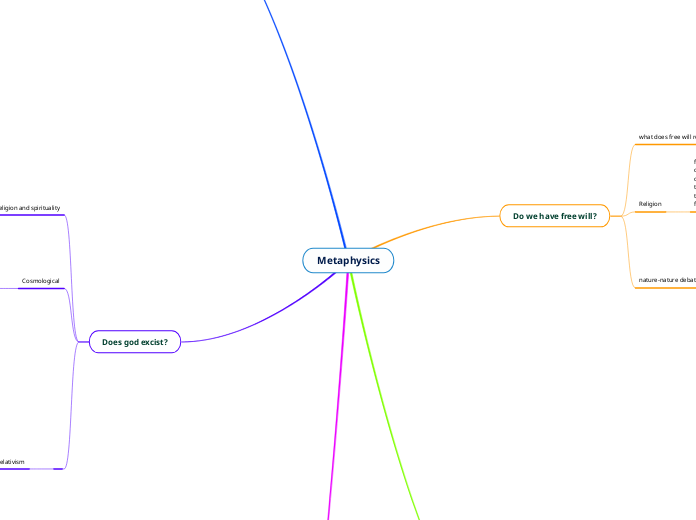
what does free will really consist of?
when people make their own decisions like going out for dinner instead of staying in and cooking, they usually feel like they have free will. People have desires and preferences that influence their decision making and actions but is it really free will if there is nothing preventing one to go out or making them stay in?
Religion
free will or 'Moral liberty' in the Christian tradition is known a doing what's known as 'good' inst4ead of following ones desires. Philosopher Immanual Kant spoke on the link between the ideal free will and what's 'good'. stating' if we are not free to choose then it would make no sense to say we ought to follow the path of righteousness.'
nature-nature debate
The 20th century debate has lead us to think more on how our own desires, decisions and everyday actions are influenced by things out of our control. as stated in the 'there's no such thing as free will' article by Stephan Cave if we study neuroscience and the brains anatomy enough in theory we would be able to predict an individual's response 100% of the time to any given situation, therefor we are absolutely predictable
Creature Consciousness
Creature consciousness is the act of being aware and being able to react to what is happening. some levels of consciousness are not only about being aware but being aware that you are aware. Thomas Nagel's famous 'what it is like' aims to capture more subjective notions of being conscious or having the ability to do so. According to Nagel bats are a conscious being because of the way they use echolocation and echo-locutory senses.
State conciousness
A conscious mental state is simply a mental state one is aware of being in. (Rosenthal) A conscious state of mind involves a form of meta-mentality or meta-intentionality ex. to have the desire for a cup of coffee is to have such desire and also be simultaneously aware of the desire for one. Unconscious thoughts and desires are ones we have without being aware that we are having them. This results from lack of self-knowledge or more psychoanalytic causes. these notions are some of many of what makes a state conscious independently specified. although they are important notions of the topic they do not exhaust all the possible options and contain potential links.
Consciousness as an entity
in between creature and state consciousness as well as many other varieties. they can refer to phenomenal consciousness, access consciousness, relative or meta-mental consciousness, etc. Consciousness itself is not usually referred to as a substantive entity but the abstract of whatever property or aspect is relevant to the use of the adjective 'conscious'. Consciousness is a complex feature of the world, and understanding what it is and why we have it will require a lot of conceptual tools for dealing with its many differing aspects. One can not possibly be able to answer exactly what consciousness is without addressing the why issues of its functional roles in the world as is.
existence
existence is the fact of having actual being or the state of being real, but what's the purpose and meaning behind it/ existential theory is a root in the philosophical idea that all have free will and because of that we all have the power to shape our lives and ourselves into what we wish. Soren Kierkegaard (father of existentialism) understood existence as a particular way of living and that humans lose their sense of individuality changing and shaping themselves to fit into crowds instead of excepting themselves and their own personal desires.
concience and mind
Sigmund Freuds theory on the conscience and mind consists of three systems; the conscience, the preconscious and the unconscious which are controlled by two systems. The primary process- creating an alternative to discharge unacceptable urges from the unconscienced mind. and the secondary process- the process of acting on an urge of the conscience mind but having self-control and discipline to wait until an appropriate time.
physical and mental connections
Researchers studying the meaning of life have divided it into three factors; Coherence(the feeling that life make sense), purpose(working towards/achieving goals) and matter (feeling as though your life has value and makes a difference in the world) Vlad Costin argues that mattering is the most important factor of the meaning of life because when people value and enjoy their life they are happier especially when they believe in something bigger then themselves (god) or feel they impact others lives for the better.
religion and spirituality
The belief that there is a god is based off of the opinion that whatever exists might not have existed therefor it calls for an explanation. believing in a god or something bigger then yourself or something of higher power helps people find hope and a sense of security for what happens after death. arguments by St. Thomas Aquinas have supported this research and is regarded as Cosmological Theory.
Cosmological
Cosmological is a form of argument used in natural theology to prove the existence of god. Thomas presented two versions of the cosmological arguments; Contingency- Change is in the world nonstop and that change is always the effect of some cause or causes. secondly Post-modernism- a general suspicion of reason on why things exist and where they came from.
Relativism
Relativism is the view of what is true and false, right or wrong and the standards of reasoning. detractors dismiss relativism for its alleged incoherence intellectual permissiveness. the type of dependency relativist purpose has a bearing on the questions of definitions like, justice is relative to local norms, truth is relative to language-game, and the measurement of temperature is relative to the scale we use. each of these examples exhibits relation to dependence stating that the independent variable will result in a variation of dependent variables. another approach of relativism is focusing on what is denied, relativism amounts to the rejection of a number of interconnected philosophical positions. Absolutism (bound by historical or social conditions), Objectivism (ethical and aesthetic norms and values in general), Monism (in areas or topics subjected to disagreement there can only be one truly right answer, judgment or norm), and Realism (entails both the objectivity and singularity of truth). Gilbert Harman, Robert Nozick and Crispin Wright are some of the Philosophers that have purposed versions of this thesis.
Cosmic evolution
Cosmic evolution has become the guiding principle for modern astronomy. the science programs of the world space agencies are seen as filling the details in the story of the life of the universe. Cosmic evolution has several possible outcomes. its endpoint may be planets, stars and galaxies. we observe these and know they exist, and the result is what we might call the 'physical universe'. Cosmic evolution may result in a profusion of life, either microbial or intelligent. all these outcomes have implications for human destiny. it may be our destiny to populate the universe, or to encounter with its flesh and blood intelligence in many forms.
Philosophers prospective
Greek philosophers, Heraclitus develops the notion that the Universe is continually in motion, like a river. If we consider the Earth, Solar System and the Universe as a whole, nothing is immobile.
Religion and Spirituallity
Religion and believing in something of a higher power makes people feel in place and safe, it gives them a sense of security in the universe. From a Christians perspective the universe was create by a god of higher power making everything that the earth holds including people. This perspective may give them a sense of relief by 'knowing' why we exist, why the world exists, and where we come from.