Consiousness
Hume's Copy Principle states that our ideas all come from impressions that we've had before. This relates to free will because it means that we never have an original thought. Even when we think we came up with an innovative thought, we've been influenced by things that we've seen in our life. Your ideas may have came from advertizing that you have seen, or someone else's opinion, or just something that you have heard. This denies that we have rational thought. It means that our thoughts have been premade by our unconsciousness and therefore we are not responsible for our thoughts and actions.
Religion and spirituality
I have of†en wondered that if there was a god or higher being why don't they just make us do what is "right" or most moral. Then they could have a perfect world with no sins or "bad" people. He gave people the freedom to think, feel, choose, and experience things. He gave everyone different intellects so that we would have a diverse population capable of creating new things. "For the same agent produces diverse actions through diverse forms" (Aquinas 545) writes Thomas Aquinas when talking about phantasms. He says that because we have different intellects we make different choices and that people have different senses so we perceive the world differently. These things all affect our problem solving and choice making skills. God wanted us to see the world for ourselves and differentiate "good" and "bad" for ourselves. Thus, also why God gave us free will.
Philosophy in the Middle Ages
Mind and matter
We have the freedom to choose whatever we may want to do in this life but our actions do have consequences. We can never get away for the opinions of other people. According to Jean-Paul Sartre "it is impossible to transcend human subjectivity" (Sartre 458). The acts that we choose make our character and we should be careful when doing this because it also reflects on all people. When we create our own image it is a great responsibility because it involves everyone, especially people in the same group as you. For example; people in the same age group, people of the same ethnicity, people of the same town, etc. Thus, while we have the freedom to create whatever we want with ourselves it also affects other people.
reason and responsibility
Possibility
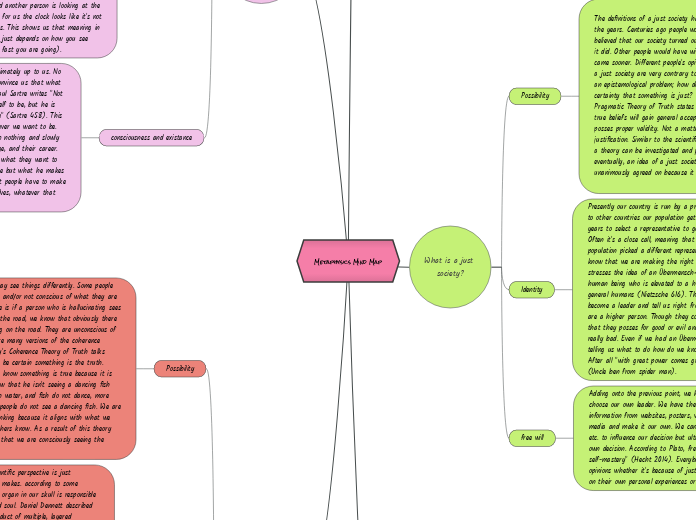
The definitions of a just society have changed over the years. Centuries ago people would have never believed that our society turned out the way that it did. Other people would have wished that it came sooner. Different people's opinions about what a just society are very contrary to each other. It's an epistemological problem; how do we know with certainty that something is just? Peirce’s Pragmatic Theory of Truth states that in time true beliefs will gain general acceptance if they posses proper validity. Not a matter of fate but justification. Similar to the scientific method where a theory can be investigated and proven true, eventually, an idea of a just society will be unanimously agreed on because it is infeasible.
Identity
Presently our country is run by a prime minister. Similar to other countries our population gets to vote every few years to select a representative to govern our country. Often it's a close call, meaning that a good deal of our population picked a different representative. How do we know that we are making the right decision? Nietzsche stresses the idea of an Übermensch— an exceptional human being who is elevated to a higher level above general humans (Nietzsche 616). The Übermensch could become a leader and tell us right from wrong since they are a higher person. Though they could use the power that they posses for good or evil and could turn out to be really bad. Even if we had an Übermensch or even God telling us what to do how do we know to believe them. After all "with great power comes great responsibility" (Uncle ben from spider man).
cambridge dictionary of philosophy
free will
Adding onto the previous point, we have the freedom to choose our own leader. We have the brainpower to absorb information from websites, posters, videos and all sorts of media and make it our own. We can use reason, passion, etc. to influence our decision but ultimately it is still our own decision. According to Plato, free will is "a kind of self-mastery" (Hecht 2014). Everybody has their own opinions whether it's because of justice or passion based on their own personal experiences or stories.
consciousness
How do we know that we exist? How do we know that we aren't imagining the entire universe and all the people in it? This epistemological problem has had many philosophers stumped and creating explanations. Descartes explains that he can doubt if he has a body and he can doubt if anything in the world really exists. Even so the reality is that he is thinking these things therefore there is no reason to think that his mind doesn't exist but all other matter could just be inventions of his mind (Descartes 81). The fact that he can be conscious of his thoughts is sufficient reason for him to know that he exists but he does not know what he is.
RENE DESCARTES
Existance
We see hundreds of things everyday, how are we sure that we are actually seeing these things? What if we are only seeing the appearance of these objects? Nietzsche argues that things and values don't have an absolute "existence" in themselves (Nietzsche 615). When we experience an object we are only experiencing its appearance. Our knowledge of the world could be completely different from another person's knowledge of this world. The world may be inconsistent in the way that it presents itself to different people (Ibid 615). If that is the case that means that our perception of the world is just a world of our own ideas and it could actually contain nothing, or something completely different.
The Cambridge dictionary of philosophy
abstract objects and mathematics
there are many things in the world which we do not know about. Through our senses we can not deny the presence of material objects, but many of the things that we know are not actual objects. Much of our knowledge is concepts and it cannot be physically seen by other people. For example, numbers. Aristotle says that things like numbers have a real universal existence even though they are not material objects. Realists believe that even though numbers are only just a concept you cannot deny that they exist, they exist in a separate world away from our minds. Our knowledge must be put to the test to prove that it is valid and real.
Free will and Determinism
If every event that happens has an ultimate reason then everything that you do in your life has meaning. Leibniz's Principle Of Sufficient Reason states this exact thing. According to the principle nothing happens without a reason. When we make a decision it is influenced by a decision made in the past and it will influence decisions made in the future. Even the lack of decision making will play a part in something. Often we do not know the cause or purpose of our decisions but one way or another it will change the outcome of the future. It is similar to a child asking why something happens and then asking over and over again because there is never an end.
“The fundamental principle of reasoning is that there is nothing without a reason; or to explain the matter more distinctly that there is no truth for which a reason does not subsist” (Leibniz [2], “Metaphysical Consequences of the Principle of Reason,” 172).
https://1000wordphilosophy.com/2018/03/27/leibnizs-principle-of-sufficient-reason/
Space and time
Meaning in life could mean different thing to different people. They may have a lower threshold of of what meaning means to them. Meaning in life is relative. Two people may have the exact same schedule for their day, one person may find meaning in their time spent helping people while the other finds more meaning in the time that they spent finishing their homework. This is where Einstein's Principle of Relativity comes in. The Principle of Relativity is a scientific fact but it can also help explain the metaphysical question "what is a meaningful life?". Basically, according to the theory, time changes how we perceive things. If we are looking at a clock and traveling at the speed of light and another person is looking at the same thing and walking, for us the clock looks like it's not moving but in reality it is. This shows us that meaning in our life is relative and it just depends on how you see things (kind of like how fast you are going).
consciousness and existance
The creation of meaning in life is ultimately up to us. No one else can tell us what to do or convince us that what we do doesn't have meaning. Jean-paul Sartre writes "Not only is man what he conceives himself to be, but he is also only what he wills himself to be" (Sartre 458). This shows us that we can become whatever we want to be. Throughout one's life they start from nothing and slowly build up belongings, friends, knowledge, and their career. People are able to constantly choose what they want to do. He also says "Man is nothing else but what he makes of himself" (ibid 458). Meaning that people have to make effort to make something of themselves, whatever that may be.
Reason and responsibility
Possibility
Different people may see things differently. Some people might be impaired and/or not conscious of what they are seeing. An example is if a person who is hallucinating sees a fish dancing on the road, we know that obviously there are no fish dancing on the road. They are unconscious of this fact. There are many versions of the coherence theory but Bradley's Coherence Theory of Truth talks about how we can be certain something is the truth. Fundamentally, we know something is true because it is consistent. We know that he isn't seeing a dancing fish because fish live in water, and fish do not dance, more importantly other people do not see a dancing fish. We are justified in our thinking because it aligns with what we know and what others know. As a result of this theory we can be certain that we are consciously seeing the world around us.
Mind and Matter
Consciousness from a scientific perspective is just something that our brain makes. according to some philosophers the 3 pound organ in our skull is responsible for our consciousness, and soul. Daniel Dennett described consciousness as "the product of multiple, layered computer programs running on the hardware of the brain" (The New Yorker). Dennett is a physicalist, physicalists believe that things like consciousness can be explained physically correlating with neurons, and brainwaves. He believes that the brain controls the the soul you can tell if something is conscious with science. Using a zombie as an example, you would have to analyze it's brain and the brain waves, electricity, etc. to tell you whether or not the zombie is conscious. Likewise animals "sort of" have consciousness because they have a fraction of the same parts of the brain. All of the parts of our brain work together to create our consciousness, so if an animals only has some then they have some consciousness.
https://www.newyorker.com/magazine/2017/03/27/daniel-dennetts-science-of-the-soul (stuff on personhood aswell)
space and time
We cannot possibly be conscious of everything that is going on. Using quantum mechanics specifically, the double slit experiment as an example, the light/ information goes through a lot of steps to get to our brain. The light first goes through the screen, then wires, then the computer, and lastly through our retinas. The chain is called the Von-Neumann chain. During one of these steps the wave function collapses, "consciousness collapses the wave function" (PBS Space Time). We don't know which spet the happens in. Another experiment, the Wigner’s friend experiment explains how if you weren't conscious of the result and your friend was the one who told you, the wave would collapse when you become conscious of the fact. Meaning that the wave would collapse at different time for both of you. If our consciousness is the reason for the collapse then maybe it would be better if we weren't conscious of it.