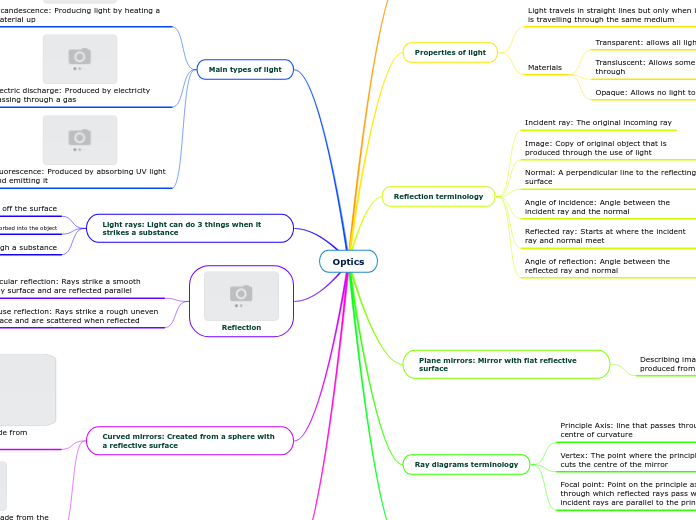
Optics
Light prodution
Natural: From the sun
Artificial: From lightbulbs, candles and fire
Properties of light
Light travels in straight lines but only when it is travelling through the same medium
Materials
Transparent: allows all light to pass through
Transluscent: Allows some light to pass through
Opaque: Allows no light to pass through
Reflection terminology
Incident ray: The original incoming ray
Image: Copy of original object that is produced through the use of light
Normal: A perpendicular line to the reflecting surface
Angle of incidence: Angle between the incident ray and the normal
Reflected ray: Starts at where the incident ray and normal meet
Angle of reflection: Angle between the reflected ray and normal
Plane mirrors: Mirror with flat reflective surface
Describing images: To describe images produced from plane mirrors we use SALT
Size: smaller, larger, or same size
Attitude: is the image upright or inverted
Location: Is it closer to the mirror or farther from it
Type: is it a virtual image or a real image
Ray diagrams terminology
Principle Axis: line that passes through the centre of curvature
Vertex: The point where the principle axis cuts the centre of the mirror
Focal point: Point on the principle axis through which reflected rays pass when the incident rays are parallel to the principle axis
Refraction: Refraction is the bending of light as it travels from one medium into
another (different) medium
Index of refraction: Ratio of speed of light in a vacuum to the speed of light in a medium
Formula
n: index of refraction
c: speed of light ((3.0 x 10(small 8) m/s)
v: speed of light in medium
Main types of light

Incandescence: Producing light by heating a material up
Electric discharge: Produced by electricity passing through a gas
Fluorescence: Produced by absorbing UV light and emitting it
Light rays: Light can do 3 things when it strikes a substance
Reflect: The rays bounce off the surface
Refract: Rays bend and light is absorbed into the object
Transmit: Rays go through a substance
Reflection
Specular reflection: Rays strike a smooth shiny surface and are reflected parallel
Diffuse reflection: Rays strike a rough uneven surface and are scattered when reflected
Curved mirrors: Created from a sphere with a reflective surface
Concave mirror: The reflection is made from the inner surface of the sphere
Virtual image: A image that is made by light coming from a light source but not from the actual image location
Real image: Image that is seen and is produced by light coming from the actual image location
The image is where the reflected rays intersect
Convex mirror: The image is made from the outer surface of the sphere
Images are always virtual, smaller and upright in a convex mirror
Internal reflection: When the ange of incidence is greater than the critical angle
Critical angle: the angle of incidence that results in an angle of refraction of 90⁰