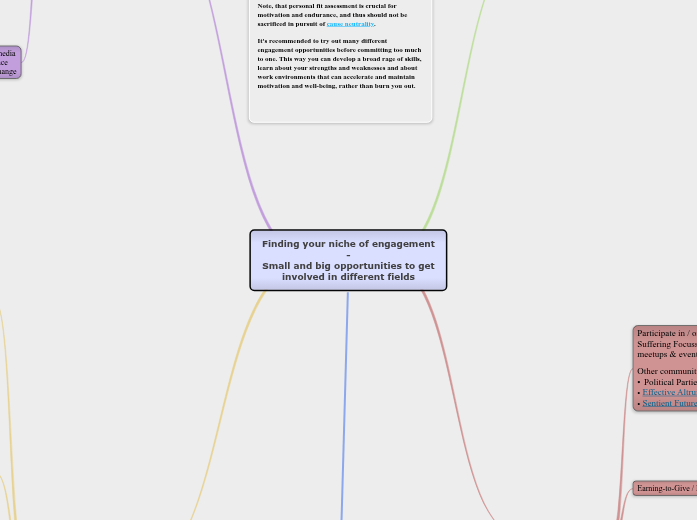
Finding your niche of engagement
-
Small and big opportunities to explore and get involved
- Advocacy
- Raising awareness
- Education
- Publicity
Events
and meetups
Participating in or organising meetups helps to exchange ideas and deepen understanding of and concern for the topics discussed.
Online
activism
Resource
sharing
Promoting content
that raises awareness /
educates etc.
'Liking' respective material throughout social media increases traction and motivates the authors. Cross-post resources where there might be a relevant audience, such as other activist groups or organisations (e.g. political parties, NGOs and educational and youth groups).
Remember to avoid being spammy and always maintain an attitude of service, not demand or judgement.
Translate relevant resources / literature / articles
Art and media
to influence
culture change
E.g. illustrations, memes, fictional and personal stories, blogs, video clips, (short) films, music, podcasts
Example: Helping people become open minded about abolishing carnism: Make / share compilations of (wild) carnivores befriended with their prey. Share them with us and incorporate those in your presentations / campaigns.
Online magazine
Examples: The School of Life, School of Thought and Center for Applied Rationality
Research
To increase wellbeing for all sentient beings and minimise risks of future suffering, research is needed across a broad range of domains to develop a broad range of new interventions and welfare oriented technologies.
To find more high impact research opportunities join the Effective Thesis Fellowship program.
And to increase the impact of your research e.g. by involving decision-makers check out the research guide by Charity Entrepreneurship.
Animal Welfare science
for wild animals and farmed animals.
Assessing the quality of life of various species in various environmental settings to find and assess welfare interventions. See Animal Ethics & Wild Animal Initiative
Fertility control (See also: Influencing Policy)
Compassionate population control to replace lethal or other aggressive population control strategies.
'Pests'
Rodents
Rodent Fertility Control: What It Is and Why It’s Important
Laboratory Evaluation of the Effectiveness of the Fertility Control Bait ContraPest® on Wild-captured Black Rats
Stray pets
Parsemus Foundation
Alliance for Contraception in Cats and Dogs (ACC&D)
Wildlife
Meta Orgs:
- Wild Animal Initiative
- Botstiber Institute for Wildlife Fertility Control
Overpopulating species
e.g. deer, wild boar, rabbits,
pigeons, neobiota / invasive species...
Nicarbazin: an avian reproductive inhibitor for pigeons and geese
Immunocontraception for feral pigs
Grey squirrel fertility control
Wildlife contraception and welfare by Simon Eckerström Liedholm and the Wild Animal Initiative
Wildlife Contraception — Issues, Methods, and Applications
'Dangerous species'
e.g. parasites, carnivores,
disease transmitting species
Sterile Insect Technique
Tsetse fly eradicated on the Island of Zanzibar
Screwworm Free Future
Predator Free 2050
Welfare Footprint Institute
Sentient Futures
CaML: shaping how advanced AI treats sentient beings.
Center on Long-Term Risk: addressing worst-case risks from advanced AI, with current focus on conflict scenarios and the technical and philosophical foundations of cooperation.
Sentient Futures: capacity building & fellowship programs
The Good Food Institute
Healthspan Action Coalition (HSAC)
XPRIZE Healthspan
Capacity Building
Participate in / organise
Suffering Focussed (Compassionate) Impact meetups & events.
Other communities to tap into:
- Political Parties
- Effective Altruism
- Sentient Futures
Prepare talks / workshops on
Moral Psychology
Cause Areas
Existing Body of Work
Impact Optimisation Tools & Strategies
Neglected Opportunities of Impact
Moral Philosophy
Profession-specific networking and conferences
Self-education /
study groups
Reading group
Prioritisation workshops
Go to / watch relevant talks in pairs / groups (e.g. from international animal rights conference/ Effective Animal Advocacy) and then discuss relevance for your own approach.
Earning-to-Give / Effective Giving
Fundraising
On an individual level e.g. by using fundraising via FB during holidays, birthdays, match makers.
On an organisational level: Funds, prizes and contests for research contributing to abolishing suffering.
See Founding to Give
See AIM Grantmaking
Opportunity Board (jobs and volunteering)
See e.g. CRS’s Career Advice
Other Examples:
- EA Work Club
- 80,000 Hours
- Animal Advocacy Careers
Newsletter with
High Impact Jobs & Volunteering opportunities in most relevant cause areas
Updates from most relevant organisations
Upcoming Events
Influencing Policymaking
Systemic foundations
Before specific welfare policies can take hold, the underlying political and institutional environment needs to support them sustainably.
CFI’s Evolutionary Anthropology & Prosocial System Design
Power for Democracies
CRS’s Improving our political system
OPIS’s Guide to Compassionate Governance
EA Forum Improving institutional decision-making
Cause-specific policy ambitions
Fertility control
'Pests'
Rodents
Rodent Fertility Control: What It Is and Why It’s Important
Laboratory Evaluation of the Effectiveness of the Fertility Control
Bait ContraPest® on Wild-captured Black Rats
Insects
Tsetse fly eradicated on the Island of Zanzibar
Sterile Insect Technique
Stray pets
Wildlife
Overpopulating species
e.g. deer, wild boar, rabbits,
pigeons, neobiota / invasive species...
Nicarbazin: an avian reproductive inhibitor
for pigeons and geese
Intervention Report: Wildlife Contraception
Wildlife Contraception —
Issues, Methods, and Applications
'Dangerous species'
e.g. parasites, carnivores,
disease transmitting species
Predator Free 2050
Removing dependency on
animal (derived) products
Making cellular research independent from bovine calf serum: not only for in-vitro meat development, but also to make in-vitro research vegan.
Lobbying for vegan dietary in kindergarten / schools / public institutions and events.
Lobbying for
animal rights
Fighting speciesist approach on rights: not humanness, nor intelligence matters, but ability to suffer
Acknowledgement of sentient entities as entities requiring rights protected by law
Long term plan:
Promotion of a sentience welfare system
Right to have interests represented by independent qualified allies
Genetic welfare for sentient beings
Community Genetics in Israel
Compassionate Genomics & Genomic Welfare
Public funding, prizes and research incentives to help accelerate research that may contribute to preventing suffering and improving welfare long-term
Promoting (development of) animal free
biotechnological / medical
research and testing.
Making cellular research independent of bovine calf serum: not only for in-vitro meat development, but also to make in-vitro research vegan/vegetarian.
Reduce, Refine, Replace
Particularly promising interventions are tentatively listed at the top and highlighted.
Note, that personal fit assessment is crucial for motivation and endurance, and thus should not be sacrificed in pursuit of cause neutrality.
It's recommended to try out many different engagement opportunities before committing too much to one. This way you can develop a broad rage of skills, learn about your strengths and weaknesses and about work environments that can accelerate and maintain motivation and well-being, rather than burn you out.
Enterprises / institutions
Existing enterprises / institutions
Education
Center for Applied Rationality
School of Thought
Fertility control
SenseTech: offering rodent fertility control
Ovocontrol: offering pigeon fertility control
Oxitec: offering insect fertility control
Think tanks / research
Invincible Wellbeing
Animal Ethics
Sentience Institute
Sentience Politics
Center on Long-Term Risk
Center for Reducing Suffering
Qualia Research Institute
Organisation for the Prevention of Intense Suffering
Algosphere Alliance
Wild Animal Initiative
Cellular agriculture
For-profit organisations
Contract Manufacturing Database
Alternative protein company database
Non-profit organisations
New Harvest
Good Food Institute
Cellular Agriculture Society
Transhumanism
Humanity+
Foresight Institute
Institute for Ethics and Emerging Technologies
Betterhumans
Transhumanist UK
Needed enterprises / institutions
Air cleaning technology:
producing oxygen, reducing CO2 and pollution -> making human quality of life independent from nature.
We need advocacy, marketing, fundraising, and research.
For information on the importance see the map of life expectancy reduction due to pollution or a video on lead poisoning.
For solution approaches see MechanicalTrees and examples no. 1, and no. 2.
Fertility control:
as opposition to poisoning and predation against ‘pest’ or population control of wild animals, and to reduce struggle for resources.
Production and sale of non-invasive fertility control products 'against' 'pests' and stray animals.
A genetic health organisation for all sentient beings
Offering conferences
Organising public image campaigns
Offering networking to politics, research and industry
Suffering abolition funds or prizes
Academic journal
Evaluation of (biotechnological) research papers in regard of their (potential) contribution to suffering abolition.
To be checked:
1. whether papers are specifically aiming for suffering abolition / promoting the concept of suffering abolition,
2. whether the research approach is ethical,
3. whether research/technological enhancement is (potentially) valuable for the suffering abolition,
4. has low risk for creating suffering (through abuse, lack of control etc.).
Suffering Research Institute
Robert Daoust's proposal