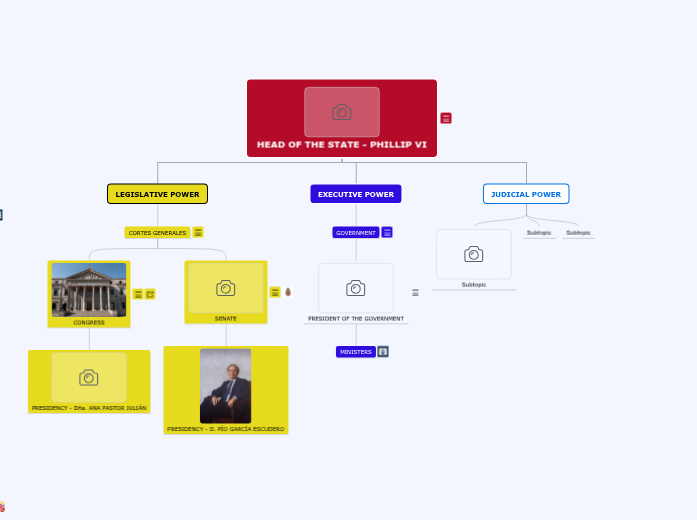

HEAD OF THE STATE - PHILLIP VI
Article 56 1. The King is the Head of State, the symbol of its unity and permanence. He arbitrates and moderates the regular functioning of the institutions, assumes the highest representation of the Spanish State in international relations, especially with those nations belonging to the same historic community, and exercices the functions expressly conferred on him by the Constitution and the law. Article 62 It is incumbent upon the King: a) to sanction and promulgate the laws; b) to summon and dissolve the Cortes Generales and to call elections under the terms provided in the Constitution; c) to call a referendum in the circumstances provided in the Constitution; d) to propose a candidate for President of the Government and, as the case may be, appoint him or remove him from office, as provided in the Constitution. e) to appoint and dismiss members of the Government on the proposal of its President; f) to issue the decrees agreed upon by the Council of Ministers, to confer civil and military positions and award honours and distinctions in conformity with the law; g) to be informed regarding affairs of State and, for this purpose, to preside over the meetings of the Council of Ministers whenever he deems opportune, at the request of the President of the Government; h) to exercise supreme command of the Armed Forces; i) to exercise the right to grant pardons in accordance with the law, which may not authorise general pardons;j) to exercise the High Patronage of the Royal Academies.
LEGISLATIVE POWER
CORTES GENERALES
Article 66 1. The Cortes Generales represent the Spanish people and consist of the Congress of Deputies and the Senate. 2. The Cortes Generales exercise the legislative power of the State, approve its Budget, control Government action and hold all the other powers vested in them by the Constitution. 3. The Cortes Generales are inviolable.
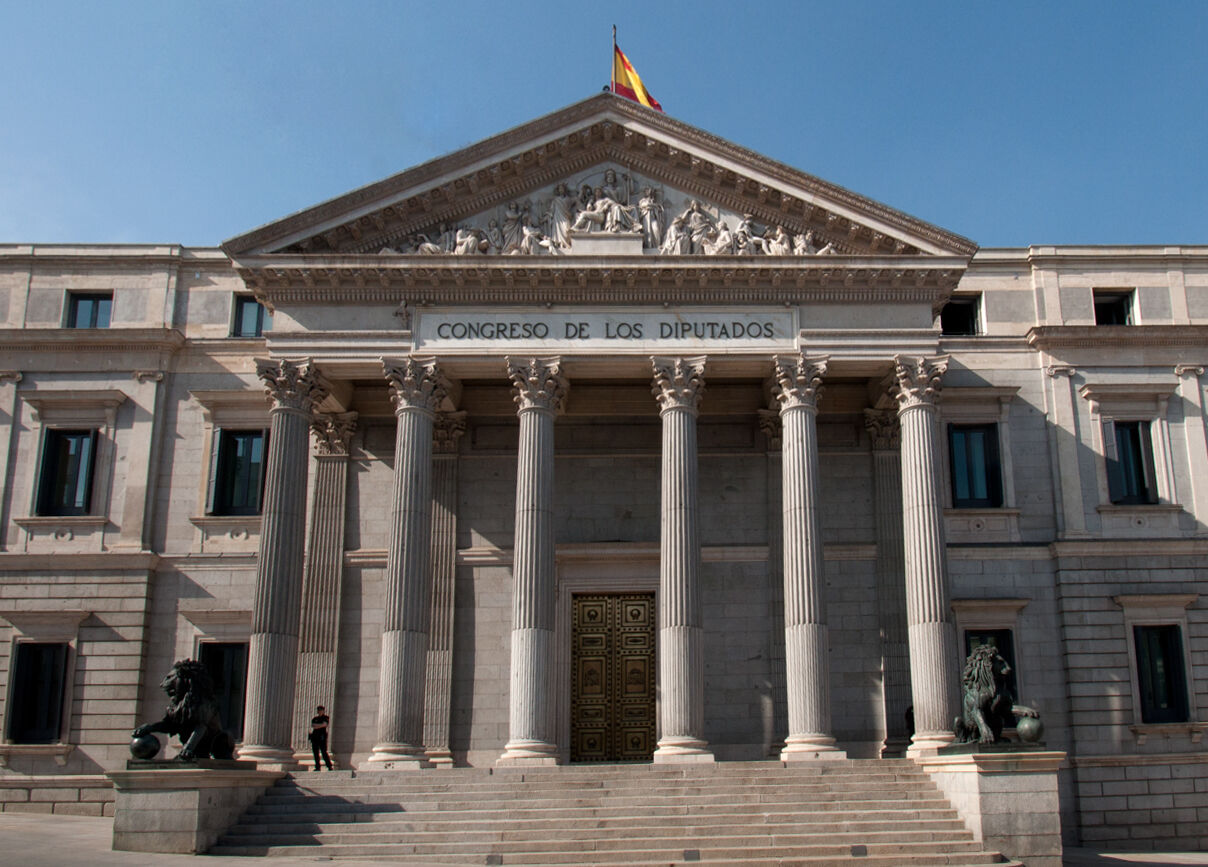
CONGRESS
Article 68 1. Congress consists of a minimum of three hundred and a maximum of four hundred Deputies, elected by universal, free, equal, direct and secret suffrage, under the terms established by law.
aPRESIDENCY - Dña. ANA PASTOR JULIÁN
SENATE
Article 69 1. The Senate is the House of territorial representation. 2. In each province, four Senators shall be elected by the voters thereof by universal, free, equal, direct and secret suffrage, under the terms established by an organic law.

PRESIDENCY - D. PÍO GARCÍA ESCUDERO
EXECUTIVE POWER
GOVERNMENT
Article 97 The Goverment directs domestic and foreign policy, civil and military administration and the defence of the State. It exercises executive and statutory authority in accordance with the Constitution and the law.Article 98 1. The Government consists of the President, Vice-Presidents, when applicable, Ministers and other members as may be created by law.
PRESIDENT OF THE GOVERNMENT
Article 982. The President directs Government action and coordinates the functions of the other members thereof, without prejudice to the competence and direct responsibility of the latter in carrying out their duties.
JUDICIAL POWER
Subtopic
Subtopic
Subtopic
