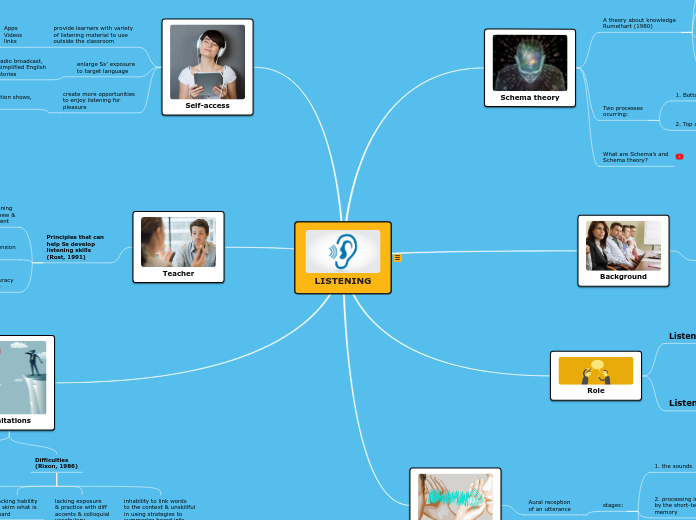

LISTENING

Schema theory
A theory about knowledge
Rumelhart (1980)
what we understand of something
how it’s represented
how it facilitates the use
of the knowledge in a
particular way
it’s a function of our
past experiences &
backgrounds
Two processes
ocurring:
1. Bottom up processing
involves the movement of data
from the page to the brain
2. Top down processing
represents an attempt by the
brain to fine an existíng
knowledge
What are Schema’s and
Schema theory?

Background
Listening comprehension in
learning English language
Involves individual units,
linguistic & cognitive skills,
strategies & expectations
that the listener uses to decide
what is presented
Role
Listening
in building language competence
should be focused on
strategies & techniques
to promote language
learning & comprehension
Listener
should not only understand
what is being said but also select
important & relevant info
reduce it so it can be
taken down quickly
in writing
Subtopic
Subtopic
remain understandable
for later intake

Process
Aural reception
of an utterance
stages:
1. the sounds
go into a sensory store
called “echonic” memory
are organized into meaningful units
according to the knowledge of the
language listener already has
2. processing info
by the short-term
memory
words or groups of
words are checked
and compared to info
already held in the long
term memory
and the meaning extracted
from them
3. construct meaning
from the utterance
if not fully
info may be transfer
to the long term memory
for later use
Self-access
provide learners with variety
of listening material to use
outside the classroom
Apps
Videos
links
They can self-access
& select according to
interest & level
enlarge Ss’ exposure
to target language
radio broadcast,
simplified English
stories
create more opportunities
to enjoy listening for
pleasure
watch conversation shows,
films, videos

Teacher
Principles that can
help Ss develop
listening skills
(Rost, 1991)
- focus on meaning
& try to learn new &
important content
by focusing on meaning
learners can mobilize both
their linguistic & non-lingustic
abilities to understand
- work on comprehension
activities
by focusing on specific goals
for listening, learners can
evaluate their efforts and abilities
- attention to accuracy
& analysis of form
by learning to hear sounds
& words more accurately,
learners gain more confidence
Limitations
Criticism
(Richards, 1992)
traditional approaches
to language teaching
tend to underemphasize
the importante of teaching
EFL listening comprehension
Difficulties
(Rixon, 1986)
Sound problems
including pronunciation
Lacking hability
to skim what is
heard
lacking exposure
& practice with diff
accents & colloquial
vocabulary
inhability to link words
to the context & unskillful
in using strategies to
summarize heard info
at the macro & micro level