Produkte
Mindmap Programm
Gliederungen Programm
Software für Gantt-Diagramme
Anwendungen
Mindmaps für Bildung
Mindmaps für Unternehmen
Mindmaps für die persönliche Entwicklung
Mindmapping Vorteile
Ressourcen
Funktionen
Bildung
Persönlich & Beruflich
Desktop
Videoanleitungen
Sehen Sie sich Tipps und Tricks zur Verwendung von Mindomo an.
Hilfezentrum
Detaillierte Hilfeanleitung zur Konfiguration und Verwendung von Mindomo.
Artikel
Was ist eine Mindmap?
Wie man eine Mindmap erstellt?
Wie kann man mit Mindmaps Notizen machen?
Mindmapping als assistive Technologie
Was ist eine Concept Map?
Die 29 besten Mindmap-Beispiele
Preise
Anmelden
Registrieren
Produkte
Mindmap Programm
Gliederungen Programm
Software für Gantt-Diagramme
Anwendungen
Mindmaps für Bildung
Mindmaps für Unternehmen
Mindmaps für die persönliche Entwicklung
Mindmapping Vorteile
Artikel
Was ist eine Mindmap?
Wie man eine Mindmap erstellt?
Wie kann man mit Mindmaps Notizen machen?
Mindmapping als assistive Technologie
Was ist eine Concept Map?
Die 29 besten Mindmap-Beispiele
Funktionen
Bildung
Persönlich & Beruflich
Desktop
Hilfe
Videoanleitungen
Hilfezentrum
Preise
Registrieren
Anmelden
Kategorien:
Alle
von
capi capija
Vor 8 Jahren
370
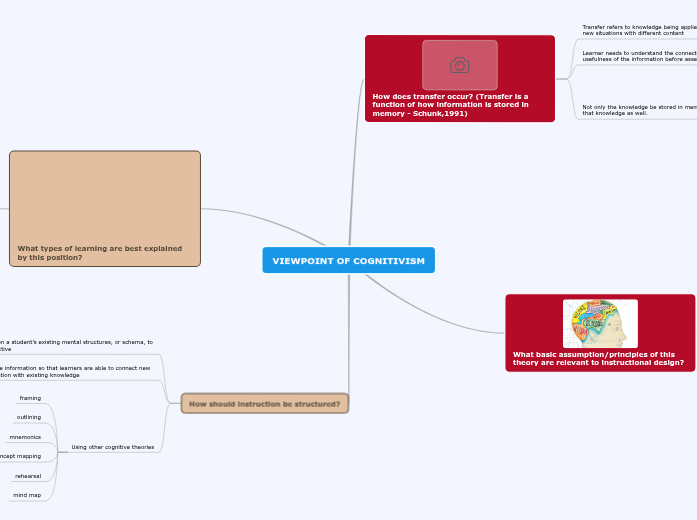
VIEWPOINT OF COGNITIVISM
Öffnen
VIEWPOINT OF COGNITIVISM
How should instruction be structured?
Using other cognitive theories
mind map
rehearsal
concept mapping
mnemonics
outlining
framing
organize information so that learners are able to connect new information with existing knowledge
based on a student’s existing mental structures, or schema, to be effective
What types of learning are best explained by this position?
effectiveness and efficiency of knowledge transfer are simplification and standardization.
appropriate for explaining complex forms of learning
information-processing
Problem-solving
Reasoning
What basic assumption/principles of this theory are relevant to instructional design?
Creation of learning environments that allow and encourage students to make connections with previously learned material
Recall of prerequisite skills; use of relevant examples, analogies
Emphasis on structuring, organizing, and sequencing information to facilitate optimal processing
Use of cognitive strategies such as outlining, summaries, synthesizers, advance organizers, etc.
Use of hierarchical analyses to identify and illustrate prerequisite relationships
Cognitive task analysis procedures
Emphasis on the active involvement of the learner in the learning process
Learner control, meta cognitive training (e.g., self-planning, monitoring, and revising techniques)
People learn through practice and feedback opportunities
computer simulations
Cognitivists examine the learner to determine how to design instruction so that it can be readily assimilated
Cognitivists look at the learner to determine his/her predisposition to learning
The use of feedback
cognitivists make use of feedback (knowledge of results) to guide and support accurate mental connections.
How does transfer occur? (Transfer is a function of how information is stored in memory - Schunk,1991)
Not only the knowledge be stored in memory but the uses of that knowledge as well.
Constructing a meaning to the information being processed
Rehearse the information and start putting this gained information into context from previous acquired knowledge
Select relevant information
Learner needs to understand the connection between the usefulness of the information before assessing the knowledge
Transfer refers to knowledge being applied in new ways, in new situations with different content