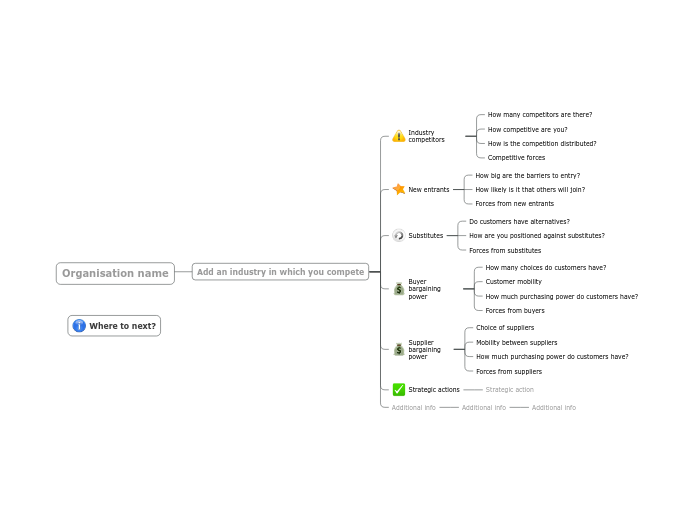
This mind map will help you analyze the forces on your organization with the Porter's Five Forces model, which examines how external forces control pricing and profit levels. Firstly, begin by specifying your industry’s competitors, how they are distributed, and estimate their competitive position and their forces on the market. Evaluate the newcomers on the market and their forces: how likely is for others to enter the industry and what challenges they will encounter. Consider the alternatives of your products or services and assess how appealing they are compared to the others available to consumers. Grade your products or services position against other options out there. An individual has the opportunity and freedom to choose a product or service selected from at least two options available. Determine how many sources of similar products or services a customer finds and rank the strength of their negotiation. After evaluating the consumers' habits and forces, think of yourself as a manufacturer or entrepreneur and identify the options of suppliers you have, and rank your flexibility when it comes to changing them. Porter's Five Forces is a method for examining the competitive environment of an organization and can be used as a business guideline for competitive strategies. Although this analysis is fairly simplistic, it may take some time to develop, because it needs good insight into the behavior of each industry or market in which you compete. Begin by typing in the name of your organisation. Type in the name of an industry or sector in which your organisation competes. Looking at the positive and negative forces in each market, type in a strategic action based on the importance and volume of the market, and the strength of negative forces. Looking at the answers above, how do you rate the bargaining power of suppliers of materials and services used in this market? Do you make big enough purchases to be able to negotiate pricing with your suppliers in this market? Is it easy for you to switch between suppliers for the materials and services you purchase? How many choices do you have in terms of suppliers? Are there many suppliers for the materials you use? Looking at the answers above, how do you rate the bargaining power of buyers in this market? Do customers make enough purchases to negotiate their pricing? Is it easy for customers to switch between comparable products and services? Are there multiple sources of comparable products and services? Looking at the answers above, how do you rate your position against substitutes? Is your product or service attractive, when compared to the substitutes available to customers? How essential is your product or service to customers? Are there many alternatives to buying from you? Looking at the answers above, how do you rate the position of new entrants in the market? Rate the probability by clicking an icon below: If a new organization wanted to join this industry, how big are the barriers to entry? Looking at the answers above, how do you rate your competitive position in the market? Are there lots of similar players, or is the market dominated by a few players? Rate your competitiveness by choosing an option below: Assess the amount of competition by choosing one of the options below: Los mapas mentales ayudan a realizar lluvias de ideas, establecer relaciones entre conceptos, organizar y generar ideas. Sin embargo, las modelos de mapas mentales ofrecen una forma más fácil de empezar, ya que son estructuras que contienen información sobre un tema específico con instrucciones orientativas. En esencia, las modelos de mapas mentales garantizan la estructura que combina todos los elementos de un tema específico y sirven como punto de partida para su mapa mental personal. Son un recurso que proporciona una solución práctica para crear un mapa mental sobre un tema concreto, ya sea para los negocios o para la educación. Mindomo le ofrece modelos de mapas mentales inteligentes que le permiten funcionar y pensar sin esfuerzo. Puede elegir entre una variedad de modelos de mapas mentales de las cuentas empresariales o educativas de Mindomo, o puede crear sus propios modelos de mapas mentales desde cero. Cualquier mapa mental puede transformarse en un mapa plantilla añadiendo notas orientativas a uno de sus temas.Porter's 5 forces Template
Acerca de esta plantilla
Use the Porter's 5 forces analysis template to identify the industry's structure and to assess your corporate strategy.
Where to next?
It is worth collaborating with your colleagues, who may each have specialist knowledge in one or two sectors. Inputs can then be combined to prioritize strategic actions.
Share your mind mapOrganisation name
Add an industry in which you compete
This mind map will help you to analyse your position in that industry.Additional info
Strategic actions
Strategic action
Strategies may include:Supplier bargaining power
Forces from suppliers
Rate your purchasing power:Mobility between suppliers
Rate your mobility by choosing an option below:Choice of suppliers
Assess your range of choice by choosing an option below:Buyer bargaining power
Forces from buyers
How much purchasing power do customers have?
Rate their purchasing power by choosing an option below:Customer mobility
How many choices do customers have?
Assess the customer's freedom of choice by choosing an option below:Substitutes
Forces from substitutes
How are you positioned against substitutes?
Rate your position:Do customers have alternatives?
Assess the range of alternatives:New entrants
Forces from new entrants
How likely is it that others will join?
How big are the barriers to entry?
Assess the barriers by choosing an option below:Industry competitors
Competitive forces
How is the competition distributed?
Rate the distribution:How competitive are you?
How many competitors are there?
¿Por qué utilizar una modelo de mapa mental Mindomo?
Una plantilla tiene varias funcionalidades:
-
Productos
-
Usos
- Usos generales
- Mapas Mentales para la Educación
- Mapas Mentales para Empresas
- Mapas Mentales para el Desarrollo Personal
- Tecnología Asistida
- Colaboración en equipo
- Briefs de campaña para profesionales de marketing
- Talleres de descubrimiento de clientes para consultores
- Recorridos de onboarding para RR. HH. y L&D
- Gestión del conocimiento
- Matriz de competencias del equipo
- Biblioteca de proyectos
- Roles
- Profesionales de marketing
- RR. HH. y L&D
- Consultores
- Gestión de proyectos
- Planificación de campañas de marketing
- Despliegues de formación de empleados
- Alcance del trabajo
- Organización de ideas
- Árboles de problemas
- Análisis de necesidades de formación
- Beneficios de los Mapas Mentales
-
Soluciones
- Guías
- Hacer presentaciones con mapas mentales
- Aprender con mapas mentales
- Planificar y organizar con mapas mentales
- Priorizar tareas con mapas mentales
- Tomar notas con mapas mentales
- Historias reales de clientes
- Escalar contenido educativo para 11.000 médicos
- Flujo de trabajo en equipo: de la prueba a imprescindible en dos meses
- 10 años sin diapositivas: repensar las clases de arquitectura
- Leer todas las historias
-
Recursos
- Aprende lo básico
- Los 29 mejores Ejemplos de Mapas Mentales
- Programa de Gantt
- ¿Cómo hacer un Mapa Mental?
- Creador de Diagramas de Gantt
- Guías y Soporte
- Tutoriales en video
- Centro de ayuda
- Foro
- Ejemplos y plantillas
- Qué es un Mapa Conceptual
- Creador de Mapas Conceptuales
- Plantilla de Mapa Conceptual
- Plantillas de Diagramas
- Páginas de funciones
- Educación
- Tareas para profesores
- Trabajo & Personal
- Desktop
- El blog de Mindomo
- Precios
- Iniciar sesión
- Registrarse
- Panel de control
Gestión del conocimiento
Beneficios de los Mapas Mentales
Por qué el pensamiento visual facilita recordar y planificar.
Aprende lo básico
Guías y Soporte
Ejemplos y plantillas
Páginas de funciones
 Blog
El blog de Mindomo
Guías, ejemplos e investigación sobre el pensamiento visual.
Ver todos los artículos
Blog
El blog de Mindomo
Guías, ejemplos e investigación sobre el pensamiento visual.
Ver todos los artículos