
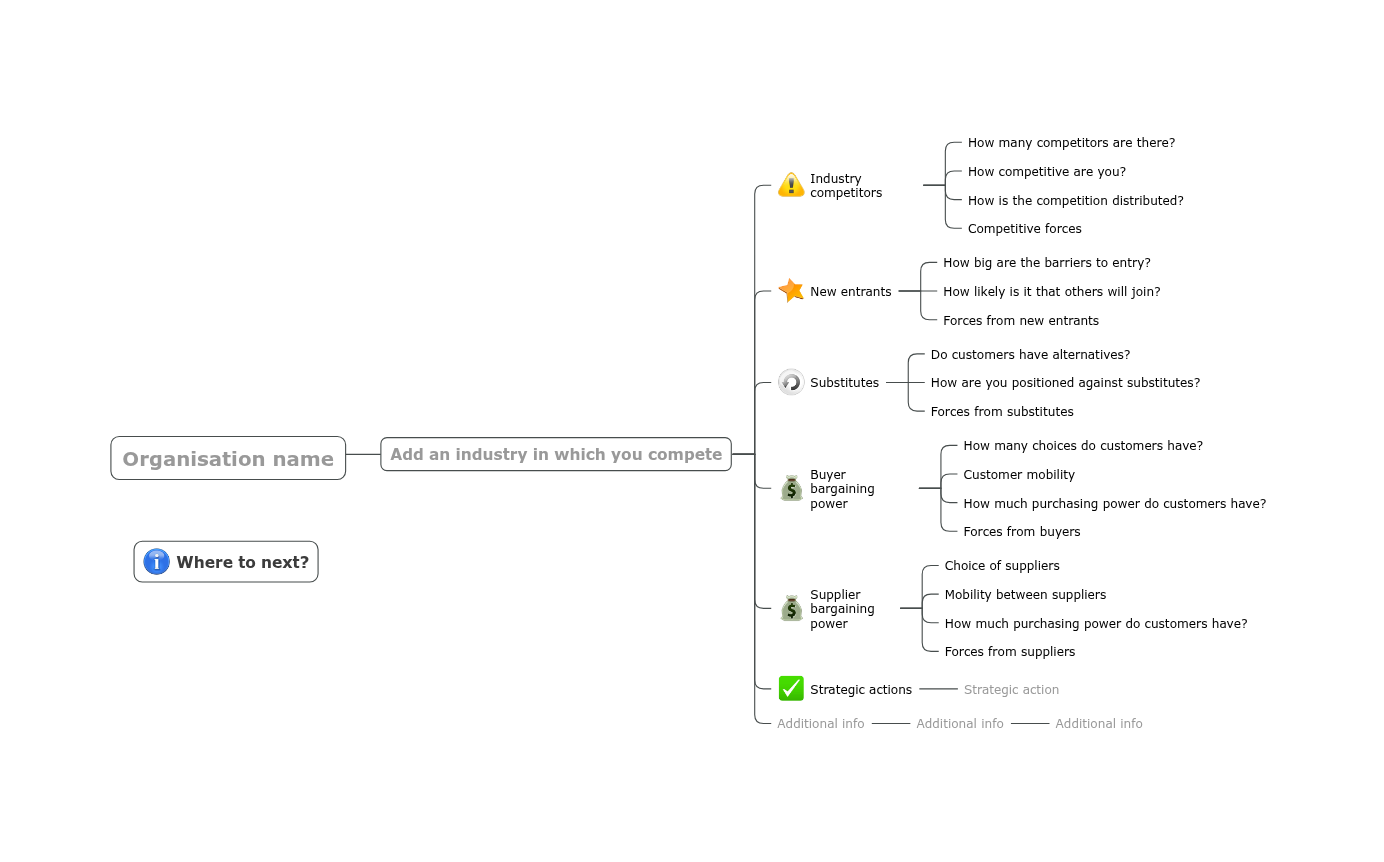
Add an industry in which you compete
6 topicsType in the name of an industry or sector in which your organisation competes. This mind map will help you to analyse your position in that industry.
Industry competitors
- How many competitors are there? — Assess the amount of competition by choosing one of the options below: Lots of competitors, making it hard to get noticed A few competitors Almost no competitors and little choice
- How competitive are you? — Rate your competitiveness by choosing an option below: We often lose to competitors We win sometimes and lose sometimes We win most of the time
- How is the competition distributed? — Are there lots of similar players, or is the market dominated by a few players? Rate the distribution: A few major names dominate the market, but we are a minor player The market is not really dominated by anyone A few major names dominate the market, and we are one of them
- Competitive forces — Looking at the answers above, how do you rate your competitive position in the market? Our competitive position is a negative force that makes us vulnerable Our competitive position is neither helping nor hindering Our competitive position is a positive force for us
New entrants
- How big are the barriers to entry? — If a new organization wanted to join this industry, how big are the barriers to entry? Assess the barriers by choosing an option below: Few barriers, making it easy for others to walk in Another organization could join with some dedication Serious investment is needed to join this industry
- How likely is it that others will join? — Rate the probability by clicking an icon below: Probable: it is a profitable market and demand keeps prices high Possible: it is a growing market and could be profitable in the future Unlikely: profits are low, and the market is already saturated, or even shrinking
- Forces from new entrants — Looking at the answers above, how do you rate the position of new entrants in the market? It is both easy and attractive for new entrants to join this market New entrants could join if they perceive enough advantages It is both difficult and unattractive for new entrants to join
Substitutes
- Do customers have alternatives? — How essential is your product or service to customers? Are there many alternatives to buying from you? Assess the range of alternatives: Our product or service is optional, and/or it is easy for customers to find substitutes Customers prefer to buy, but can find substitutes if motivated Our product or service is essential, and/or there are very few acceptable substitutes
- How are you positioned against substitutes? — Is your product or service attractive, when compared to the substitutes available to customers? Rate your position: Our product or service requires more customer commitment and appreciation than many of the substitutes Our product or service is roughly equal to most of the substitutes Our product or service is a more compelling option than most of the substitutes
- Forces from substitutes — Looking at the answers above, how do you rate your position against substitutes? Customers can easily adopt substitutes and our product or service is not compelling Substitutes are available, but customers usually prefer our type of product or service There are few viable substitutes and our type of product or service is valued by customers
Buyer bargaining power
- How many choices do customers have? — Are there multiple sources of comparable products and services? Assess the customer's freedom of choice by choosing an option below: There are many vendors with very similar products or services There are only a few vendors of comparable products and services Most of the products and services have special features
- Customer mobility — Is it easy for customers to switch between comparable products and services? It is easy and inexpensive for a customer to switch from one vendor to another Customers can switch if they are motivated to Customers are generally locked into a product or service, and it is costly to switch
- How much purchasing power do customers have? — Do customers make enough purchases to negotiate their pricing? Rate their purchasing power by choosing an option below: Customers make significant purchases and demand discounts Some discounts are expected, but we can control them Pricing is not usually negotiable and customers accept our pricing
- Forces from buyers — Looking at the answers above, how do you rate the bargaining power of buyers in this market? Customers can control price negotiations by having the freedom to take important business elsewhere Price negotiations do happen but are balanced Customers cannot negotiate terms
Supplier bargaining power
- Choice of suppliers — How many choices do you have in terms of suppliers? Are there many suppliers for the materials you use? Assess your range of choice by choosing an option below: We have trouble finding alternative sources of supply for the materials and services we need There are a few suppliers for the materials and services we buy We can purchase similar materials and services from multiple suppliers
- Mobility between suppliers — Is it easy for you to switch between suppliers for the materials and services you purchase? Rate your mobility by choosing an option below: We are locked into single suppliers and it would be expensive to change them We could switch if we needed to It is easy for us to use materials and services from multiple suppliers
- How much purchasing power do customers have? — Do you make big enough purchases to be able to negotiate pricing with your suppliers in this market? Rate your purchasing power: Our purchase volumes are not really important to our suppliers We get the same discounts as everyone else Our purchases are big enough to make suppliers deal with us personally
- Forces from suppliers — Looking at the answers above, how do you rate the bargaining power of suppliers of materials and services used in this market? There are only a few suppliers and we are locked in We have limited freedom for negotiation with our suppliers We can control price negotiations with our suppliers
Strategic actions
- Strategic action — Looking at the positive and negative forces in each market, type in a strategic action based on the importance and volume of the market, and the strength of negative forces. Strategies may include: Making your products and services more competitive in this market Making your products and services more difficult to emulate, deterring others from joining the market Making your products and services more valuable when compared to substitutes