

Concept map maker: Free to start, online and collaborative
Mindomo is a concept map maker for the browser, desktop and mobile. Put your concepts in boxes, join them with arrows, and label every arrow with a linking word such as “increases” or “is part of”, so each link reads as a statement. Then share the map and edit it with others in real time.
This page shows how to make a concept map in Mindomo, what the editor can do, and how to start from a template. New to the method? Start with what a concept map is.

On this page
How to make a concept map in Mindomo
Six steps take you from a blank page to a shared map. The example is a map of how hybrid work affects a company: the screenshots show it at each step. These steps cover the clicks in Mindomo; for the method itself (a focus question, ordering concepts from general to specific, choosing linking words), see our in-depth guide on how to make a concept map.
1. Start a blank concept map
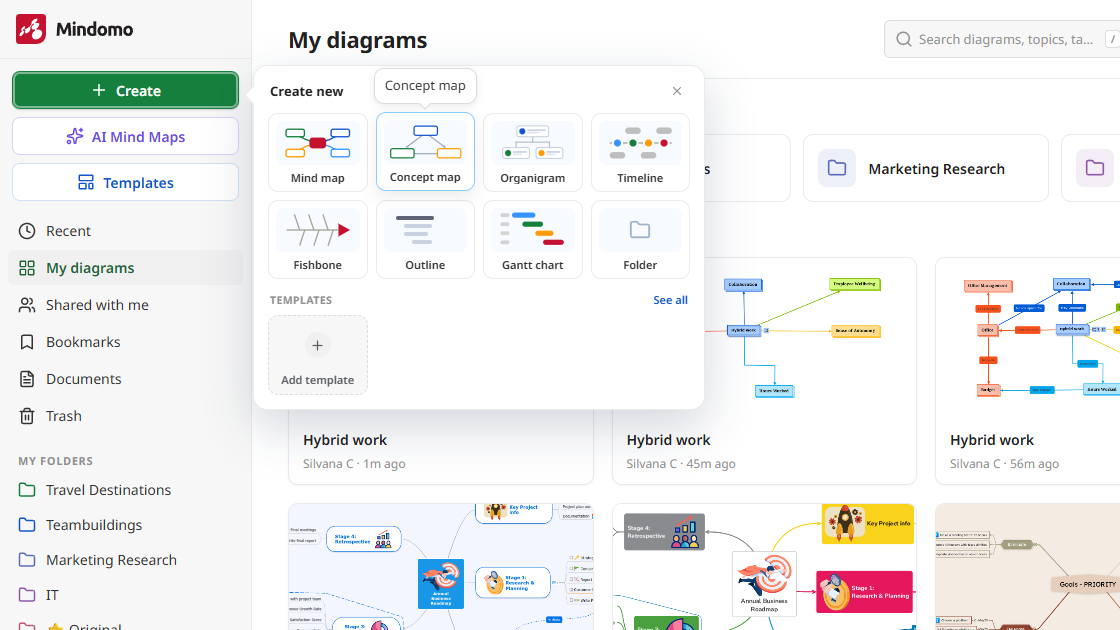
Sign in, select Create on your dashboard, and choose Concept map. Type your main concept in the first topic: the most general idea of the map, usually one or two words. In the example it is “Hybrid work”.
It helps to write down the question the map should answer before you start, such as “How does hybrid work change a company?” Every concept you add should help answer it.
2. Add the related concepts
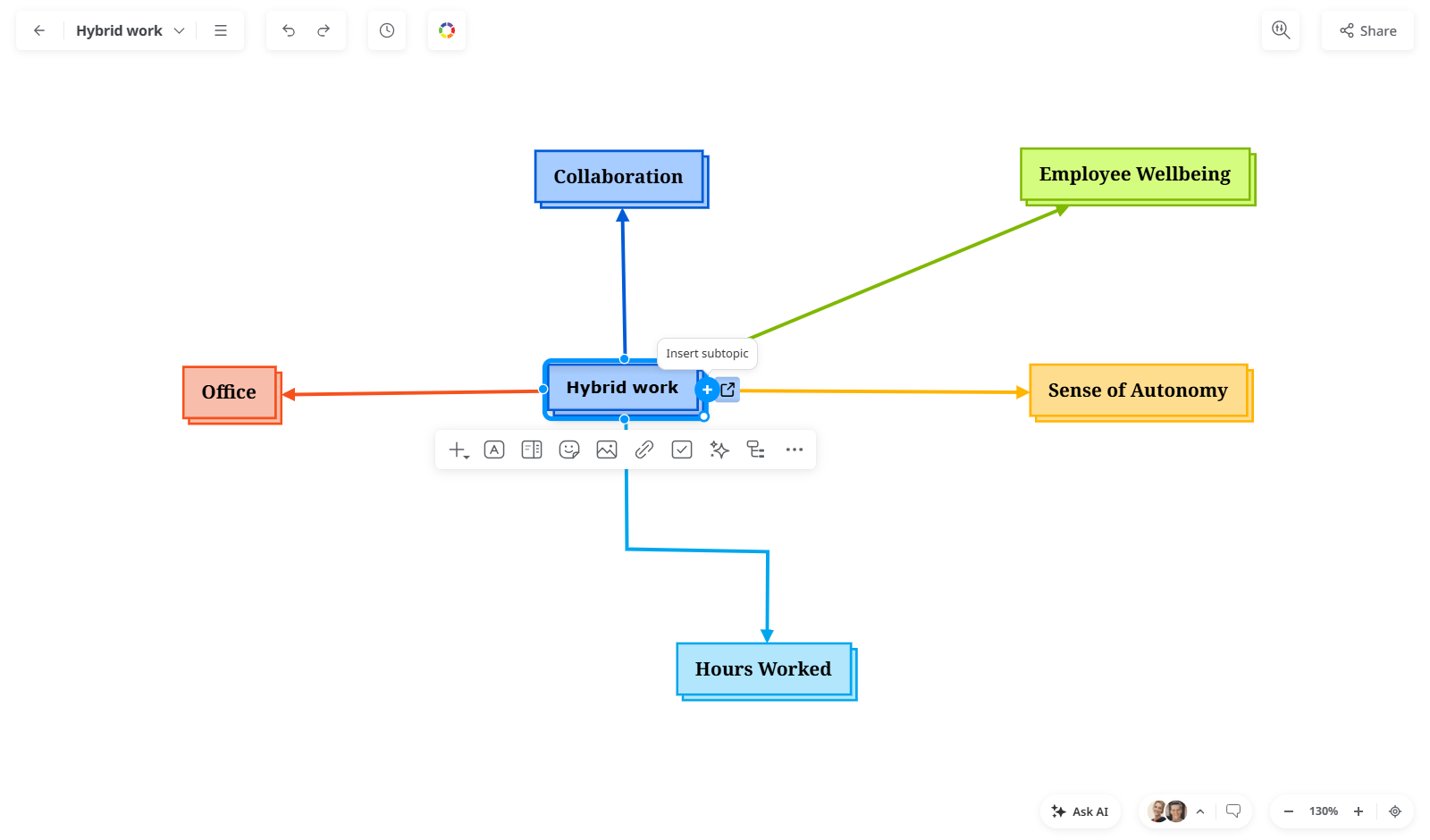
Add the concepts that relate to the main one. Select a topic and press Tab to add a concept below it, or Enter to add one on the same level; the + on the edge of a selected topic does the same. Mindomo joins each new concept to its parent with an arrow.
The example adds Collaboration, Employee Wellbeing, Office, Sense of Autonomy and Hours Worked.
3. Label every arrow
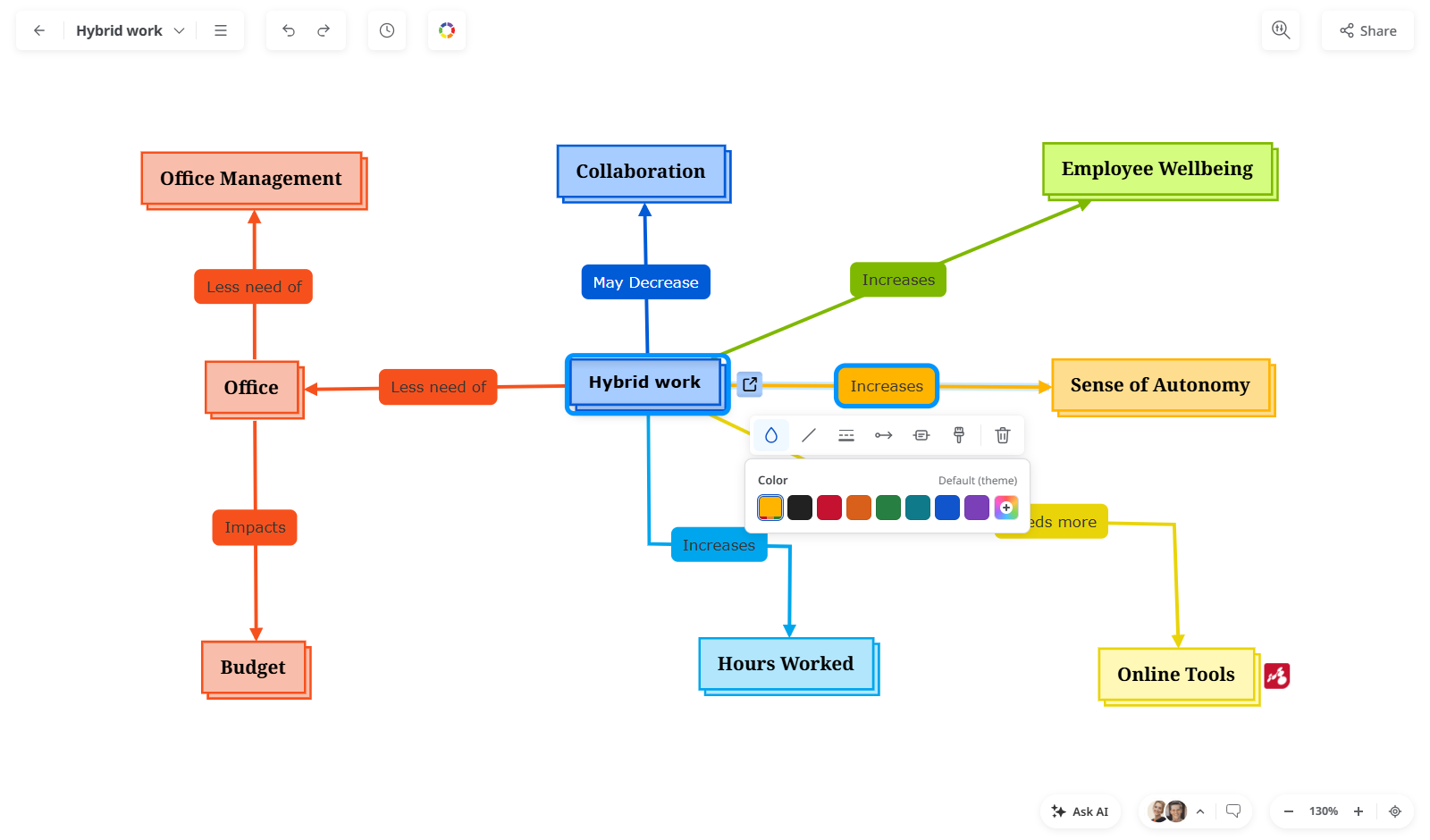
Select an arrow and type a linking word on it: usually a verb or a short phrase. Read each pair aloud. “Hybrid work → increases → sense of autonomy” and “hybrid work → may decrease → collaboration” are statements; if a pair does not read as one, change the label.
The toolbar that appears on a selected arrow sets its color, shape, width and line endings, so you can tell kinds of relationships apart at a glance.
4. Connect concepts across the map
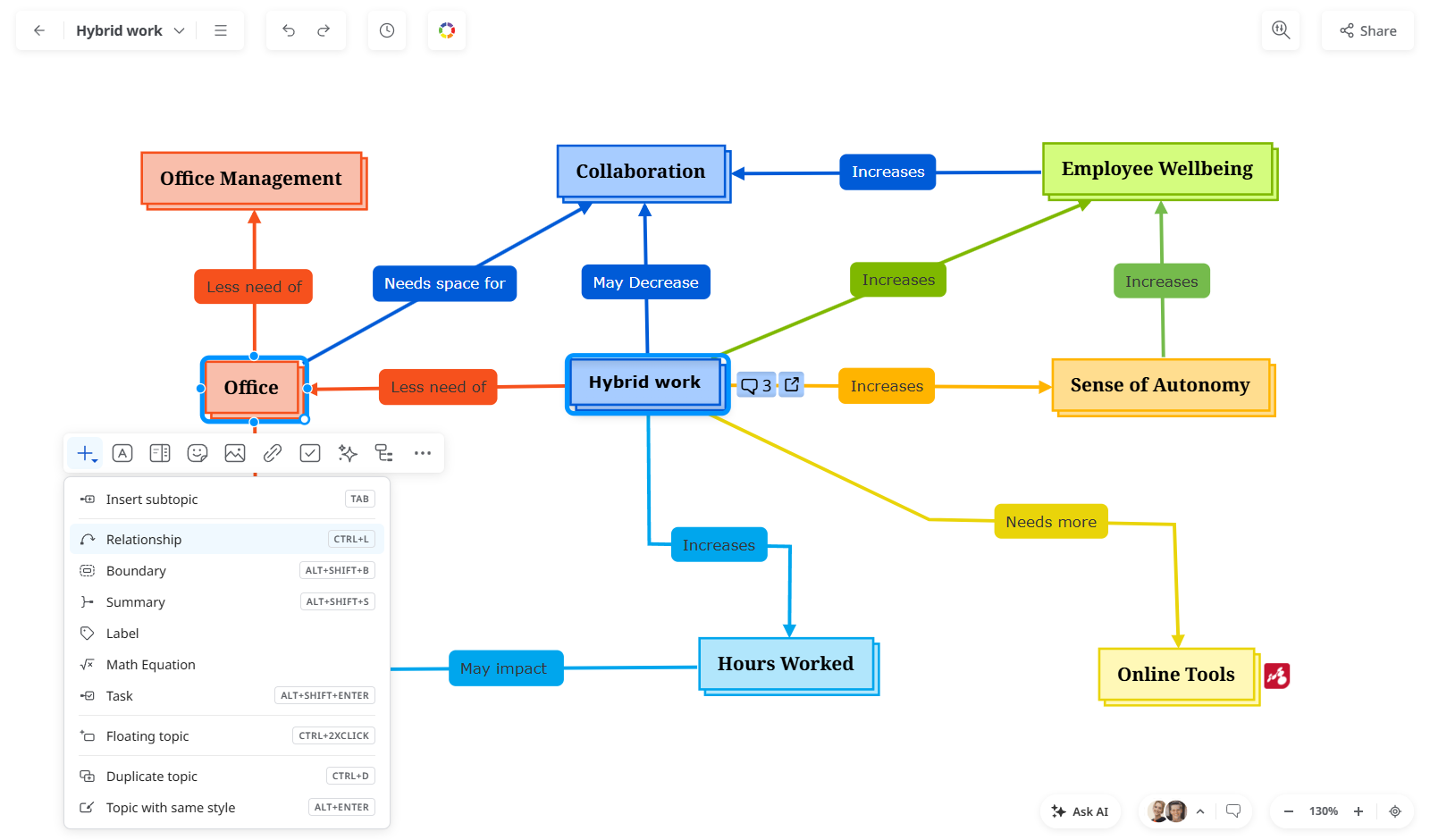
A concept map is not limited to a tree: any concept can link to any other. Select a topic, open Insert (the + in its toolbar) and choose Relationship, or press Ctrl+L. Then click the concept you want to link to, and label the new arrow too.
These cross-links usually carry the most interesting ideas. In the example, “office → needs space for → collaboration” and “hours worked → may impact → budget” join concepts that sit on different branches.
5. Arrange and style the map
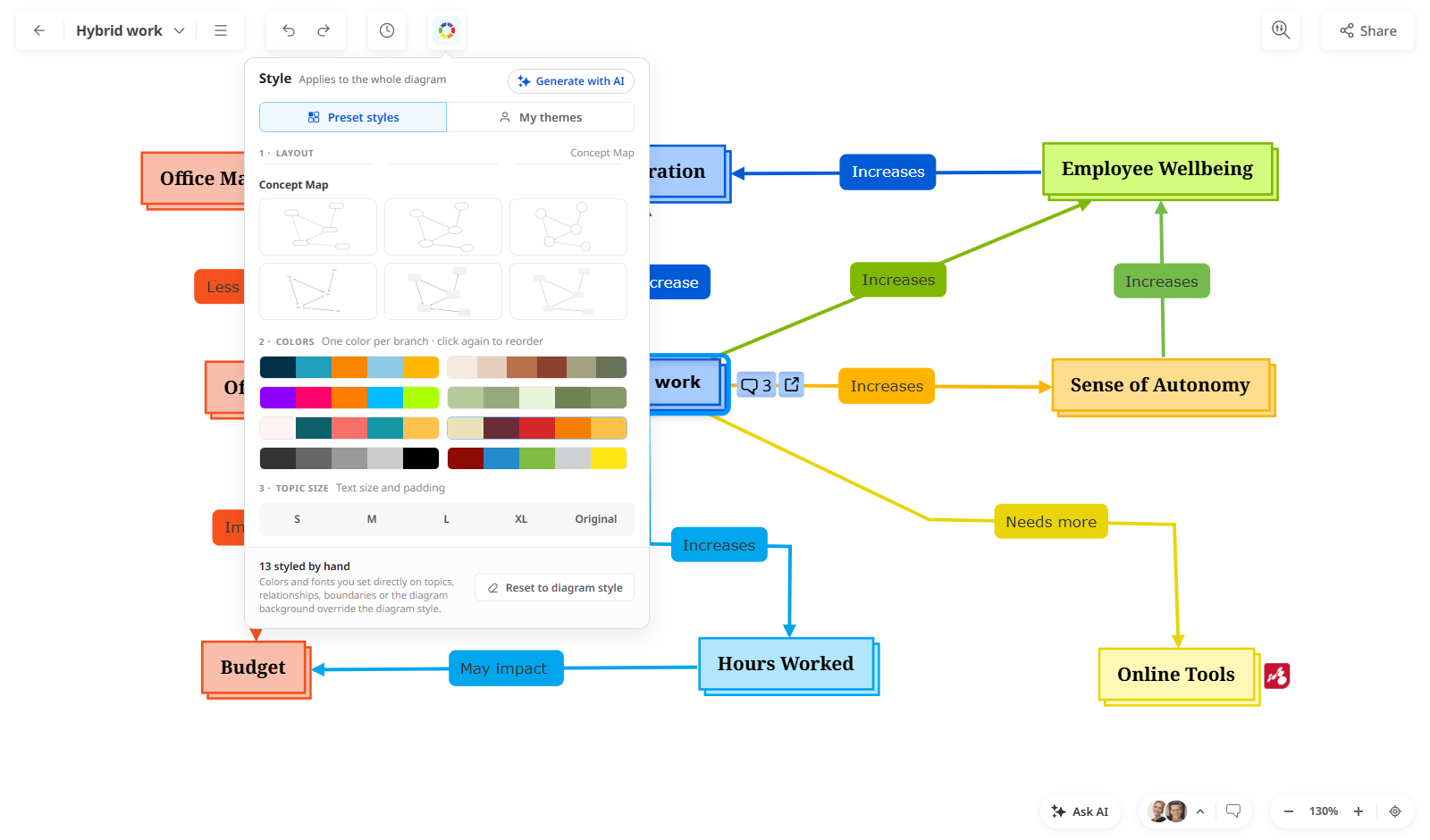
Drag concepts anywhere on the canvas until the structure is easy to follow; the central topic moves too. Open Style (the color wheel at the top) to restyle the whole map at once: pick a concept map layout, a color palette and a topic size, or use one of your own from My themes.
Each topic can also have its own color, font and shape, plus icons, images, videos, audio, links and notes.
6. Share, discuss and export
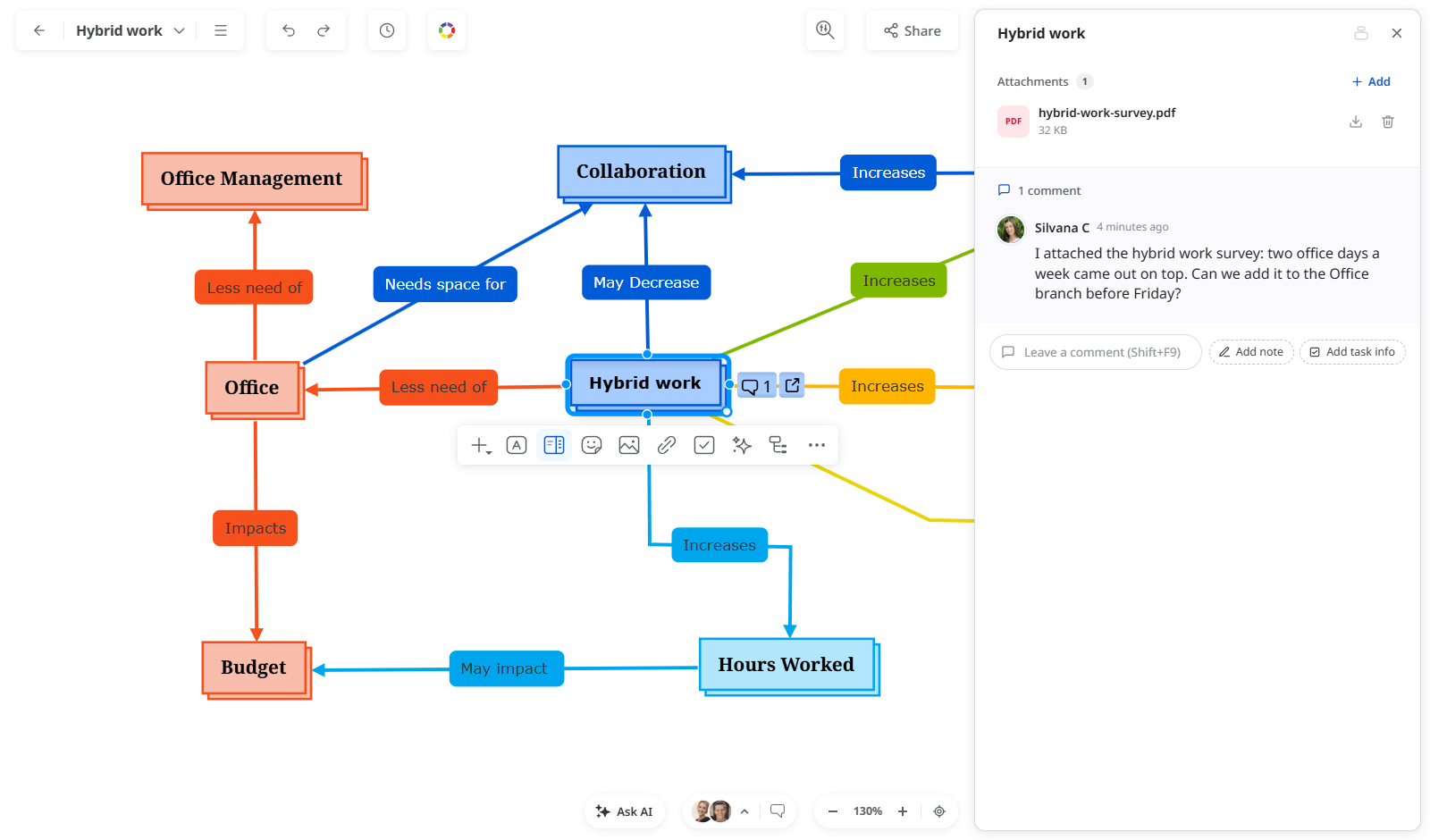
Select Share to invite people by email or send a link, then discuss any topic in its comments and attach files to it, such as a PDF. Everyone who can edit sees the others’ changes as they happen.
When the map is done, present it from Mindomo, publish it, or export it. The free plan exports to Mindomo and text files; paid plans add PDF, Word, image and, on the higher plans, PowerPoint, Excel and MS Project.
What you can do with Mindomo’s concept map maker
Everything that makes a concept map a concept map, rather than a tree or a list, is built into the editor:
Labeled links
Every arrow can carry a linking word or phrase, so the map states how two ideas relate instead of only showing that they do. Each arrow has its own color, weight, shape, line pattern and direction.
Cross-links and many-to-many links
Link any concept to any other, across branches, and give one concept as many links as it needs. Nothing forces the map into a hierarchy.
A free layout
Place concepts anywhere on the canvas, the central one included, or let a predefined concept map layout arrange them for you.
Themes
Restyle the whole map from the Style panel: a concept map layout, a color palette and a topic size, applied in one click. Themes you make yourself wait under My themes, ready for the next map.
Images, videos, notes and files
Add images, videos, audio, icons, links and notes to any concept, and attach files from your computer, Google Drive, OneDrive or Dropbox.
One map, several views
Switch the same content between a concept map and a mind map, or read it as an outline. On the Professional, Team and Business plans, it also becomes a Gantt chart.
Presentations
Present straight from the map, without rebuilding it in a slides tool. See how to make effective presentations with maps.
Work on a concept map together
A concept map is often a group’s shared picture of a subject, so Mindomo lets several people build one at once.
- Real-time editing: everyone with access edits the same map and sees each change as it is made, wherever they are.
- Comments and chat: discuss a single topic in its comments, or the whole map in the chat, without leaving it.
- Playback: replay how the map was built, with each person’s changes highlighted in their own color.
You decide who sees the map. Share it with specific people, make it public, or share a link that lets whoever has it either view or edit the map.
Start from a concept map template
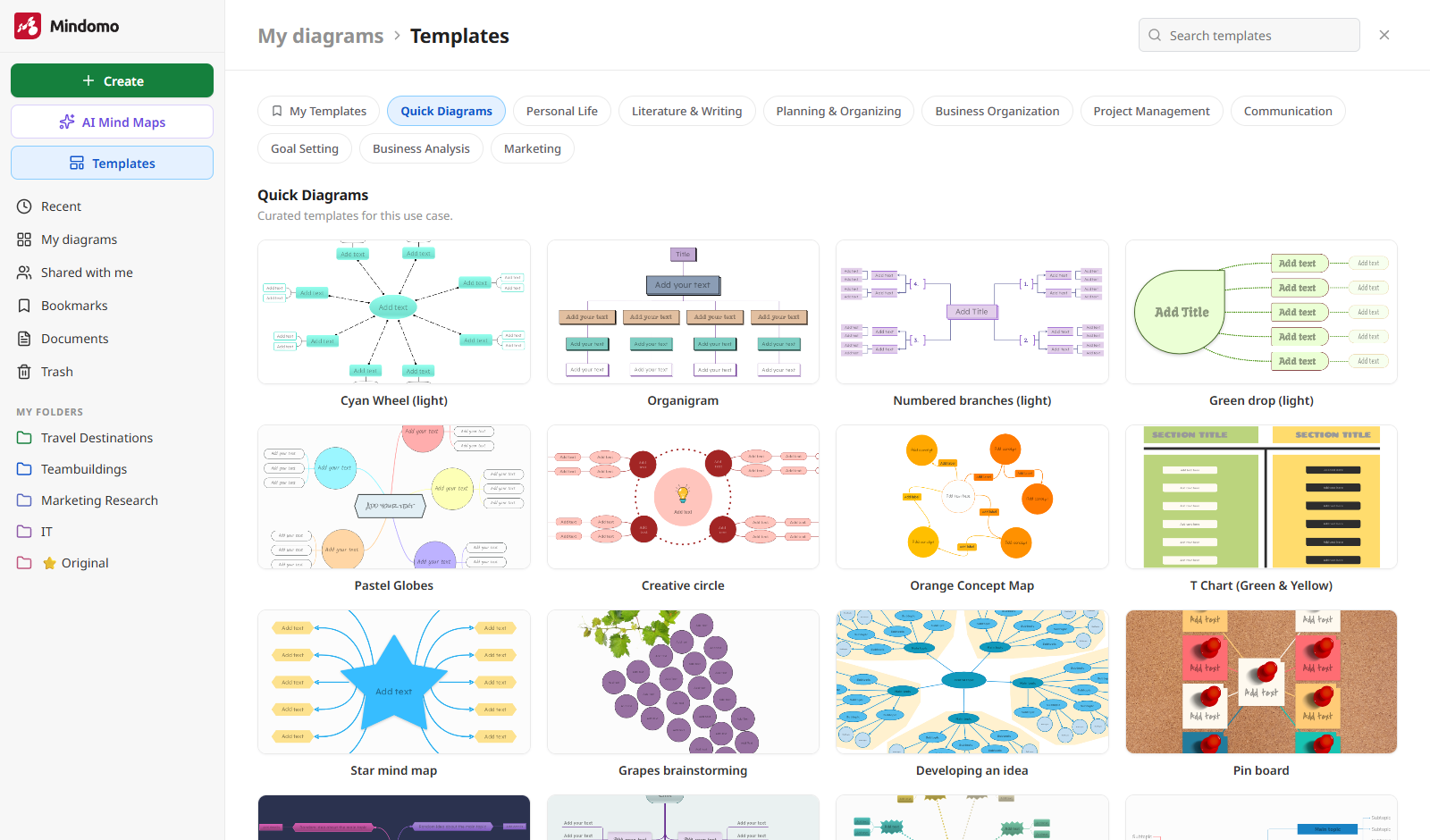
You don’t have to start from a blank page. Select Templates on your dashboard to browse ready-made maps grouped by use case, such as Personal Life, Planning & Organizing or Science & Biology, and open one to make it yours.
You can also start from any public map below: choose Copy and edit from its menu, and the copy is yours to change, share and edit with others.
A few concept maps to start from. The concept map templates page has more, with what each one shows:


Make a concept map with AI
Mindomo AI does the groundwork. The linking words stay with you, and that is where a concept map does its work: deciding how two ideas relate is what makes you understand them.
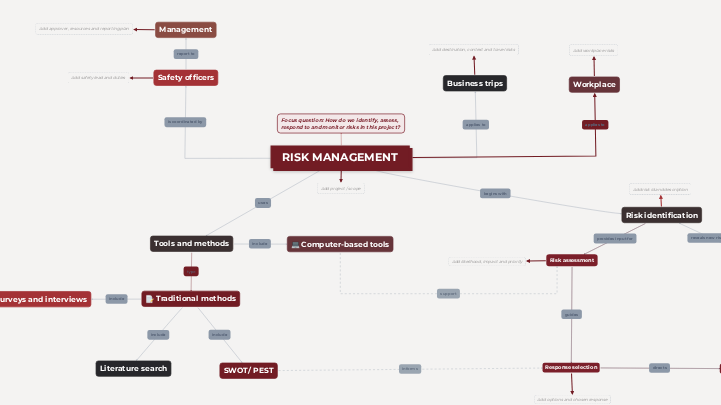
- Start from a prompt. Describe your topic under AI Mind Maps on the dashboard and the AI builds a structured map of it. Open Style, choose the Concept Map layout, and label the arrows.
- Expand a concept. Select any concept and open Smart Tools to add ideas, questions, pros and cons or a SWOT analysis around it, or to have it explained.
- Ask for changes. The Mindomo AI panel takes requests in plain language and edits the map, and you can undo any change it makes from the panel.
The free plan includes 1 AI credit to try it, and paid plans add credits every month. See the AI mind map generator.
Video: making a concept map in Mindomo
Prefer to watch? The video walks through the same steps in the Mindomo editor.
Plays from YouTube. Google may set cookies once you press play.
Use it on any device, with the tools you already have
Make concept maps in the browser, in the desktop app for Windows, macOS and Linux, or in the iOS and Android apps. The desktop app also works fully offline, with local files or synced to the cloud.
- Import maps and outlines from XMind, MindManager, MindMeister, FreeMind, iThoughts, SimpleMind and Bubbl.us, or from OPML, Markdown and Excel files.
- Classrooms: use Mindomo from Moodle, Blackboard, Canvas, Brightspace, Schoology, itslearning and Google Classroom.
- Teams: create and edit maps inside Microsoft Teams, and back them up daily to Dropbox or OneDrive.
- AI assistants: connect the Mindomo MCP server and an assistant such as ChatGPT or Claude can build and edit maps for you.
See all Mindomo integrations.
Who uses a concept map maker
Concept maps suit any subject where the relationships matter as much as the facts. Three groups use them most:
Students and teachers
Students build concept maps to study: labeling a link forces you to decide how two ideas relate, and research finds that building a map helps learning more than rereading notes. Teachers use them to plan courses, set assignments and see what a student has understood. More on Mindomo for education.
Teams at work
Teams map business requirements, strategy and processes, record meeting notes, and agree on what their terms mean. Because the links are labeled, a map still makes sense to someone who was not in the room. More on Mindomo for business.
Personal projects
Plan a project, summarize a book you want to remember, or explore a new interest and see how its parts fit together, with images, links and notes kept in one place.
Frequently asked questions
Is Mindomo’s concept map maker free?
Yes. The free plan includes 3 maps with labeled links, cross-links and themes, and exports to Mindomo and text files. Paid plans add unlimited maps, printing and more export formats, such as PDF, Word and image. See pricing.
Can I make a concept map offline?
Yes, with the desktop app for Windows, macOS and Linux. It works fully offline with local files, or syncs your maps to the cloud when you are back online.
Can AI make a concept map?
Yes, with one step from you. Mindomo AI builds a map from a prompt; switch it to the Concept Map layout in the Style panel, then write a linking word on each arrow. The AI can also add ideas, questions or subtopics to any concept.
Can I turn a mind map into a concept map?
Yes. Mindomo switches the same content between a mind map and a concept map, so you can brainstorm in one and show relationships in the other without copying anything. Read how concept maps and mind maps differ.
Can several people edit the same concept map?
Yes. Share the map, and everyone with edit access works on it at the same time and sees each other’s changes as they happen. Comments, chat and playback history keep track of the discussion and of who changed what.
Can I make a concept map on my phone?
Yes. The Mindomo apps for iPhone and iPad and Android create and edit concept maps, and maps you edit offline sync when you are back online.
Can I import concept maps from another tool?
Mindomo imports files from XMind, MindManager, MindMeister, FreeMind, iThoughts, SimpleMind and Bubbl.us, as well as OPML, Markdown and Excel.