Use caseIssue trees for consulting

Issue trees, built
for partner review

Branch the question until it's MECE. Hang a hypothesis and an evidence need on every branch. Test the whole thing with the client before the work plan gets written, not after the first status call goes sideways.

Issue tree mind map in Mindomo with a core question branching into MECE sub-questions, each carrying a hypothesis, an evidence need, an owner, and a priority tag

The tree looked clean on the deck. It wasn't clean where it mattered.

By the end of week one, you've got a first cut: the core question at the top, five or six branches under it, a hypothesis pinned to each. It presents well. Clean indentation, tidy boxes, the kind of structure that gets a nod in the kickoff.

Then someone actually pulls on it. Branch two and branch four turn out to cover the same ground, worded differently enough that nobody caught it while building the deck. One hypothesis has no evidence attached at all, so nobody can say what data would prove or kill it. Two branches got merged onto one slide for space, and the logic connecting them quietly disappeared.

“Where's the evidence for branch three?”

The tree wasn't wrong. It just wasn't finished, and a slide doesn't show you the gaps. It only shows you what's already there.

THE FOUR PLACES ISSUE TREE LOGIC BREAKS DOWN

🌿

Branches

In the deck. Overlap hides behind clean indentation.

💡

Hypotheses

Pinned to a box. Nobody checks whether they're actually testable.

🔍

Evidence needs

In a separate workplan, disconnected from the branch that needs them.

MECE check

Run once, on a whiteboard, week one. Never rerun once branches move.

On one canvas, those four pieces stop living apart. Branches sit next to the hypotheses they're testing and the evidence each one needs, so a gap is visible the moment it opens, not three weeks later in front of the client.

When two branches overlap, you see it before an associate spends two days pulling data for a question the tree has, somewhere else, effectively already answered.

The issue tree stops being a slide the team built once and becomes the working logic the whole engagement runs on.

This is problem structuring for engagements where the analysis is only as good as the underlying question. A tree that looks MECE and a tree that is MECE are two different objects, and the gap between them usually surfaces in front of the client, not in the team room. Mindomo keeps the structure alive past the first draft, so branches, hypotheses, and evidence needs move together instead of quietly drifting apart the moment the deck gets built.

Why a canvas, not a deck

A red pen catches the gap after the fact. A canvas doesn't let it hide in the first place.

🖊️ What the deck needs a red pen for

Market entry: should we expand into APAC?
Demand signal
Competitive gap
Regulatory risk
Channel readiness
⚠ overlaps branch 2?
⚠ no evidence attached
⚠ where did this go?

Caught eventually, usually out loud, in the room.

✓ What the canvas doesn't need a red pen for

Market entry: should we expand into APAC?
Demand signal
Competitive positioning
Regulatory risk
Channel readiness
✓ hypothesis + evidence needed, both attached

Same tree. Every gap was visible while it was built, not after.

PowerPoint rewards a tree that presents well. Mindomo rewards a tree that's actually built right, because a canvas won't let a gap hide behind a clean layout the way a slide will.

Move a branch and everything under it moves too: the hypothesis, the evidence need, the owner. Nothing gets orphaned in a text box nobody notices for two weeks.

Mindomo: the tree is the thinking

Steps to build an issue tree
that stands up to scrutiny

Mindomo turns the issue tree from a slide that the team builds once into the structure that the engagement actually runs on. Branches, hypotheses, and evidence move together, so what the client sees in the workshop is what the analysis ultimately chases.

Chart

Start from the core question, not a blank canvas. Branch until every question is a genuine child of the one above it, then run the MECE check on the spot: do any two branches overlap, and together do they cover the whole problem?

Pull the framing straight out of the client discovery workshop, so the tree starts from what the client actually said, not a template with the client's name swapped in.

Core question branching into MECE sub-branches on an issue tree canvas

Test

Pressure-test every branch with a hypothesis and the evidence that would prove or kill it. If a branch has one but not the other, it isn't ready to leave the tree yet, no matter how clean it looks.

Share the link with the team or the client, and let them challenge a branch directly. Comments sit on the branch in question, so a challenge to hypothesis four doesn't get lost in a chat thread about something else entirely.

Team commenting on individual issue tree branches to challenge a hypothesis

Assign

Hand branches to the team with owners and a priority tag, so week two starts on the branches actually worth the associate's time, not the ones that happened to be easiest to word.

Low-effort, high-impact branches get chased first. The rest wait, visibly, instead of quietly absorbing hours nobody budgeted for.

Issue tree branches assigned to team members with impact and effort priority tags

Handoff

Flip the tree into a work plan. Branches become workstreams, hypotheses become the deliverables that test them, and the scope of work traces back to the actual question it's answering, not a generic bullet list.

No re-keying into a separate document. The structure the client agreed to in the workshop is the structure the work plan runs on.

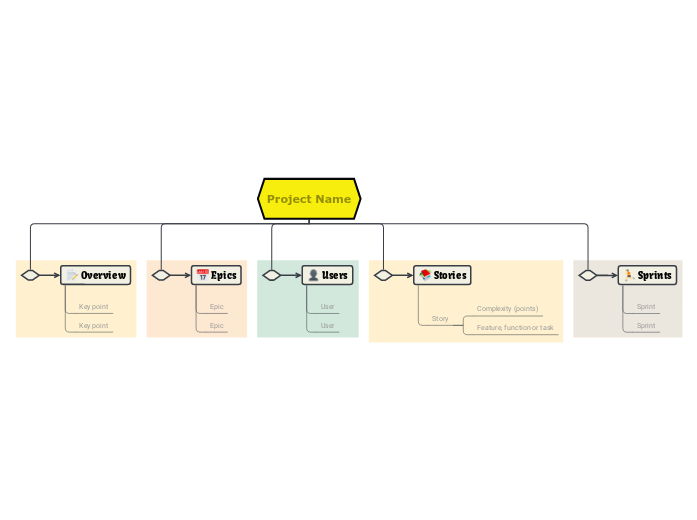
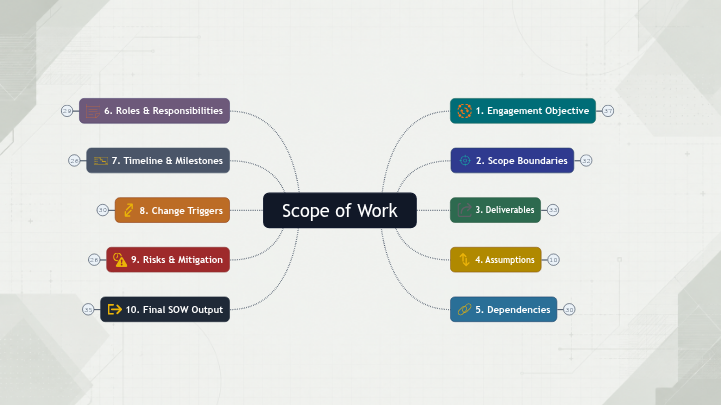
Issue tree branches flowing into a scope of work and project workplan

A tree that's been pressure-tested before the analysis starts removes most of the rework that shows up later. Not because the branches were guessed better, but because the gaps were visible before anyone started pulling data.

What makes it work
  • Drag-and-drop branches
  • Evidence notes
  • Owners & priority tags
  • Real-time collaboration
  • Word, PPT & PDF exports
The issue tree pressure test

The parts of the tree that quietly
decide whether the analysis holds

An issue tree rarely fails on wording. It fails when what a branch depends on stays invisible. Mindomo makes that visible from day one.

Branches

Prove the branches are MECE

MECE is easy to claim and hard to actually do. Two branches quietly cover the same territory, or the tree leaves a chunk of the problem with nowhere to live.

On a canvas, siblings sit next to each other where the overlap is visible, not scattered across slides where it isn't. Drag a branch under a different parent and see immediately whether it still fits or was never really MECE to begin with.

A branch that survives being moved was probably placed the first time correctly.
MECE issue tree branches checked for overlap
Hypotheses

Each branch - a testable claim

A branch without a hypothesis is a question with nowhere to go. "Pricing" isn't a hypothesis. "Pricing is the primary driver of churn in the mid-market segment" is one, because it can be proven wrong.

Attach the hypothesis directly to the branch it belongs to, so anyone opening the tree mid-engagement sees not just what's being asked, but what the team currently believes the answer is.

A hypothesis that can't be proven wrong isn't doing any work.
Hypotheses attached to individual issue tree branches
Evidence needs

Each branch, its own evidence

Every hypothesis implies a piece of evidence that would kill it or confirm it: an interview, a dataset, a benchmark. In a work plan, that request sits disconnected from the branch that justified it in the first place.

Keep the evidence needed as a note on the branch itself. When the data comes back, the person reviewing it can see exactly which hypothesis it's supposed to move.

A hypothesis without evidence is an opinion with better formatting.
Evidence needs linked to hypotheses and issue tree branches
Prioritization

Entire team on the same page

Not every branch deserves equal hours. Some are high-impact and cheap to test; others are low-impact and expensive. That triage usually happens in someone's head, and it happens again every Monday.

Tag branches by impact and effort once, on the canvas, and the whole team works from the same priority instead of re-litigating it in standup.

The tree decides where the week goes, not whoever spoke first in standup.
Issue tree branches tagged by impact and effort
The issue tree becomes easier to defend because it's easier to inspect.  Mindomo doesn't just help you draw the branches. It helps you show the logic each one depends on.

Check the tree before partners do

  1. The same five things a partner checks during review are walked through and settled here before anyone's sitting in that room.

    Branches

    Every branch has a sibling it doesn't overlap with.

    Hypotheses

    Every branch carries a hypothesis that could be proven wrong.

    Evidence

    Every hypothesis has an evidence need attached to it.

    Ownership

    Every branch has an owner, not just an author.

    No shortcuts

    Nothing's been merged onto one slide "for space."

    Five checks, not five steps. Pass them, and review will become a formality.

Built for problem structurers

Whoever owns the tree owns the direction of the analysis

The issue tree is where an engagement's first two weeks either spent well or spent guessing. These are the teams who build it, defend it, and live with what it pointed them toward.

Best fit

Teams running engagements where the first two weeks determine the shape of everything that follows get the most out of this. Below that scale, a whiteboard photo and a follow-up email are usually enough. Above it, once a partner, a steering committee, or the client's own analysts are going to pull on the logic before it's approved, a tree that only exists as a slide starts costing real hours: an associate re-proving a branch nobody flagged as untested, a partner asking where the evidence went. Mindomo earns its place exactly there, where MECE takes real discipline, and the gaps have to survive scrutiny before the analysis starts.

Strategy consultants & boutiques

The tree is the backbone of the engagement before it's anything else. Mindomo keeps it alive from the first draft through the workshop to the workplan it becomes.

Internal strategy & corp-dev

Framing an investment case, a market entry question, or a build-versus-buy decision. A defensible tree is half the argument to the steering committee.

PMOs & transformation offices

Structuring a diagnostic before a transformation program gets scoped. Getting branches right up front is cheaper than re-scoping workstreams three months in.

Product & research teams

Framing a discovery question before it turns into a roadmap. The same MECE discipline applies whether the client is external or the next team over.

Common questions

FAQs

Practical answers about building issue trees in Mindomo.

Isn't this just a mind map with extra rules?
The branching is a mind map, yes. What a plain mind map doesn't give you is a hypothesis and an evidence need attached to every branch, or a record of who challenged a branch and why. That structure is what turns a mind map into an issue tree that can actually be defended.
How does Mindomo enforce MECE, or does it just draw the boxes?
It won't run the logic for you; no tool does that, honestly. What it does is make overlap and gaps visible: siblings sit next to each other so duplication is obvious, and dragging a branch under a different parent instantly shows whether it still fits.
Can the client see the tree during a workshop?
Yes. Guest editing, included on the Professional and Business plans, lets a client comment, challenge, or restructure a branch live without creating an account. This is the same mechanism used to run client discovery workshops where clients co-edit the map directly.
What happens to the tree once the analysis starts?
It doesn't get retired. Branches keep their hypothesis and evidence visible as the data comes in, so the team can update a branch's status without redrawing the whole structure from scratch.
Can this replace a whiteboard-and-sticky-notes session?
For the live session, yes, and it has an advantage a whiteboard doesn't: nothing gets lost when the photo is blurry, or someone erases a branch before it's transcribed. The canvas is the record, not a photo of one.
Does the tree automatically turn into a work plan?
Not automatically, deliberately. You choose which branches become workstreams when you flip to the workplan view, so the handoff to the scope of work reflects a decision, not a default.
How is this different from running client discovery in Mindomo?
Discovery is where you find out what the client's problem actually is. The issue tree is where you structure it for analysis. Most engagements run discovery first, then branch the tree from what surfaced, using the same canvas rather than starting from a blank one.
Can we reuse a tree structure from a past engagement?
If a similar problem has been branched before, that structure is a much better starting point than a blank template. Keeping past trees somewhere your team can find and adapt them is worth doing even if this isn't the tool you use to store them.
What if the workshop surfaces more branches than the tree can hold cleanly?
Branches collapse with a click, so the canvas stays readable as the tree grows. Drill into one branch at a time when a single question needs the room's full attention, then zoom back out to check it against the rest of the structure.
Structure the next problem

Branch the question. Test the logic. Hand it to the work plan.

The same structure becomes the tree the team debates, the workshop the client sits through, and the scope of work everyone signs. Absolutely nothing rebuilt in between.

Start now Explore idea organization

Create a shared workspace for your team and co-edit the tree with clients and stakeholders on a Mindomo Business plan.

Also great for Consultants Corporate Development Product & Engineering Marketers Operations