This mind map helps you outline the plan for an Agile project. Agile planning is a way to capture an accurate description of the work that needs to be done. Use this template to discuss plans, features, and specifications from the agile projects. It will be useful for you if you are a product owner. Write down a summary of your project, adding key points. Also, write down the epics (the major stages) of a project. Add the sprints. They are groups of users’ ideas that can be demonstrated and used. Type in the users’ stories and make a list of users (people that will interact with the solution). Do not use users’ names, but their roles based on the task they will perform. Begin by typing in the name of your project, then press Enter. Sprints are groups of user Stories that fit together well enough to be demonstrated and used. Sprints are defined by timeboxing, and also by what is practical to deliver and use. Type in a user story, in the following format: Feature, function or task Complexity (points) Estimate the relative complexity of this story, expressed as story points. Trivial things are only a point or two, and the average is about 5 points. Next, make a list of Users. These are the people who will interact with the solution that you are creating. Epics are the major stages in a project and are divided up into sprints. Write down a summary of your project's key points, to act as a reference for discussions. Every Mindomo template opens with its structure already in place: descriptive topics, guiding notes attached to the branches where people usually get stuck, and a default shape that new topics inherit. Edit it in the browser, switch it to a concept map, outline or Gantt chart without redrawing anything, and export it in more than twenty formats. See how mind map templates work, or browse the full gallery by category.Agile plan template
The map aims to capture an accurate description of the work to be done and you can use the mind map to discuss and explain stories, specifications, features, and plans.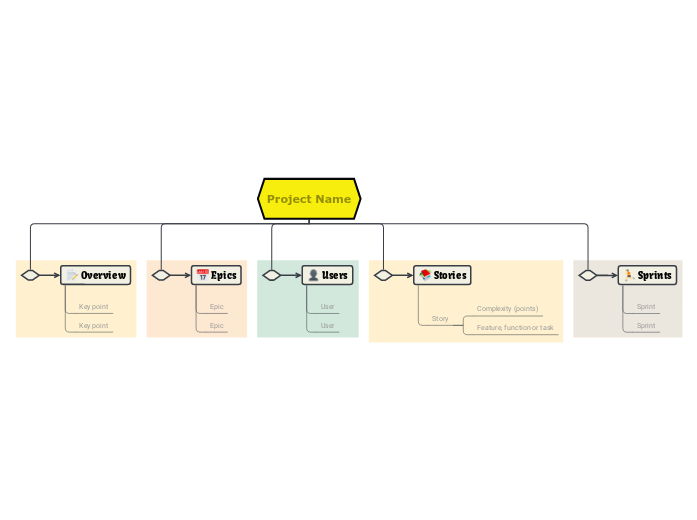
About this template
Agile plan template
Project Name
Sprints
Identify Sprint groupings from your stories and add them here.Sprint
Stories
Story
'As a [A], I need to [B], so that I can [C]'
where:
[A] is a user role,
[B] is what the user needs to do, and
[C] is why they need to do it.
If you find it hard to guess, you may need to break it down further into smaller stories.Users
Users are identified not by personal name, but by their role in relation to the task they perform.
Add a User role and press Enter.User
Epics
An epic is often a product release point or a handover to the customer.
Add an Epic of your project.
If you have a target date in mind, include it in the topic text for clarity.Epic
Overview
Add a key point about your project.Key point
Why use a Mindomo mind map template?
-
Products
-
Uses
- General Uses
- Mind Maps for Education
- Mind Maps for Business
- Mind Maps for Personal Development
- Assistive Technology
- Team Collaboration
- Campaign briefs for marketers
- Client discovery workshops for consultants
- Onboarding journeys for HR & L&D
- Knowledge Management
- Team Skills Matrix
- Engagement Library
- Roles
- Marketers
- HR & L&D
- Consultants
- Project Management
- Marketing campaign planning
- Employee training rollouts
- Scope of Work
- Idea Organization
- Issue Trees
- Training Needs Analysis
- Mind Mapping Benefits
-
Solutions
- Guides
- Make Presentations with Mind Maps
- How to Learn with Mind Maps
- Plan and Organize with Mind Maps
- Prioritize Tasks with Mind Maps
- Take Notes with Mind Maps
- Real Customer Stories
- Scaling educational content for 11,000 doctors
- Team workflow: from trial to indispensable in two months
- 10 years without slides: rethinking architecture lectures
- Read all stories
-
Resources
- Learn the basics
- What is a Mind Map?
- How to Mind Map?
- What is a Concept Map?
- Benefits of Mind Mapping
- Guides & Support
- Video tutorials
- Help center
- Forum
- Examples & templates
- Top 29 Mind Map Examples
- Concept Map Templates
- Plan projects with a Gantt Chart Maker
- Mindomo's Efficiency in Education
- Feature pages
- Education
- Teacher Assignments
- Work & Personal
- Desktop
- The Mindomo blog
- Pricing
- Log In
- Sign Up
- Dashboard
Mind Mapping Benefits
Why visual thinking makes recall and planning easier.
Learn the basics
Guides & Support
Examples & templates
Feature pages
 Blog
The Mindomo blog
Guides, examples and research on visual thinking.
Browse all articles
Blog
The Mindomo blog
Guides, examples and research on visual thinking.
Browse all articles