Use caseVisual campaign briefs for marketers

Campaign briefs
your whole team can edit

A shared workspace where strategists shape the angle, writers draft the copy, designers add the visual direction, and the agency plugs in. All of it live, on one document. The brief stays alive as the campaign evolves.

Campaign brief mind map in Mindomo with strategy, message, channels, creative, metrics and timeline branches, and the whole team editing live
Live activity feed showing team members editing the campaign brief

A typical campaign starts with a brief. By week three, the brief is irrelevant.

A situation often seen: the marketing manager wrote v1 in a Google Doc on a Wednesday. Strategy added comments. The brand lead added inline suggestions. Legal flagged three lines. The agency got sent a PDF export and replied with questions in email. The designer started working from v2 because that's what was in the Figma file. The paid media lead is briefing creative from the Notion version because that's where the campaign goals were updated last week.

  • Google Doc v1: strategy comments, never resolved
  • Notion v2: campaign goals updated last week
  • Figma file v2 again: designer's source of truth
  • Slack thread legal flags, mostly lost
  • PDF export what the agency is briefing from

Five versions of the same brief, none of them current, none of them complete, all in different tools.

The solution is about putting the campaign brief on a single shared canvas where strategy, creative, channels, agencies, and stakeholders contribute in the same place, and where the brief stays alive as the campaign evolves, instead of going stale the moment it's "approved."

We call this collaborative briefing. Not "marketing ships a brief and the agency hopes for the best." The brief must be something a team builds together while the campaign evolves.

  1. 01

    The brief is a one-way document

    A senior marketer drafts it; everyone else reads it. Comments come in, but they live in a margin nobody re-opens after approval. Questions that never got answered quietly become assumptions, and the assumptions only surface when the campaign starts to drift.

    "Should we still target SMB?" unanswered · 19d
    "Is the hero claim cleared?" unanswered · 12d
    Thread closed when brief was approved
  2. 02

    Stakeholders edit in different tools

    Strategy lives in one doc, channel plans in another, visual direction in Figma, timeline in Asana, budget in a sheet, message hierarchy in someone's head. When the brief is rewritten (and it gets rewritten several times) the rewrite rarely propagates back to all of them.

    Strategy rewrote the objective v3 · today
    Channel plan still references v1
    Figma brief never got the update
  3. 03

    Agencies & freelancers get the worst version

    Internal teams have hallway context. External partners get a PDF. They reply with questions in email, the answers live in that thread, and half the context never makes it back into the canonical document. Six weeks later the creative misses, and nobody can reconstruct why.

    Agency: "What's the offer?" Re: brief.pdf · 04/12
    Internal: "See answer in v3" 04/14
    Context still in email, not in the brief
  4. 04

    The brief doesn't survive launch

    When performance data arrives, the team pivots: new headlines, new audience cuts, new asset weights. The brief that justified the original direction sits frozen while the campaign quietly becomes something else. The end-of-campaign review reflects the brief that was written, not the campaign that ran.

    Wk 1 → CTR 0.8% vs 1.4% target
    Wk 2 → swapped to hero variant B
    Brief still says "variant A primary"

A living brief, on a shared canvas, with the right view for each contributor, removes most of this friction. Not by adding more documentation, but by making the documentation that already exists visible to everyone working from it.

How to manage this workflow in Mindomo

A realistic brief, with strategy, creative, channels & an external agency contributing

Seven moves that turn the brief from a downloadable PDF into a living document.

1

Open the Campaign Brief template and add stakeholders from day one

Don't write v3 alone and then "share for feedback." The brief is sharper when the channel owner, the agency strategist, and the creative lead are in the map while you're still figuring out the angle, all together.

Mindomo's link-based sharing means the agency joins as a guest editor without a paid seat, and without the PDF-to-email cycle that loses half the context.

Day-one collaboration replaces week-three reconciliation.
Brief stakeholder roster showing internal team, cross-team reviewers and external agency guest editors
2

Map the brief around campaign branches, not document headings

The branches a campaign brief usually needs: objective, audience, key message, channels, creative direction, success metrics, budget, dependencies, timeline. Each branch is assigned to the collaborator who is supposed to work on it.

Audience belongs to the strategist. Creative direction belongs to design. Channels belong to whoever runs paid, organic, email, and social.

The brief stops being one person's document and starts being the team's working canvas.
Campaign brief branches with an owner assigned to each: objective, audience, message, channels, creative, metrics and timeline
3

Comment in context, not in email threads

When the brand lead has a question about the message hierarchy, the comment lives on the message branch, not in a reply-all thread. When legal flags a claim, the flag is anchored to the line. When the agency asks about budget split, the question lives where the budget lives.

Six months later, the rationale is still next to the decision.
Anchored, threaded comments from legal, brand, agency and copy attached to the message branch of the brief
4

Switch views by stakeholder

The writer flips to outline to draft copy directly inside the brief, with indent-friendly editing for headlines and subheads. The campaign lead flips to Gantt to see milestones (kickoff, creative review, legal sign-off, launch, performance read) laid out against the calendar. The strategist stays in mind map to keep the audience-message-channel logic visible.

Same data, different lens, no copy-pasting between tools.
The same brief shown as outline and Gantt views side by side, with teammates editing in real time
5

Pull approvals into the brief instead of out of it

Sign-offs from legal, finance, and exec stakeholders happen on the relevant branch, with comments and version history attached. The approval trail lives next to the thing being approved.

When someone six weeks later asks "who signed off on the budget?" or "did legal clear the testimonial claim?", the answer is on the map, not in a Slack search.

No approvals lost to inboxes. The decision sits next to the artifact.
Approval trail attached to brief branches showing brand, legal, exec, finance and agency sign-off statuses
6

Update the brief mid-campaign, not after

When the launch date slips, when a competitor moves first, when the creative tests poorly and you swap the hero variant, update the brief. Version history captures what changed.

The post-campaign review then reflects the campaign that actually ran, which is the only review worth doing.
Version history of the campaign brief with 37 versions and 14 contributors, showing mid-campaign edits
7

Save the final brief as your team's next template

After the campaign closes, the brief becomes the starting point for the next campaign of the same shape. Most marketing teams end up with two or three master templates: a product launch shape, a brand campaign shape, a demand-gen sprint shape and start every new brief from the closest match. Save the diagram as a template all your team can access.

Compounding template library. Every campaign closes a loop instead of opening a blank canvas.
A closed campaign brief being saved as a reusable team template for the next launch
The Mindomo advantage

One brief, three views, one source of truth

The same brief renders three different ways, and each contributor works in whichever fits the role they're playing.

Mind map view

For the strategist

Audience, message, channels, and metrics aren't a flat list. They're connected. The mind map shows the through-line: why this message lands with this audience, why this channel sequence supports the funnel logic, why these metrics are the right read. Strategy thinking is non-linear; this view matches the thinking. Read more about what a mind map is.

Campaign brief in mind map view, with audience, message, channels, creative, metrics and timeline radiating from the centre
Outline view

For writers and copy leads

Same content, document-shaped. Indent, outdent, reorder. Headlines, subheads, and body copy live in a structure that's fast to edit at speed. Required disclaimers and legal claims stay visible inline.

Campaign brief in outline view with headlines, subheads, CTA copy and inline legal flags
Gantt view

For the campaign lead

The brief has dates: kickoff, creative review, legal sign-off, launch, performance review. In Gantt view those render as a timeline. When legal review slips two days and the launch shifts, the team sees it on the same canvas the brief lives on. Read more about how to plan projects using a Gantt chart maker.

Campaign brief in Gantt view showing strategy, creative, legal, launch and read-out milestones across six weeks
One brief, three lenses.  Edits in any view appear in all three, in real time.
Other useful features
Guest editing for agencies and freelancers: external collaborators can edit the brief without having a Mindomo account of their own.
 
Real-time co-editing for easy collaboration. Comments anchored in context. Full version history. Always in sync and up to date.
 
20+ export formats including Word, and PowerPoint when the brief needs to leave the canvas for an exec who isn't going to log in.
Starting points

Related templates

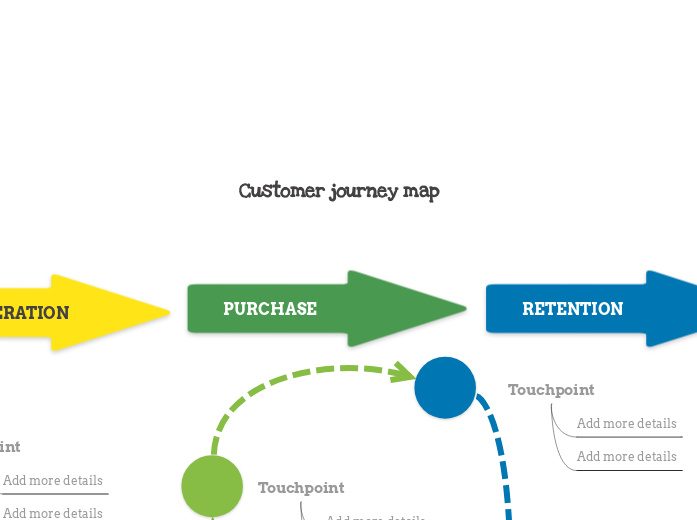
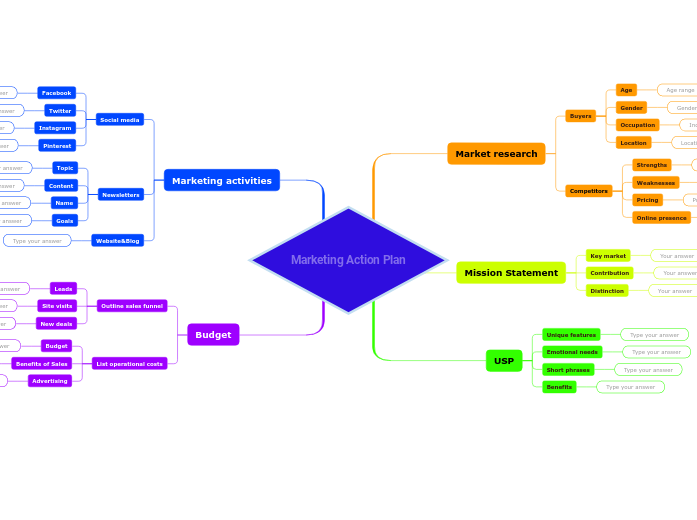
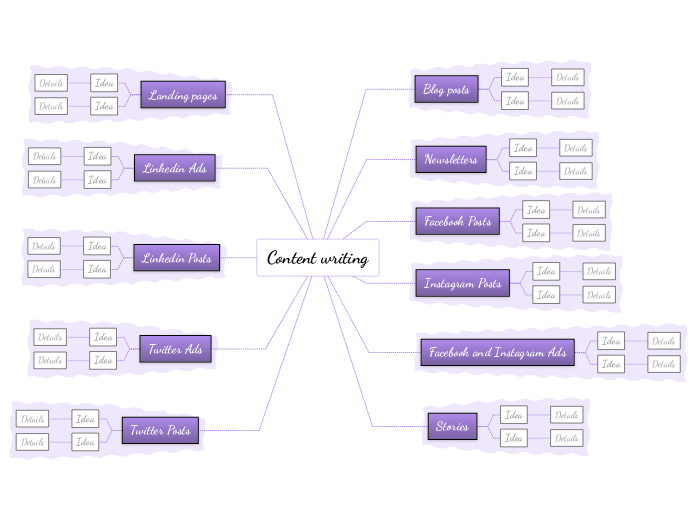
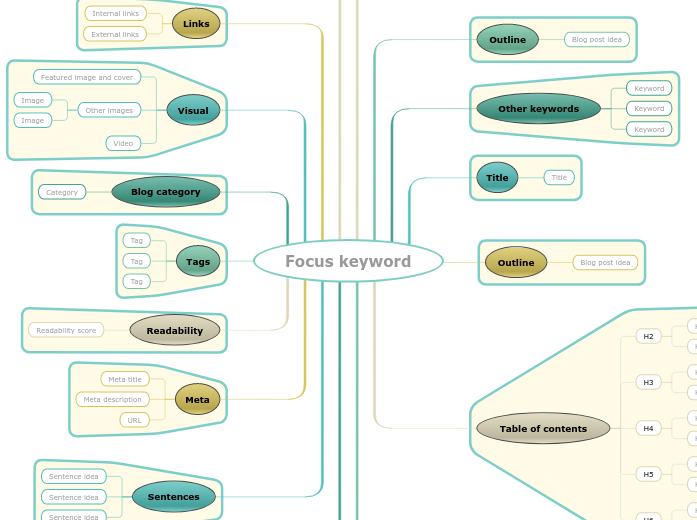
Six Mindomo templates worth adapting into your campaign brief workflow. Each one covers a different part of the conversation: audience flow, the plan, the message, channels and the stack. Combine them to fit how your team actually runs campaigns.

Who this is useful for

Built for the people who actually run campaigns

Same workspace, different roles. Each team works in the view that fits them best and everyone is editing the same brief.

Field note

Teams running 4+ campaigns a quarter, with at least one external agency or freelance contributor in the brief, see the biggest lift. The shared canvas earns itself back the first time a brief survives launch unbroken.

In-house marketing teams

Running multi-channel campaigns where copy, design, paid, and brand all contribute to the brief before launch.

Product marketers running launches

Where the brief sits at the centre of coordination across PMM, product, sales enablement, customer success, and PR.

Brand & content teams

Maintaining a recurring editorial cadence. Each piece has its own micro-brief, and the macro-narrative needs to stay coherent across them.

Marketing agencies

Briefing clients, and being briefed by them. Guest editing turns the client from a PDF recipient into a real collaborator.

Demand gen & growth teams

Aligning campaign briefs with sales messaging and ICP definitions that move quarterly. The canvas keeps both in sync.

Distributed marketing orgs

Where the strategist, the writer, the designer, and the agency are in four time zones and the brief has to travel through the map, not the hallway.

Common questions

FAQ

Practical answers about how campaign briefs work in Mindomo.

What's the difference between a campaign brief and a creative brief?
A campaign brief covers the whole campaign: objective, audience, message, channel mix, budget, timeline. A creative brief is a subset, usually scoped to a specific deliverable like a video, landing page, or ad set. Teams using Mindomo's shared canvas often write the campaign brief at the root of the map and add creative briefs as sub-branches off the relevant channels. One canvas, multiple briefs, all connected.
Why do most campaign briefs fail?
Most briefs fail for the same reason: they're written as if the campaign is decided when it isn't. The brief locks in a strategy before the team has finished debating it, then drifts as the team revises in silence. A living brief, shared, editable, and version-tracked, captures the debate as part of the document instead of around it.
Who should own the campaign brief?
Usually the marketing manager or campaign lead. But "owns" is the wrong frame. Someone owns the document structure and the final sign-off. Contributors own their branches: strategy owns audience and message, creative owns visual direction, channel leads own their tactics. A shared workspace makes that distinction natural rather than political.
Can agencies edit the brief without a paid Mindomo account?
Yes. Guest editing lets external collaborators co-edit via link, no account required. Up to 5, 10, or 20 simultaneous guest editors depending on your plan. For agencies briefing in or being briefed, this is usually the right setup.
How is this different from running briefs in Google Docs or Notion?
Docs and Notion are linear. Briefs aren't. The audience section connects to the message section connects to the channel mix connects to the metrics, and those connections are what make the brief coherent. Document tools bury those relationships in scroll; a visual canvas surfaces them. The Mindomo difference is that the same content can be viewed both ways: as a document when you're editing copy, as a map when you're stress-testing the strategy, as a timeline when you're tracking the brief's milestones.
Can we reuse the same brief structure across campaigns?
Yes. Save any approved brief as a team template. The final brief structure will be saved as a template that everyone on your team can access. Whenever you need it for a new campaign, simply select the template to generate a new editable copy. You can add any diagram to the team template library, and you can also create your own private templates.
Does this work for product launches too?
Yes. A launch is a campaign with more cross-functional stakeholders. The brief sits at the centre of a wider plan covering product, sales enablement, customer success, and PR. The shared map structure scales up: launch leads typically run the brief at the root and add cross-functional workstreams as parallel branches off the centre.
Start your team's campaign brief workspace

Pick a template. Share the link. Write the brief together, not in sequence.

The brief travels with the campaign from kickoff to the post-launch review. Same canvas, same views, same contributors.

Guest editing (agencies and freelancers can co-edit your briefs without having a Mindomo account of their own) is included with the Professional and Business plans.

Also great for Consultants Salespeople Product managers & Engineers HR & L&D Educators & Trainers