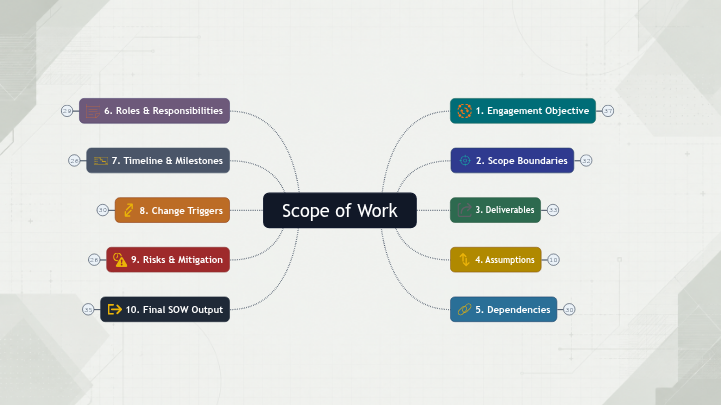
Turn discovery notes into a clear scope of work. Define project scope, deliverables, assumptions, exclusions, dependencies, milestones, owners, risks, and change triggers in one visual planning canvas. Define project boundaries, deliverables, assumptions, timelines, and responsibilities using this scope of work template. This template helps project managers, consultants, agencies, and client-facing teams turn early discussions into a clear working agreement. Start by outlining the project overview, including the client context, business objective, project goals, and the main problem the work is meant to solve. Map the agreed scope by separating in-scope work, out-of-scope items, deliverables, milestones, dependencies, and acceptance criteria so expectations stay visible from the beginning. Use the timeline section to organize phases, key dates, review points, approvals, and handover moments. Add dependencies to show what needs to happen before each deliverable can move forward. Document roles and responsibilities by identifying the project owner, client stakeholders, delivery team, reviewers, decision-makers, and any external contributors involved in the work. Complete the template by capturing assumptions, risks, required inputs, change request rules, communication routines, and sign-off details, so the scope of work remains clear, traceable, and easier to defend throughout the project. Use this scope of work planning template to turn discovery notes into a clear SOW. Map objectives, deliverables, assumptions, exclusions, dependencies, owners, milestones, risks, and change triggers before the statement of work becomes a document. Prepare the finalized scope of work for review, export, approval, and handoff. Define what happens after approval, such as kickoff, delivery planning, reporting, or change tracking. Track where the SOW stands in the review and approval process. Choose the format needed for review, presentation, approval, or project planning. Confirm that the scope, deliverables, assumptions, dependencies, exclusions, and change process are clear. Organize the key sections that should appear in the final SOW document. Identify potential issues that could affect scope, timeline, cost, or delivery, and define how they will be managed. Define the actions that reduce risk, such as confirming assumptions, adding checkpoints, documenting decisions, and setting an escalation path. Track practical execution risks such as limited access, low stakeholder engagement, poor data quality, or unclear ownership. Identify risks that may affect cost, effort, procurement, revisions, or the change request process. List delays that could affect milestones, approvals, resources, dependencies, or final delivery. Capture risks related to unclear boundaries, hidden requirements, stakeholder misalignment, or competing priorities. Define the events or conditions that would change the agreed scope, timeline, cost, or delivery depth. Define how changes are documented, assessed, approved, and reflected in the updated SOW. Show conditions that may reduce the depth, accuracy, or completeness of the final work. List the situations that may require additional budget, such as extra revisions, consulting days, travel, or specialist input. Capture delays or missed dependencies that may shift milestones, approvals, or final delivery. Identify requests that expand the agreed work, such as new deliverables, extra workshops, or additional stakeholder groups. Organize the engagement into phases, key activities, and checkpoints so the delivery sequence is clear. Mark the key approval and delivery points that show progress through the engagement. Complete the review, revisions, final presentation, and handover process. Develop, validate, and refine the proposed solution or recommendations before client review. Gather and review the information needed to understand the current state and shape the work. Set up the engagement with kickoff, access, documentation, and stakeholder confirmation. Clarify who is involved, what each person owns, and how decisions will be made during the engagement. Set the meeting cadence, status updates, review sessions, and escalation path for the engagement. Specify who approves the scope, budget, deliverables, timeline, and any future changes. Define who is responsible, accountable, consulted, and informed for key activities and decisions. List the consulting roles responsible for planning, managing, analyzing, delivering, and supporting the engagement. Identify the client-side stakeholders, reviewers, approvers, and subject matter experts involved in the work. Identify the client, consultant, technical, and decision-related items that must happen before work can move forward. Identify approvals, sign-offs, budget decisions, and governance checkpoints that control progress. Capture systems, tools, data quality, integrations, and security requirements that affect execution. Track internal consulting work, reviews, specialist input, and partner contributions required before delivery. List the client-side inputs, approvals, access, and availability needed to keep the engagement moving. Define the conditions that must remain true for the agreed scope, timeline, and cost to hold. Show what happens if an assumption no longer holds, such as added cost, timeline changes, reduced depth, or a change request. Clarify the business terms behind the estimate, including workshops, revisions, working hours, travel, and third-party costs. Capture the operating conditions the engagement depends on, such as permissions, tools, approvals, and stable scope. Confirm that sponsors, subject matter experts, decision-makers, and reviewers will be available when needed. List the information, access, documentation, and client-side resources needed to complete the work. Define what the client will receive and how each output will be reviewed, approved, and delivered. Mark the key delivery points from draft review to final presentation or handover. Define what counts as complete, who approves it, and how many review rounds are included. Specify the form each deliverable should take, such as document, deck, spreadsheet, workspace, or PDF. Capture secondary materials that support the final work, even if they are not the main client-facing deliverables. List the main outputs the engagement is expected to produce. Keep the suggestions that fit the project profile, or add new deliverables as needed. Define what the engagement includes, excludes, and still needs to clarify. Record scope decisions, owners, dates, reasons, and impact for future reference. Impact Reason Date Owner Track unresolved scope items that need confirmation before the SOW is finalized. Capture extra services or extensions that could be added later if approved. Identify work that is not included, so expectations stay clear from the beginning. Identify the work that is formally included in the SOW, such as agreed workstreams, activities, meetings, and deliverables. It shows the client exactly what the engagement covers before anything moves into exclusions, add-ons, or open questions. meeting activity Start with why the work exists. This anchors the whole SOW before you define scope, deliverables, or timeline. Your own template notes that this branch clarifies why the work exists before defining what will be delivered. Connect the engagement to company priorities, department goals, or broader initiatives. Define how both sides will know the work has been completed successfully. method expectation condition result List the concrete results the client expects after the engagement. Clarify the issue, gap, or opportunity the work is meant to address. info... Define the larger business result this engagement should support. Every Mindomo template opens with its structure already in place: descriptive topics, guiding notes attached to the branches where people usually get stuck, and a default shape that new topics inherit. Edit it in the browser, switch it to a concept map, outline or Gantt chart without redrawing anything, and export it in more than twenty formats. See how mind map templates work, or browse the full gallery by category.Scope of Work Template
About this template
Scope of work template
Scope of Work
10. Final SOW Output
Next step
Change log
Status reporting
Project workspace
Delivery plan
Kickoff meeting
Approval status
Signed
Final edits
Export formats
Gantt chart
Outline
PowerPoint
Word
Change process defined
Exclusions explicit
Dependencies mapped
Assumptions visible
Deliverables clear
Scope confirmed
Document sections
Terms
Fees
Timeline
Exclusions
Assumptions
Deliverables
Scope
Objectives
Background
9. Risks & Mitigation
Mitigation plan
Review scope weekly
Document decisions
Define escalation path
Add approval checkpoints
Confirm assumptions
Delivery risk
Ambiguous ownership
Poor data quality
Low stakeholder engagement
Limited access
Commercial risk
Procurement delay
Unclear change process
Unplanned revisions
Underestimated effort
Timeline risk
Dependency delays
Resource conflicts
Data delays
Slow approvals
Scope risk
Competing priorities
Hidden requirements
Stakeholder misalignment
Unclear boundaries
8. Change Triggers
Change process
Update SOW
Approve change
Confirm cost/timeline
Assess impact
Document request
Quality / depth triggers
Reduced review time
Missing documentation
Conflicting requirements
Limited stakeholder access
Incomplete data
Cost triggers
Specialist input added
Travel required
Third-party cost introduced
Additional consulting days
Extra revision round
Timeline triggers
Dependency missed
Decision postponed
Access not granted
Approval delayed
Client feedback delayed
Scope triggers
Additional analysis required
Extra workshop requested
New market or region added
Additional stakeholder group added
New deliverable requested
7. Timeline & Milestones
Milestones
Project closed
Final approved
Draft delivered
Kickoff complete
SOW approved
Phase 4 — Final delivery
Handover
Final presentation
Revisions
Phase 3 — Recommendation
Internal review
Draft recommendations
Validation session
Option development
Phase 2 — Discovery
Findings synthesis
Current state assessment
Data review
Interviews
Phase 1 — Initiation
Stakeholder confirmation
Document collection
Access setup
Kickoff
6. Roles & Responsibilities
Communication rhythm
Escalation path
Review session
Status update
Steering meeting
Weekly check-in
Approval owners
Change approval
Timeline approval
Deliverable approval
Scope approval
RACI view
Informed
Consulted
Accountable
Responsible
Consulting team
Account owner
Specialist
Analyst
Project manager
Engagement lead
Client team
Reviewers
Legal/procurement contact
Subject matter experts
Project owner
Executive sponsor
5. Dependencies
Timeline impact
Triggers change request
Requires re-planning
Delays final delivery
Shifts milestone
Blocks start date
Decision dependencies
Vendor selection
Steering committee decision
Sponsor sign-off
Budget approval
Scope confirmation
Technical dependencies
Security approval
Tool setup
Data quality
Integration readiness
System access
Consultant dependencies
Partner input
Specialist availability
Internal QA
Analysis completion
Research completion
Client dependencies
Procurement process
Legal review
Internal approvals
Stakeholder availability
Data access
4. Assumptions
Risk if assumption changes
New approval needed
Change request required
Reduced deliverable depth
Additional cost
Timeline extension
Commercial assumptions
Project conditions
Availability
Client inputs
3. Deliverables
Delivery milestones
Executive presentation
Final delivery
Revision round
Client review
Draft delivery
Acceptance criteria
Final sign-off condition
Revision limits
Approval owner
Review process
What complete means
Format
Live workspace
PDF
Mind map
Spreadsheet
PowerPoint deck
Word document
Supporting deliverables
Review checklist
Draft version
Stakeholder feedback synthesis
Data analysis
Research summary
Meeting notes
Primary deliverables
Recommendation deck
Audit findings
Workshop summary
Implementation roadmap
Strategy document
Final report
2. Scope Boundaries
Scope decision log
Decision
Open scope questions
Requires legal/procurement input
Depends on timeline
Depends on budget
Requires technical validation
Needs client confirmation
Optional add-ons
Ongoing advisory support
Extended reporting
Training session
Extra analysis round
Additional workshop
Out of scope
Implementation beyond agreed phase
Post-project support
Extra stakeholder groups
Excluded systems
Excluded services
In scope
Included meetings
Required activities
Workstream 3
Workstream 2
Workstream 1
1. Engagement Objective
Strategic alignment
Compliance requirement
Transformation initiative
Department goal
Company priority
Success criteria
Reporting method
Stakeholder expectation
Acceptance condition
Measurable result
Expected outcomes
Outcome 3
Outcome 2
Outcome 1
Problem statement
What happens if unresolved
Urgency
Business impact
Current challenge
Business goal
Support decision-making
Launch new capability
Improve customer experience
Reduce cost
Increase efficiency
Why use a Mindomo mind map template?
-
Products
-
Uses
- General Uses
- Mind Maps for Education
- Mind Maps for Business
- Mind Maps for Personal Development
- Assistive Technology
- Team Collaboration
- Campaign briefs for marketers
- Client discovery workshops for consultants
- Onboarding journeys for HR & L&D
- Knowledge Management
- Team Skills Matrix
- Engagement Library
- Roles
- Marketers
- HR & L&D
- Consultants
- Project Management
- Marketing campaign planning
- Employee training rollouts
- Scope of Work
- Idea Organization
- Issue Trees
- Training Needs Analysis
- Mind Mapping Benefits
-
Solutions
- Guides
- Make Presentations with Mind Maps
- How to Learn with Mind Maps
- Plan and Organize with Mind Maps
- Prioritize Tasks with Mind Maps
- Take Notes with Mind Maps
- Real Customer Stories
- Scaling educational content for 11,000 doctors
- Team workflow: from trial to indispensable in two months
- 10 years without slides: rethinking architecture lectures
- Read all stories
-
Resources
- Learn the basics
- What is a Mind Map?
- How to Mind Map?
- What is a Concept Map?
- Benefits of Mind Mapping
- Guides & Support
- Video tutorials
- Help center
- Forum
- Examples & templates
- Top 29 Mind Map Examples
- Concept Map Templates
- Plan projects with a Gantt Chart Maker
- Mindomo's Efficiency in Education
- Feature pages
- Education
- Teacher Assignments
- Work & Personal
- Desktop
- The Mindomo blog
- Pricing
- Log In
- Sign Up
- Dashboard
Mind Mapping Benefits
Why visual thinking makes recall and planning easier.
Learn the basics
Guides & Support
Examples & templates
Feature pages
 Blog
The Mindomo blog
Guides, examples and research on visual thinking.
Browse all articles
Blog
The Mindomo blog
Guides, examples and research on visual thinking.
Browse all articles