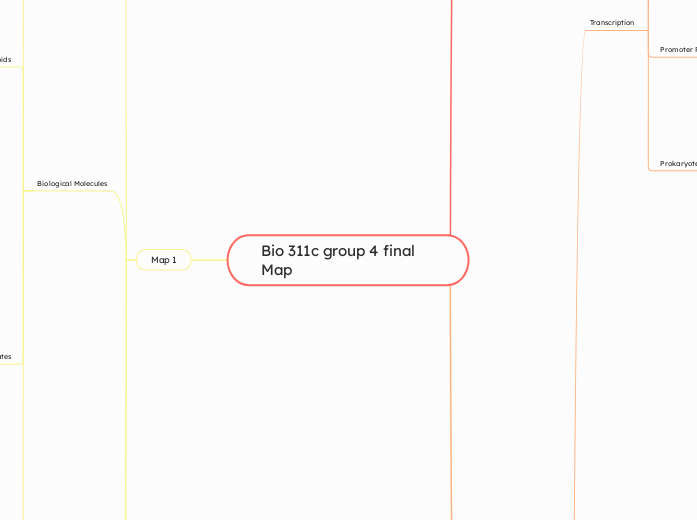
Bio 311c group 4 final Map
Map 3
Protein Pathway
other destinations
plasma membrane
lysosome
mitochondria
nucleus
cytoplasms
8. sorting at Trans-golgi Network for secretion, membrane insertion
7. processing in golgi
6. Rest of completed polypeptide leaves ribosome and folds
5. Signal peptide removed by enzyme from the receptor protein complex
4. SRP releases, polypeptide synthesis unpauses
3. SRP binds to receptor protein in ER membrane
2. SRP binds to signal peptide, temporarily pauses polypeptide synthesis
1. starts on free ribosome within the cytosol
Mutations
chromosomal mutations
Point Mutations
Frameshift Mutations
change in DNA = change in reading frame + amino acid
Nonsense Mutations
change in DNA = stop codon
Missense Mutations
change in DNA = change in amino acid
Silent Mutations
change in DNA = no change in amino acid
Translation
Components of translation
Codon
Set of 3 amino acids corresponding to an amino acid
Codon table
Noneverlapping
Degenerate
Universal
Large and small ribosomal subunit
Made of proteins and ribosomal RNA's
80S ribosomes
70S ribosomes
tRNA
Bring correct amino acid to be added
Single RNA strand about 80 nucleotides long
Release factor sits in A site disassociating the translation initiation complex
GTP driven
Stop codon is reached in A site
mRNA read in 5' to 3' direction
Amino acids added in N to C direction
Starts when tRNA carrying next amino acid comes to A site
Peptidyl transferase forms peptide bond between the 2 amino acids
tRNA in P site is now empty and moved to E site to be released
tRNA from A site moves to P site
New tRNA comes to A site
3 binding areas
E site
Exit site where tRNA leave the ribosome
A site
Holds the tRNA that carries the next amino acid
P site
Holds the tRNA that carries the growing polypeptide chain
1st amino acid
Methionine
Small ribosomal subunit and tRNA first bind the 5' cap
Scans mRNA to find first start codon (AUG)
Then large ribosomal subunit comes to form translation initiation complex
1st amino acid
Formyl-methionine
Translation initiation complex
mRNA, tRNA carrying 1st amino acid, and 2 ribosomal subunits are brought together
Requires GTP
Accurate translation
Aminoacyl-tRNA synthase
Correct match between tRNA and amino acid
Correct match between tRNA codon and mRNA codon
Gene Regulation
Differential Gene Expression
Lac Operon
LacA (Trans-acetylase)
LacY (Permease)
LacZ (B-galactosidase)
Transcription Initiation
Liver Cell vs Lens Cell Example
Liver Cell
Crystallin Gene = Not Expressed
Albumin Gene = Expressed
Lens Cell
Crystallin Gene = Expressed
Albumin Gene = Not Expressed
Process
Acivator binds to enhancer
DNA bending protien brings activators to promoter
Activators bind to mediator protiens
Control Elements
Distal
bind specific transcription factors
Enhancers
Sequences upstream/downstream
Proximal
Bind general transcription factors
Sequences near promoter
Transcription Factors
Specific
Repressors
General
Basal
Nucleosomes
Steps
Metaphase Chromosome
coil further
300-nm Fiber
forms looped domains
30-nm Fiber
fiber coils/folds
10-nm Fiber
DNA winds around histones
Histone Core
Histone Protiens
H4
H3
H2B
H2A
H1
Lac Operon Example
Options
Has Lactose
Has Glucose
Low Camp Level
Inavtive Repressor
No Glucose
Inavtive Repressor
High Camp Level
Operon = On
No Lactose
Active Repressor
Operon = Off
Regulatory Sequences
Promoter for Structural Genes
Promoter for Regulatory Gene
Regulatory Gene
LacI
Operon
Structural Genes
Operator
Negative Regulation
No Repressor = On
Repressor = Off
Positive Regulation
No Activator = Off
Activator = On
Promoter
DNA structure and replication
DNA Replication
Parts of replication:
Bidirectional & Discontinuous Replication
Discontinuous (lagging) strand: Synthesized as short 5′→3′ Okazaki fragments away from fork; later joined.
Continuous (leading) strand: Synthesized 5′→3′ in the direction of fork movement.
Bidirectional: Two replication forks move in opposite directions from ORI.
Enzymes for Replication
Lagging Stand Synthesis (Okzaki Fragments)
DNA ligase: seals nicks by forming phosphodiester bonds
DNA polymerase I: removes RNA primers and replaces with DNA
DNA polymerase III: extends each primer to make Okazaki fragments
Primase: synthesizes multiple RNA primers at intervals
Leading-Strand Synthesis Enzymes
DNA polymerase III: extends primer continuously
Primase (RNA polymerase): lays down short RNA primer
Single‑strand binding proteins (SSBs): stabilize unwound strands
Helicase: unwinds the DNA duplex
Replication forks: The two Y‑shaped junctions at bubble edges where new strands grow
Replication bubble: Local unwound region around ORI
Origin of replication(ORI): Specific DNA region where replication begins (AT‑rich for easier strand separation)
3 types of replication:
Dispersive: Both strands of both daughter duplexes are hybrids of old and new segments.
Semiconservative: Each daughter duplex contains one parental strand and one new strand.
Conservative: Original double helix remains intact; a wholly new duplex is synthesized.
Meselson-Stahl Experiment
Conclusion: Semiconservative Replication
Results after Centrifugation: Gen 1 → single intermediate band
Gen 2 → intermediate + light bands
Labeling: Grow E. coli in 15N (“heavy” nitrogen) then shift to 14N (“light”) medium.
Chargaff's rule
In any double‑stranded DNA:
AA = TT and GG = CC (base‑pair stoichiometry)
Total purines (A+G) = total pyrimidines (C+T)
Experiments demonstrating DNA is the genetic Material
Hershey-Chase Blender Experiment
Conclusion: DNA is what carries the genetic information not Protein
Observations after blending: 32P (DNA) found inside bacterial pellet
35S (protein) remained in the supernatant
Procedure: allow phage to infect bacteria and blend
Labeling: Phage protein with 35S (sulfur in protein)
Phage DNA with 32P (phosphate in DNA):
Griffith’s Transformation Experiment (1928)
Conclusion: Genes Transferable between Bacteria
Results: Live S → mice die
Live R → mice live
Heat‑killed S → mice live
Live R + heat‑killed S → mice die; live S cells recovered
Setup: Streptococcus pneumoniae strains in mice -Smooth (S) strain: virulent, capsule‑producing -Rough (R) strain: non‑virulent, no capsule
DNA Structure
Nucleotide
Deoxyribose sugar (ribose sugar for RNA)r
Phosphate group
Nitrogenous base
Double Helix with two anti parallel strands
Phosphodiester bond to link DNA and RNA monomers
Transcription
Prokaryote Vs. Eukaryote
Eukaryotes
Spliceosomes cleave introns out of Pre-mrna
Alternate splicing: Remove some introns, keep others , results in one gene expressing diverse rpteins
Transcription factors
promoter has TATA box
has initial pre-mrna
5' Cap
Poly A site, Poly A tail placed by Poly A Polymerase
RNA polymerase 2
Location: Nucleus
Prokaryotes
coupled w/ translation
mrna, no pre-mrna
RNA polymerase used
Location: Cytoplasm
Promoter Region
where RNA Polymerase and necessary transcription factors bind
Visual Interpretation
Template strand 3' to 5'
Uracil(U) instead of Thymine(T)
written 5' to 3'
Downstream: +2, +3
Upstream: -1, -2
Start Site: +1
3 steps
Termination
Elongation
Initiation
Map 2
Cell Membranes
Membrane Proteins and R-Groups Orientation
Protein Structure Bonds
Multiple Polypeptides Interacting
Hydrophobic Interactions
Disulfide Bridges
β-Sheets
α-Helices
Hydrophobic R-Groups
Embedded in Lipid Bilayer
Hydrophilic R-Groups
Face Aqueous Exterior/Interior
Structure and Function
Membrane Fluidity
Unsaturated Fatty Acids
Saturated Fatty Acids
Selective Permeability
Large and Polar
Require Transport
Small Nonpolar Molecules (O₂, CO₂)
Pass Freely
Membrane Proteins
Peripheral (Surface Attached)
Integral (Embedded)
Phospholipid Bilayer
Hydrophobic Tail
Phosphate and Glycerol
Communication and Signaling
Cell signaling
Phosphodiesterase
Converts cAMP to AMP
Adenylyl Cyclase
Converts ATP to cAMP
Phosphotase
Removes a phosphate group from proteins
Kinase
Catalyze the transfer of phosphate groups from ATP to proteins
Transduction
Phosphorylation Cascade
Kinases are activated by the addition of a phosphate group
cAMP
Binds and activates protein kinase which goes on to activates other kinases
Reception
Intracellular receptors
Steroid hormone receptor
Membrane receptors
Hydrophilic signal
Ion channel receptor
Signal molecule binds to the receptor and the gate allows specific ions through a channel in the receptor
G protein linked receptor
Signal binds to GPCR causing a change in GCPR shape allowing G protein to bind to it. GDP is replaced with GTP on the G protein. The activated G protein can now activate a nearby enzyme.
Cell communication
Types of signaling
Long distance
Local signaling
Physical Contact
Cell surface proteins
Gap junctions
Energy Transfer
Enzymes
Function
Allosteric Regulation
Feedback Inhibition
Cooperativity
Inhibitors
Activators
Noncompetitive Inhibition
Competitive Inhibition
Normal Binding
Enzyme Activity
Substrate Concentration
Catalytic Cycle
Binding of Substrate
Lowers Activation Energy
Energy Changes
Powered by ATP
ATP Cycle
Mechanical
Transport
Energy Coupler
No Change (ΔG=0)
Exergonic (ΔG0)
Thermodynamics
Laws
2 - Energy transfer increases entropy
1 - Energy can be transferred, but not created/destroyed
Surroundings
System
Open Sytem
Closed System
Metabolic Pathways
Anabolic Pathways
Photosynthesis
Polymerization
Biosynthetic Pathways
Catabolic Pathways
Cellular Respiration
Glucose oxidized, Oxygen Reduced
Anaerobic(doesn't require O2)
fermentation
Lactic Acid Fermentation
Outputs: Lactate, NAD+
Inputs: 2 Pyruvate, NADH
Alchohol fermentation
outputs: ethanol, NAD+
inputs: 2 Pyruvate, NADH
Glycolysis (info in aerobic section)
Aereobic(requires Oxygen)
Oxidative Phosphorylation
Paired Process
Chemiosmosis
H+ transported down concentration gradient using ATP Synthase (facilitated diffusion), produces lots of energy which is used for Pi+ADP=ATP
Electronic Transport Chain
As electrons are transferred down ETC, the energy released is used to pump H+ against concentration gradient
Outputs: H2O, 26-28 ATP
Inputs: O2, 10 NADH, 2 FADH2
Takes place in inter membrane space
krebs cycle
Step 3: Isocitrate is oxidized to alpha ketoglutarate while NAD+ is reduced to NADH
Step 1: Acetyl CoA adds its 2 Carbon groups to Oxaloacetate, forming Citrate
Outputs: 6 NADH, 2 FADH2, 2 ATP
Inputs: 2 Acetyl CoA
Takes place in mitochondrial matrix
Pyruvate Oxidation
Takes place in Cytosol then mitochondrial matrix
Outputs: 2 Acetyl CoA , 2 NADH
Inputs: 2 pyruvate, 2 CoA
Glycolysis
Step 3: Phosphofructokinase converts Fructose 6 Phosphate to Fructose 1,6 Biphosphate
Step 1: Hexokinase converts Glucose to Glucose 6 Phosphate
Uses Substrate level Phosphorylation to produce ATP
Outputs
Total: 2 Pyruvate, 2 NADH, 4 ATP
Net: 2 Pyruvate, 2 NADH, 2 ATP
Inputs: 1 Glucose, 2 ATP
Takes Place in Cytosol
Map 1
Water
Water molecules & heat
Heat is released
Hydrogen bonds form
Heat is absorbed
Hydrogen bonds break
Bonds
Molecular Structure
Bent
Molecules interacting with water
Hydrophilic
Acids and Bases
pOH
Neutral
Water Properties
Universal Solvent
Denser a Liquid than a Solid
Expansion Upon Freezing
High Heat of Vaporization
Evaporative Cooling
High Specific Heat
Helps moderate temperature
Adhesion
Cohesion
Surface Tension
Water Transport in Plants
Chemical Bonds
Electronegativity
Bond Strength
Intramolecular Forces
Ionic
Covalent
Polar Covalent
Non Polar Covalent
Intermolecular Forces
Ion-Dipole
Dipole-Dipole
Hydrophobic
Hydrogen Bonding
Biological Molecules
Nucleic Acids
Nucleosides
Nucleotides
Use Phosphodiester Bond
Nitrogenous Base
Guanine
Adenine
Cytosine
Phosphate Group
Deoxyribose Sugar
Both
Sugar-phosphate Backbone
Base Pairing
Use Hydrogen Bonds
RNA
Single-Stranded
Uracil
Deoxyribose
DNA
Complementary Base Pairing
Uses Hydrogen Bond
Double-Stranded
Thymine
Ribose
Carbohydrates
Glucose
Beta
Alpha
Polysaccharides
Use Glycosidic Linkage
Bet 1, 6
Beta 1, 4
Alpha 1, 6
Alpha 1, 4
Storage
Starch
Amylopectan
Some Branching
Amylose
Glycogen
Extensive Branching
Structure
Cellulose
No Branching
Linear
Lipids
Steroids
Cholesterol
LDL
HDL
In Cell Membrane
Amphipathic
Phospholipids
Parts
Hydrophobic Tails
Hydrophilic Head
Form Closed Liquid Bilayers
Fat Molecule
Uses Ester Linkage
Fatty Acids
Saturated
Solid at Room Temperature
Unsaturated
Double Bond
Isomers
Cis
Trans
Liquid at Room Temperature
Glycerol
Protiens
Protien Structure
Physical/Chemical Conditions
Solution Prevents Disulfide Bond
Salt
Temperature
pH
Amino Acid Sequence
Protien Folding
Quaternary
Interchain Interactions
Tertiary
Interaction of R-Group
Disulfide Bonds
Van Der Waals
Ionic Bonds
Secondary
Types
Beta Pleated Sheets
Alpha Helices
Hydrogen Bonds
Primary
Peptide Bonds
Dehydration Synthesis
Amino Acid
Side Chain (R-Group)
Acidic
Basic
Nonpolar
Polar
Carboxyl Group
Amino Group
Main Chain
Cellular Functions and Organelles
Prokaryotic Only structures
Fimbriae and Pili
Flagellum
Capsules/Slime Layers
Peptidoglycan Cell Wall
Plant Only
Chloroplast
Central Vacuole
Cellulose Cell wall
Plasmodesmata
Present in both Animal and Plant Cells
Cytoskeleton
Intermediate Filaments
Microfilaments
Microtubules
Peroxisome
Lysosome
Golgi Apparatus
Endoplasmic Reticulum
Smooth ER
Rough ER
Ribosomes
vacuoles
Nucleus
Nuclear envelope
Vesicles
Mitochondria
Animal Only
Gap Junction
Desmosome
Tight Junction
Extracellular Matrix
Integrins
Protoglycan
Fibronectin
Collagen