Produkte
Mindmap Programm
Gliederungen Programm
Software für Gantt-Diagramme
Anwendungen
Mindmaps für Bildung
Mindmaps für Unternehmen
Mindmaps für die persönliche Entwicklung
Mindmapping Vorteile
Ressourcen
Funktionen
Bildung
Persönlich & Beruflich
Desktop
Videoanleitungen
Sehen Sie sich Tipps und Tricks zur Verwendung von Mindomo an.
Hilfezentrum
Detaillierte Hilfeanleitung zur Konfiguration und Verwendung von Mindomo.
Artikel
Was ist eine Mindmap?
Wie man eine Mindmap erstellt?
Wie kann man mit Mindmaps Notizen machen?
Mindmapping als assistive Technologie
Was ist eine Concept Map?
Die 29 besten Mindmap-Beispiele
Preise
Anmelden
Registrieren
Produkte
Mindmap Programm
Gliederungen Programm
Software für Gantt-Diagramme
Anwendungen
Mindmaps für Bildung
Mindmaps für Unternehmen
Mindmaps für die persönliche Entwicklung
Mindmapping Vorteile
Artikel
Was ist eine Mindmap?
Wie man eine Mindmap erstellt?
Wie kann man mit Mindmaps Notizen machen?
Mindmapping als assistive Technologie
Was ist eine Concept Map?
Die 29 besten Mindmap-Beispiele
Funktionen
Bildung
Persönlich & Beruflich
Desktop
Hilfe
Videoanleitungen
Hilfezentrum
Preise
Registrieren
Anmelden
Kategorien:
Alle
von
Nieves Muñoz Haro
Vor 8 Jahren
225
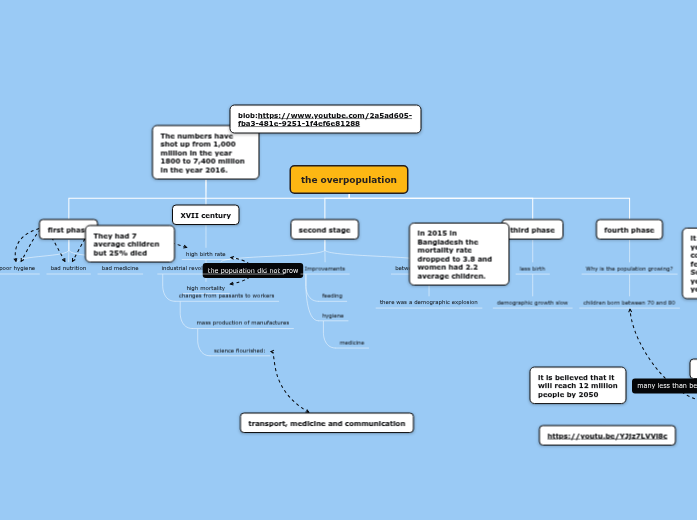
the overpopulation
Öffnen
in 2015 in Bangladesh the mortality rate dropped to 3.8 and women had 2.2 average children.
https://www.youtube.com/watch?v=5x3MLNuj_Jg
https://youtu.be/YJjz7LVVl8c
blob:https://www.youtube.com/2a5ad605-fba3-481e-9251-1f4ef6e81288
it is believed that it will reach 12 million people by 2050
it took more than 80 years for developed countries to reduce fertility, Malaysia and South Africa took 34 years, Bangladesh 20 years, Iran 20 years.
They had 7 average children but 25% died
average 2.5 and it was 5 40 years ago
they are having children
transport, medicine and communication
The numbers have shot up from 1,000 million in the year 1800 to 7,400 million in the year 2016.
XVII century
high birth rate
high mortality
the overpopulation
fourth phase
Why is the population growing?
children born between 70 and 80
third phase
less birth
demographic growth slow
second stage
between 1750 and 1850
there was a demographic explosion
Improvements
hygiene
medicine
feeding
industrial revolution in the united kingdom
changes from peasants to workers
mass production of manufactures
science flourished:
first phase
bad medicine
bad nutrition
poor hygiene