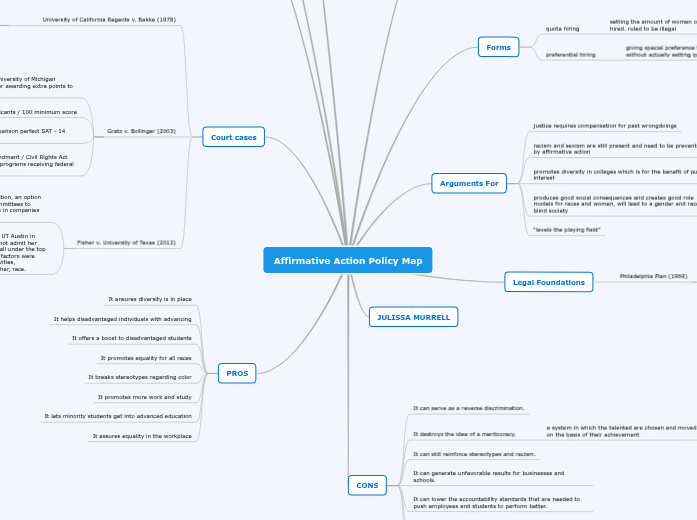
Affirmative Action Policy Map
PROS
It assures equality in the workplace
It lets minority students get into advanced education
It promotes more work and study
It breaks stereotypes regarding color
It promotes equality for all races
It offers a boost to disadvantaged students
It helps disadvantaged individuals with advancing
It ensures diversity is in place
Court cases
Fisher v. University of Texas (2012)
Plaintiff Abigail Fisher filed her lawsuit against UT Austin in 2008 because she believed the university did not admit her because she is white. Because Fisher did not fall under the top 10 percent of her graduating class, admission factors were based on leadership roles, extracurricular activities, volunteering, SAT scores and, according to Fisher, race.
The case involves the legality of affirmative action, an option that encourages employers and admission committees to increase the representation of minority groups in companies and schools.
Gratz v. Bollinger (2003)
Jennifer Gratz rejected - 14th Amendment / Civil Rights Act Title VI (prohibits discrimination in programs receiving federal funding)
Racial minority - 20 points (in comparison perfect SAT - 14 points)
150 point scale to rank applicants / 100 minimum score
Supreme Court decision: Rejects University of Michigan undergraduate admission system for awarding extra points to minority applicants
University of California Regents v. Bakke (1978)
Racial minorities were admitted with lower scores
16 / 100 for racial minorities
Allan Bakke, which medical school applicant (rejected 2 years in a row)
Supreme Court decision: Rules out racial quotas but allows race to be consider with other factors
Arguments Against
leads to negative social consequences
"common sense principle"
society should be "race and gender blind" by making these discriminations it is putting emphasis on race and gender and essentially causing that focus
people shouldn't be punished for stuff their ancestors in groups did
it is wrong because its discrimination and even though it is "good" discrimination it goes too far and is still bad because its just discrimination onto another group that doesnt deserve it
Goals
prevent future discrimination
Achieved a balanced work force
Each goal must be
must have a plan of action
implementation target date within 6 months to 2 years
specific
CONS
It is difficult to remove, even after discrimination issues have been eliminated
It can be condescending to minorities
It can lower the accountability standards that are needed to push employees and students to perform better.
It can generate unfavorable results for businesses and schools.
It can still reinforce stereotypes and racism.
It destroys the idea of a meritocracy.
a system in which the talented are chosen and moved ahead on the basis of their achievement
It can serve as a reverse discrimination.
JULISSA MURRELL
Legal Foundations
Philadelphia Plan (1969)
Expanded to include all businesses with 50 or more employees and federal contracts of at least $50,000
set numerical goals for black and other minority employees on federally financed construction jobs.
Arguments For
"levels the playing field"
produces good social consequences and creates good role models for races and women, will lead to a gender and race blind society
promotes diversity in colleges which is for the benefit of public interest
racism and sexism are still present and need to be prevented by affirmative action
justice requires compensation for past wrongdoings
Forms
preferential hiring
giving special preference to women and minorities when hiring without actually setting quotas
quota hiring
setting the amount of women or minorities that have to be hired. ruled to be illegal
Interest Groups
Oppose
believe that if you work hard your hard work will pay off and we shouldn't introduce an unfair advantage
Republican Party
sexist people
racist people
Support
believe that those people who don't start out with the same privilege should get a push start
Democratic Party
Underrepresented People
Disabled people
Minorities
Women