a Jessica Gonzalez 5 hónapja
140
Elementary Mathematics
a Jessica Gonzalez 5 hónapja
140
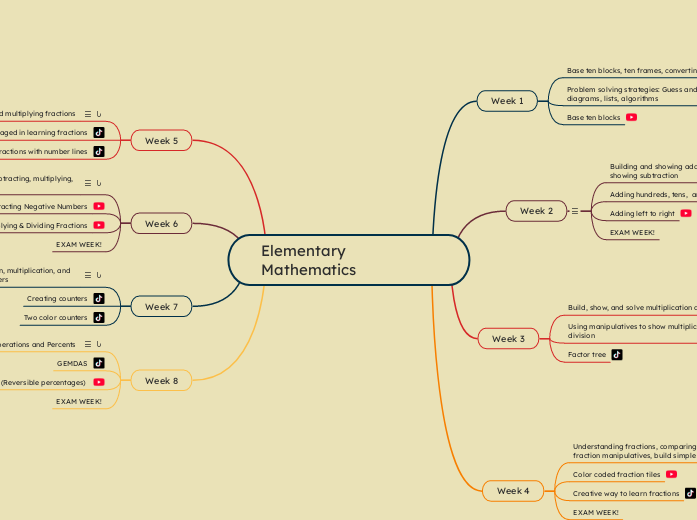
This week, we used two color counters to demonstrate addition, subtraction, multiplication, and division.
We used properties such as zero banks to find the answer
In module 6, we dove deeper in putting fractions together
We also discussed integers using positive and negative numbers
In this module, we discussed how to show and build the process of adding, subtracting, and multiplying fractions.
In this module, we discussed fractions and how to build them using fraction manipulatives such as: tiles, squares, circles, etc. We also learned how to identify which fraction is greater or smaller when comparing the two
Notes:
In this module, we went over multiplication and division principles, divisibility rules, and prime factorization. We learned how to show multiplication an division through the base ten blocks, diagrams, and algorithms. We also discussed how to group numbers within a multiplication problem (e.g. in 3*4, 3 is the represents the number of groups and 4 represents what is inside each group. Likewise, in 25/4, 4 represents the number of groups and 25 is the number we are trying to make)
Notes:
In module 1, we learned about homework procedures discussed the manipulatives we would be using throughout the course. This included base ten blocks, 2-color counters, and fraction circles.
In this module, we learned how to use diagrams and base ten blocks and algorithms (expanded form, left to right, friendly numbers, scratch, trade off, and lattice) to demonstrate addition and subtraction.
For example, to show 7-3, you would first start off with 7 units, then take away 3 of them, leaving you with a total of 4.
Notes:
This module discussed how to use base ten blocks, 5-10 frames, and how to convert bases from base ten to any particular base (and vice versa).


