Kategorier: Alla

av Anisah Khokhar för 5 årar sedan

184

Evolution
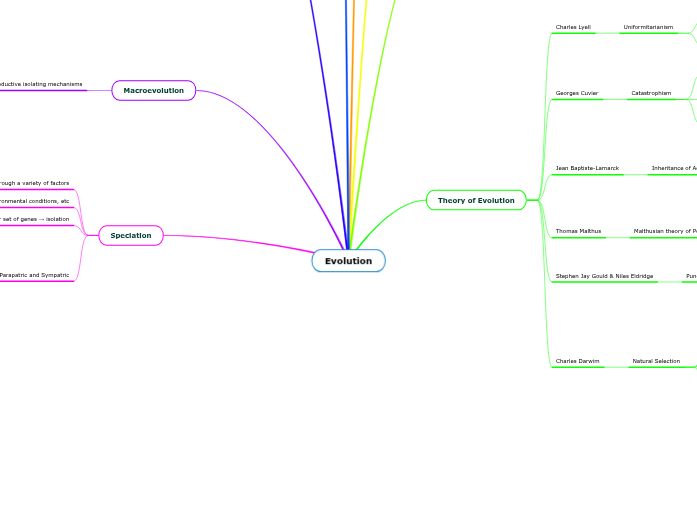
Evolution

Evolution

Speciation

3 types; Allopatric, Parapatric and Sympatric
Sympatric: happens in pops. that live in the same geographic area

Happens when gene flow is diminished by sexual selection, polyploidy and/or habitat differentiation

Less common than allopatric

Parapatric: part of a pop. enters a new habitat that borders the parent species (some gene flow may occur in border zone)
Allopatric: gene flow is interrupted when a pop. is divided into geographically isolated subpops.
A change in 1 gene or set of genes → isolation
Depends on gen. time, environmental conditions, etc
Development of a new species through a variety of factors

Macroevolution

2 types of reproductive isolating mechanisms
Post-Zygotic

Hybrid breakdown: first gen. hybrids = fertile, offspring of next gen. = fertile, weak

Hybrid sterility: hybrid is healthy but cannot reproduce

Hybrid inviability: Zygote is created but fails to fully develop due to genetic incompatibility

Pre-Zygotic

Gametic isolation: 2 pops. exchange sperm + egg but rarely form a zygote

Mechanical isolation: 2 pops. don't exchange alleles because they're anatomically incompatible

Habitat isolation: 2 pops. are in different geographical places and cannot exchange alleles

Temporal isolation: 2 pops. don't exchange alleles because they have specific times to do so during the day or year

Behavioral isolation: 2 pops. don't respond to each others mating rituals and don't exchange alleles

Mechanisms of Microevolution

Non-random mating
Mating on the basis of mate selection for a specific phenotype or inbreeding

Inbreeding is when closely related organisms breed together

Recessive alleles are expressed more when homozygous genotypes become common

Share similar genotypes so frequency of homozygous genotypes ↑

Contrast to random mating where breeding partners are random

Likelihood of genotypes mating is based on allele frequencies

The proportion of homozygous individuals in a pop. ↑

Genetic drift
Two types: Founder Effect & Bottleneck Effect

Bottleneck effect

Survivors only have part of original pop. alleles →no gene pool diversity

Fast decrease in pop. → changes in gene distribution

Founder Effect

Occurs often on islands

Diversity = limited

Founders carry some alelles from original pop.

Individual organisms (founders) start a new pop. → change in gene pool

Sample size can have a big impact on the gene pool of a pop.
Chance events in a pop. → change in allele frequencies
Gene flow
Can change allele frequencies in either/both pops.
Total movement of alleles from one pop. to another
Mutations
Introduce new alleles → changes allele frequency
Able to change the entire gene flow
Changes that occur in the DNA of an individual organism
The change in allele frequency in a population

Evidence for Evolution

DNA
2 different organisms with similar genetic pattern = common ancestor
The comparing of DNA allows scientists to determine how closely related two organisms are
Blueprint of the organism
Embryology
Used to determine relationships between organisms
Study of early pre-birth stages of an organism
Biogeography
Organisms on islands are similar to those on the nearest continent
Study of how organisms have been distributed throughout the world
Anatomy
Vestigial Structures

Lost their function but are still apart of the body because of a common ancestor

Homologous structures

Different functions but same set of bones and same organization of bones because of common ancestry

Similar structural elements and origins, different functions

Fossil Records
Evolution occurs over time
Fossils appear chronologically
Fossils in layers of rock closer to the surface are newer species compared to fossils in deeper rock layers

Theory of Evolution

Charles Darwim

Stabilizing, directional, and disruptive selection

Disruptive Selection

For 2 extreme phenotypes. against average phenotype

Directional Selection

Genetic variance shifts due to exposure of environmental change

For one extreme phenotype, against other phenotypes

Stabilizing Selection

Genetic variance in a pop. decreases

For average phenotypes, against extreme phenotypes

Descent with modification

Survival of the fittest = selective pressure

Organisms with better traits will survive and reproduce

Variations (caused by mutations) exist within a species

Stephen Jay Gould & Niles Eldridge
Punctuated Equilibrium

Balance between stasis and punctuated events

Evolution happens gradually and in small, sudden events

Thomas Malthus
Malthusian theory of Population

Sudden event occurs → survival of the fittest → can lead to new species

Human pops. grow exponentially while food pops. grow linearly → not enough food sources

Jean Baptiste-Lamarck
Inheritance of Acquired Traits

Doesn't include how we inherit traits

Traits acquired during an organism's life will be passed down to offspring

Species became more complex over time, causing them to reach a level of perfection

Georges Cuvier
Catastrophism

Doesn't include slow processes that cause change in populations

Natural events killed species in a specific region → neighboring species repopulate → change

Species are found in certain rock layers; new species appear and disappear over time

Charles Lyell
Uniformitarianism

Doesn't include varying geographical activities (natural disasters, climate change, etc.)

Slow subtle processes → long term changes

Natural Selection

Descent with Modification
The process in which species change over time while sharing a common ancestor
Artificial Selection
Form of biotechnology
Selective pressure used by humans in order to create species with desirable and modified traits
Selective Pressure
External environmental factors that can be for or against certain characteristics
The process of change in characteristics of a population over multiple generations

Adaptation and Variation

Survival Advantages
Example: Mimicry

Harmless species (viceroy butterfly) adapt to resemble harmful species (monarch butterfly) in order to survive

Organisms have better chance of surviving due to structural, behavioral or physiological adaptations
Adaptation and Survival
Helps an organism to survive and reproduce while passing on their adaptations
Changes caused by genetic mutations that have formed over multiple generations
Variations within a species
The environment influences whether the variation is positive or negative towards an organism
Created over multiple generations due to random genetic mutations
The changes are due to the structural, functional and physiological differences between organisms in a species

Origins of Life on Earth

Multicellular organisms start to form (fish → insects → reptiles → first mammals → humans)
Increased oxygen → formation of ozone layer → protection from UV radiation → complex life forms thrive
Bacteria that could conduct photosynthesis and produce their own sugars survived after life moved to the surface
Archaebacteria were first life forms